How Much Should an Indian Manufacturer Pay for AI Consulting?
The Honest Breakdown — With the Questions Your Vendor Doesn’t Want You to Ask.
Before the pricing conversation starts, there is a more important one. Most CFOs skip it. That is why most AI consulting budgets get approved for the wrong engagement.
Direct answer: What should an Indian manufacturer pay for AI consulting?
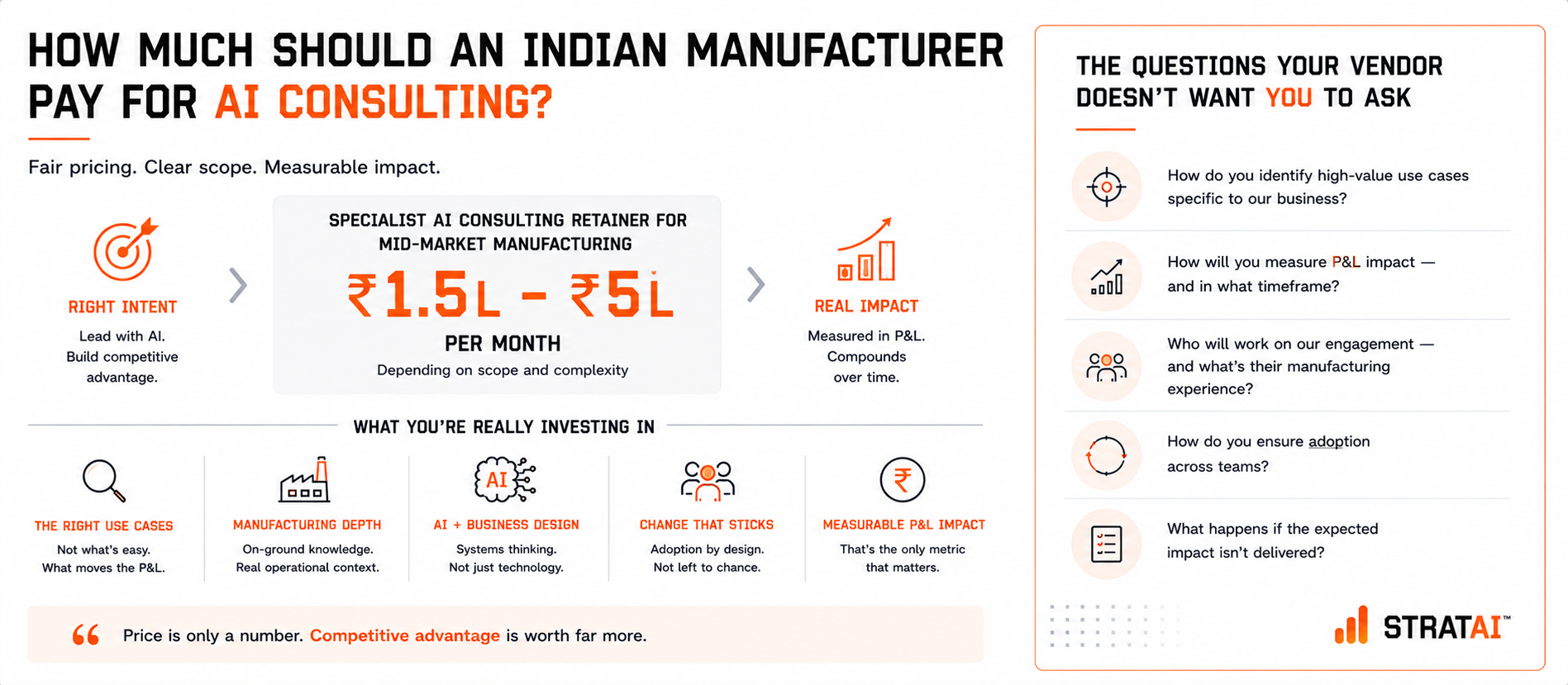
The right question is not what AI consulting costs. It is what competitive advantage costs — and what it is worth when it shows up in your P&L. The pricing range for a specialist AI consulting retainer for Indian mid-market manufacturing is ₹1.5 Lakh to ₹5 Lakh per month, depending on scope. But before that number means anything, the intent behind the investment has to be correct. An AI consulting budget approved with ‘try AI’ intent will underdeliver at any price point. Approved with ‘lead with AI’ intent, the same investment compounds.
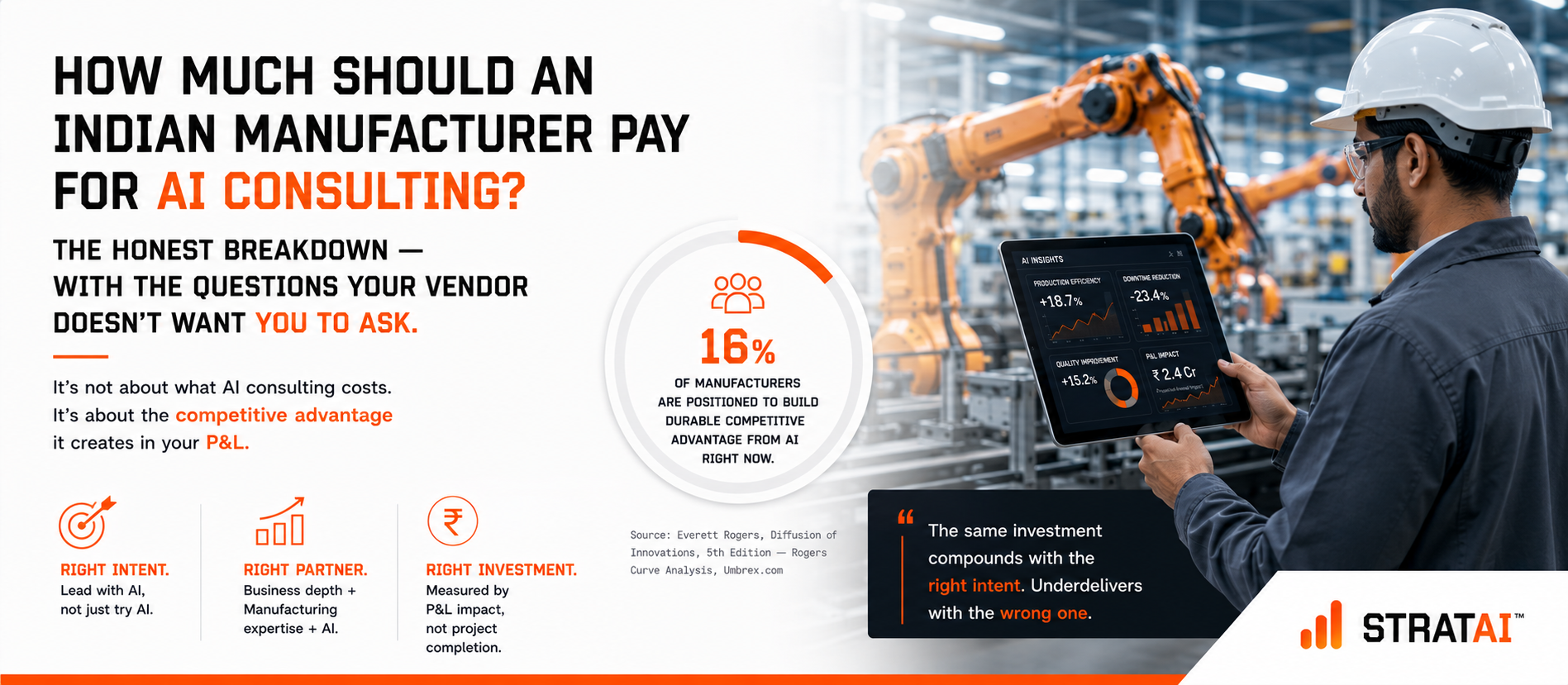
16%
of manufacturers are positioned to build durable competitive advantage from AI right now.
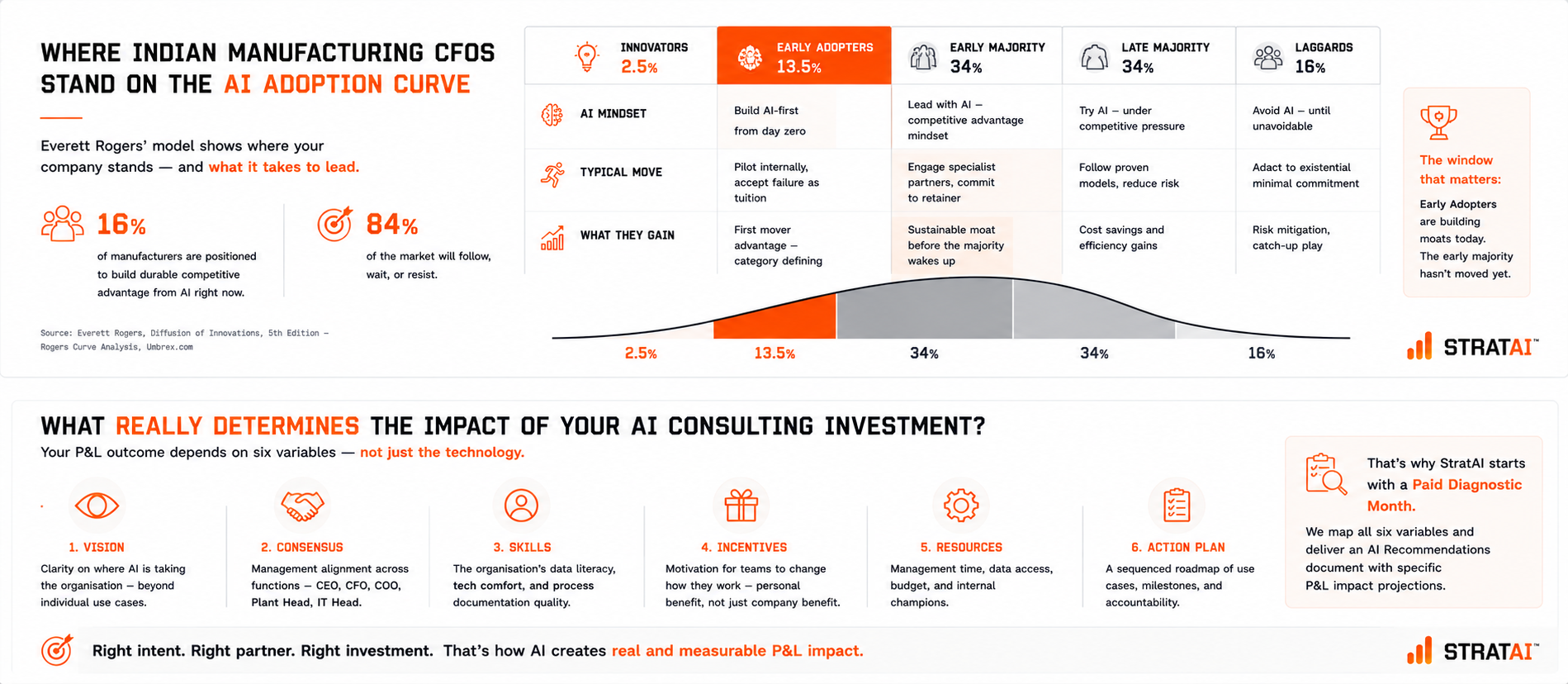
Rogers’ Diffusion of Innovations framework shows that only Innovators (2.5%) and Early Adopters (13.5%) — a combined 16% of any market — move with the intent and commitment required to build lasting advantage from a new technology. The remaining 84% follow, wait, or resist.
Source: Everett Rogers, Diffusion of Innovations, 5th Edition — Rogers Curve Analysis
The Question Before the Question: What Is Your Intent?
Every CFO who has sat across from an AI consulting vendor has eventually asked: how much does this cost? It is a reasonable question. It is also the wrong first question.
The right first question is this: what is your organisation’s intent with AI?
Not your AI strategy. Not your use case list. Your intent. The mindset with which leadership is approaching this investment determines whether the engagement delivers or disappears — at every micro-decision point that follows the contract signing.
| ‘Try AI’ Intent | ‘Lead with AI’ Intent |
|---|---|
| We will experiment and see if it works | We will build competitive advantage using AI |
| AI is a project on the roadmap | AI is the architecture we operate from |
| Success = system delivered | Success = P&L impact confirmed |
| Budget = cost to be minimised | Budget = investment to be optimised |
| Partner = vendor who builds what we ask | Partner = partner who finds what we need |
| Loses steam when friction arrives | Pushes through friction because the intent is clear |
The try-AI intent does not fail at the technology level. It fails at every human decision point along the way — when the first use case takes longer than expected, when a department head resists the workflow change, when the early results are promising but not yet visible in the P&L. At each of those moments, try-AI intent creates an exit ramp. Lead-with-AI intent does not.
The intent distinction in execution: even with lead-with-AI intent, the execution approach is disciplined and iterative — micro use case experimentation, testing, feedback, refinement, then scaling. Bold intent does not mean reckless execution. It means the organisation commits fully to the direction and moves carefully in the execution. Intent is a compass, not a speedometer.
Where Indian Manufacturing CFOs Stand on the Adoption Curve — Right Now
Everett Rogers’ Diffusion of Innovations framework — one of the most validated models in technology and organisational behaviour — maps exactly where your company stands in relation to the AI adoption wave. The percentages are precise and consistent across industries and technologies.
| Category | % of Market | AI Mindset | Typical Move | What They Gain |
|---|---|---|---|---|
| Innovators | 2.5% | Build AI-first from day zero | Pilot internally, accept failure as tuition | First mover advantage — category defining |
| Early Adopters | 13.5% | Lead with AI — competitive advantage mindset | Engage specialist partners, commit to retainer | Sustainable moat before the majority wakes up |
| Early Majority | 34% | Do AI — when peers prove it works | Follow proven models, reduce risk | Cost savings and efficiency gains |
| Late Majority | 34% | Try AI — under competitive pressure | Adopt reluctantly, minimal commitment | Risk mitigation, catch-up play |
| Laggards | 16% | Avoid AI — until unavoidable | React to existential pressure | Survival, nothing more |
The window that matters for Indian manufacturing CFOs: Early Adopters — 13.5% of the market — are the companies building durable moats right now. They are not waiting for AI to prove itself in their industry. They are generating the proof that the early majority will follow. In Indian mid-market manufacturing, this window is still open. The early majority has not yet moved. The CFO who approves the right AI consulting budget in 2026 is not buying technology. They are buying positioning — ahead of 84% of their competitive set.
Why ‘It Depends’ Is the Honest Answer — And What It Depends On
Every CFO wants a payback period. A specific timeline. A guaranteed return. Any AI consulting partner who gives you one without conducting a diagnostic first is telling you what you want to hear, not what is true.
The honest answer is: the P&L impact of an AI consulting engagement depends on six variables. These are not excuses. They are the exact variables that the Lippitt-Knoster Model for Managing Complex Change — developed by Dr. Mary Lippitt in 1987 and one of the most applied frameworks in organisational transformation — identifies as the determinants of whether any complex change succeeds or fails.
| Lippitt-Knoster Element | What it means for AI consulting | What happens when it is missing |
|---|---|---|
| Vision | Leadership clarity on where AI is taking the organisation — beyond individual use cases | Confusion — teams pull in different directions, use cases are disconnected from strategy |
| Consensus | Management alignment across functions — CEO, CFO, COO, Plant Head, IT Head | Sabotage — passive resistance from leaders who were not bought in from the start |
| Skills | The organisation’s existing data literacy, tech comfort, and process documentation quality | Anxiety — adoption stalls because people cannot use what has been built |
| Incentives | The motivation for teams to change how they work — personal benefit, not just company benefit | Resistance — people revert to old processes because the new system creates more work, not less |
| Resources | Management time, data access, budget, and internal champions | Frustration — good systems built slowly or badly because the organisation cannot support the build |
| Action Plan | A sequenced roadmap of use cases, milestones, and accountability — not a wish list | Treadmill effect — energy expended, no forward movement, false starts recurring |
This is why StratAI’s engagement always begins with a paid diagnostic month — before a single system is built. The diagnostic maps all six variables for your specific organisation and produces an AI Recommendations document that tells you exactly what interventions will be made, in what sequence, and what P&L impact to expect. Not a generic estimate. A specific projection built on what was actually observed.
Projects with robust change management processes are 3.5x more likely to succeed.
McKinsey research consistently finds that AI and digital transformation initiatives that explicitly address people, process, and behaviour change — not just technology — dramatically outperform those that treat implementation as a technical problem.
Source: Change Management Hub, Knoster Model Analysis, citing McKinsey, 2025
What AI Consulting for Indian Manufacturing Actually Costs — The Honest Breakdown
StratAI operates on a monthly retainer model. Not a project fee. Not a milestone payment. A retainer — because AI implementation is not a project that ends. It is an evolving intelligence layer that compounds as the organisation’s knowledge deepens.
The retainer covers four integrated components simultaneously: AI Strategy Consulting, AI Implementation, AI Support and Maintenance, and AI Training and Coaching. These are not sold separately. They are one engagement, because separating strategy from implementation from training is exactly what produces the gaps that make AI consulting fail.
| Tier | What it covers | Monthly investment |
|---|---|---|
| AI Starter | AI Strategy Consulting + Implementation + Support and Maintenance. The right entry point for a manufacturer committing to AI for the first time — strategy and build, with ongoing support. Does not include Training and Coaching. | ₹1.5L to ₹2.5L per month |
| AI Pro | Everything in AI Starter, plus structured AI Training and Coaching for individuals and teams. The right tier when people adoption is the primary lever — where the system is being built and the workforce needs to be upskilled to use and trust it. | ₹2L to ₹3L per month |
| All In on AI | The complete mandate: an AI-centric operating system for the company. AI-first management systems designed and established organisation-wide. Not use-case-level transformation — company-level redesign of how it operates, decides, and competes. | ₹3L to ₹5L per month |
How most engagements actually progress: StratAI does not start any client on All In on AI. The journey typically follows the evidence — AI Starter for the first 3-6 months as proof of concept is established and trust is built. AI Pro as training becomes the next leverage point. All In on AI when the organisation is ready to redesign around AI rather than add AI to the existing design. This is not upselling. It is what the Lippitt-Knoster model would predict: change at the All In on AI level requires every one of its six elements to be in place first.
What the Return Actually Looks Like: A Listed Textile Manufacturer
This is an active engagement. The client is a listed company — one of the world’s second largest manufacturers of cotton value-added products, serving global retail majors including Walmart. Anonymised by agreement.
The engagement started as a focused 6-month scope: CRM plus AI. One problem. One mandate. Build a single source of truth for customer relationships and commercial intelligence — forecasts tracked against actuals, country knowledge structured, prospect timelines visible, email intelligence consolidated.
FIELD DATA · Month 1 Diagnostic — 8 Use Cases Confirmed
Forecast vs Actual tracking · Country knowledge structuring · Prospect historical timeline · Email visibility · AI chatbot access and email drafting · Sino-IMEX intelligence · Outbound research automation · BD chatbot email drafting consistency. All identified from on-ground discovery — none from a client brief.
Two additional interventions emerged during the engagement that were not in the original scope — and were not charged as scope additions.
Intervention 1 — Purchase Optimisation: ₹1.5 Crore to the Bottom Line
The company purchases several hundred crores of textile raw material annually. StratAI identified an opportunity nobody asked for: a single source of truth for commodity procurement — integrating commodity price indices, world forecast reports for each commodity, forecasted demand, and dynamic actual demand data into one decision-support system.
Expected impact: sourcing at 0.3% better average price on commodity purchases.
FIELD DATA · ₹1.5 Crore+ Directly to the Bottom Line
Not revenue. Not cost avoidance. Direct margin improvement on commodity procurement — from a use case that was not in the original engagement scope and was not requested by the client. Identified because StratAI was close enough to the business to see it.
Intervention 2 — AI-Powered International Outbound: 8 Meetings in 2 Weeks
In month 5, the VP of Marketing was preparing for an international visit to Southeast Asia. Two weeks before departure, the request came: use AI to generate qualified outbound meetings in Indonesia and Thailand.
FIELD DATA · 6 Meetings in Indonesia · 2 in Thailand · Generated in 2 Weeks
Using AI-powered outbound research and personalised outreach. The customer lifetime value of this client’s relationships is significant enough that a single conversion from any of these meetings recovers the entire cost of the StratAI engagement multiple times over.
The core planned scope, because of these additional high-value interventions, runs approximately six weeks longer than the original timeline. This is not a planning failure. It is the natural consequence of a partner who follows the highest P&L impact wherever it appears, rather than delivering a fixed scope and closing the engagement.
The governing principle — and the CFO’s accountability benchmark: StratAI’s intent for every engagement: the client recovers what they invest within Year 1. In this engagement, the ₹1.5 Crore procurement improvement alone — from one unsolicited use case — exceeds twelve months of retainer investment at the AI Starter level. That is the return the CFO should hold the engagement accountable to. Not a dashboard. Not a system. A P&L line that moved.
The Questions a CFO Should Ask Before Approving an AI Consulting Budget
The pricing is straightforward once the intent is aligned. These are the questions that establish whether the intent — on both sides — is right.
- What is your diagnostic process before recommending a use case — and do you charge for it?
- Can you show me a specific engagement where the ROI exceeded the retainer investment within Year 1 — with named P&L metrics, not system delivery milestones?
- How do you handle use cases that emerge during the engagement that were not in the original scope?
- What does your change management approach look like — specifically how do you address the six elements: vision, consensus, skills, incentives, resources, and action plan?
- Is your engagement model a project with a handover date, or a retainer where your accountability continues as long as the engagement continues?
A partner who can answer all five with specificity is worth a second conversation. A partner who deflects to platform features or implementation methodology is not ready to be accountable for your P&L.
Cost is only one part of getting this decision right. the complete guide to AI consulting for manufacturing firms in India walks through the rest — how to scope the engagement, pick a partner, and structure it so the investment actually shows up on the P&L.
Frequently Asked Questions
How much does AI consulting cost for a mid-market Indian manufacturer?
The pricing range for a specialist AI consulting retainer covering strategy, implementation, support, and training is ₹1.5 Lakh to ₹5 Lakh per month, depending on scope and company size. AI Starter (strategy + implementation + support) runs ₹1.5L to ₹2.5L per month. AI Pro (adds individual training and coaching) runs ₹2L to ₹3L per month. All In on AI (organisation-wide AI operating system) runs ₹3L to ₹5L per month. The right question before asking about cost is whether the intent is to try AI or to lead with AI — because intent determines whether any price point delivers.
What is a realistic ROI timeline for AI consulting in Indian manufacturing?
The honest answer depends on six variables from the Lippitt-Knoster Model: vision clarity, management consensus, existing skills, team incentives, resource allocation, and the quality of the action plan. With all six in place, visible P&L impact is achievable within six months. StratAI’s governing principle is that the client should recover what they invest within Year 1. In one active engagement, a single unsolicited use case — commodity procurement optimisation — delivered ₹1.5 Crore or more directly to the bottom line against a retainer at the AI Starter level.
Should we start with AI Starter or go straight to All In on AI?
StratAI does not recommend starting any engagement at All In on AI. The journey should follow the evidence — AI Starter establishes proof of concept and builds organisational trust in the first 3-6 months. AI Pro adds the training and coaching layer once the systems are proven. All In on AI follows when the organisation is ready to redesign around AI rather than add AI to the existing design. The Lippitt-Knoster model predicts that organisation-wide transformation requires all six change elements to be in place first. Rushing to All In on AI before those elements are established accelerates failure, not advantage.
Why does StratAI use a retainer model instead of project pricing?
AI implementation is not a project that ends. It is an evolving intelligence layer that compounds as the organisation’s knowledge deepens and as new value unlock opportunities become visible. A project model closes accountability at handover. A retainer keeps the partner accountable as long as the engagement runs — and creates the incentive to continuously identify the next high-value use case rather than deliver a fixed scope and move on. StratAI’s retainer continuation rate above 90% reflects that this accountability structure works.
What does the Rogers adoption curve mean for Indian manufacturing CFOs right now?
Only 16% of any market — Innovators (2.5%) and Early Adopters (13.5%) — move with the intent and commitment required to build lasting competitive advantage from a new technology. In Indian mid-market manufacturing in 2026, this window is still open. The Early Majority has not yet moved. The CFO who approves the right AI consulting investment now is buying positioning ahead of 84% of their competitive set. The Early Majority will follow once proof exists — but they will follow, not lead. The advantage belongs to those who move before the proof is common knowledge.
Tell us your intent. We will tell you the right engagement.
→ Book your free half-day plant audit — no commitment, no strings
At the end of it, you can say no. Most don’t.
About StratAI
StratAI builds AI Advantage Systems for mid-market manufacturing companies across India. Official Registered Claude Partner and Anthropic Partner. Every engagement begins with a paid diagnostic. Every system is measured against your P&L. Retainer continuation rate: above 90%.
12+ retainer clients · 90%+ client retention · stratai.io/contact · palani@stratai.io · +91 99402 25924
“If AI isn’t in your P&L, it isn’t real.” — StratAI