Why Most AI Consulting for Manufacturing Fails:
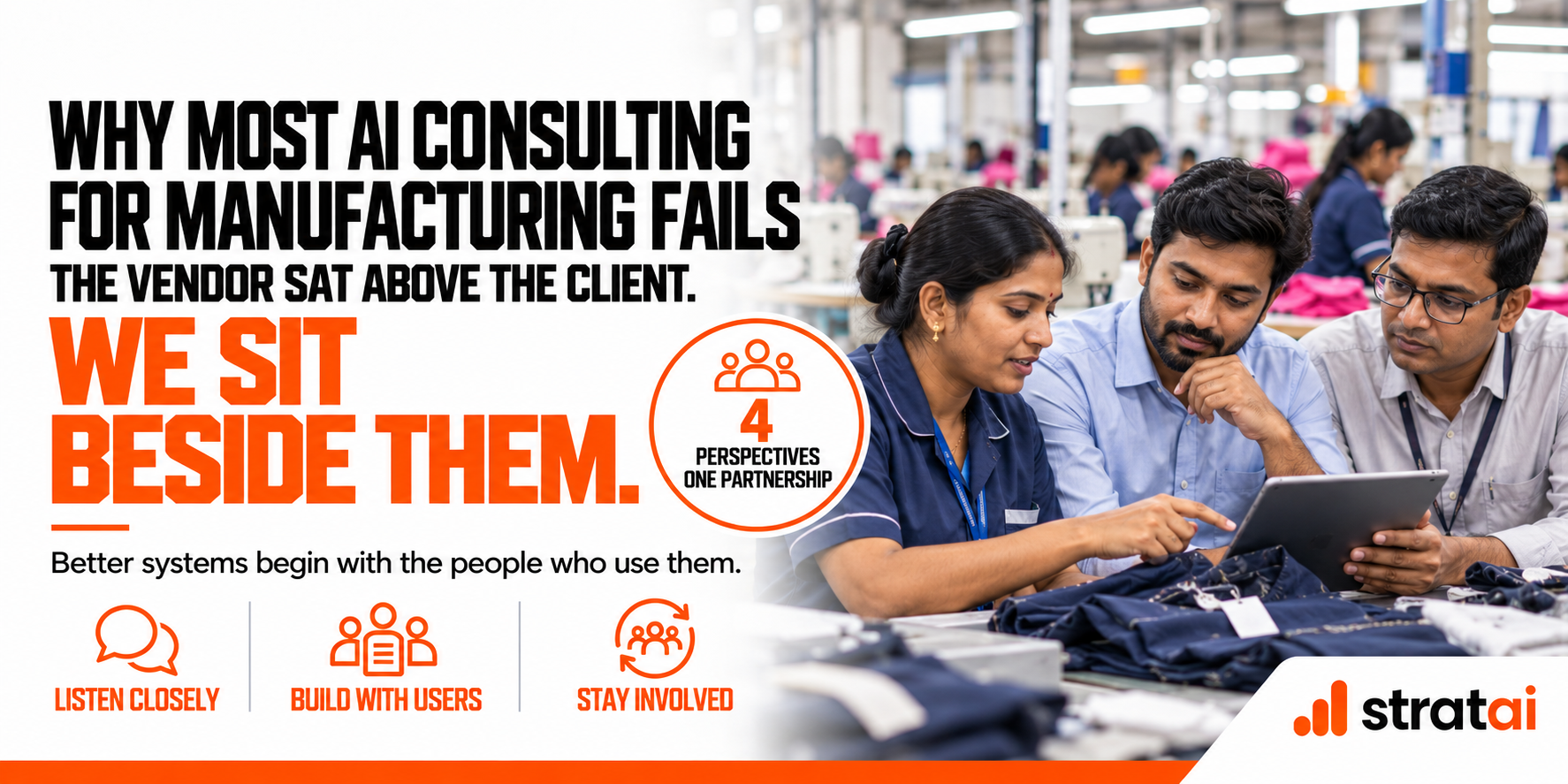
The Vendor Sat Above the Client. We Sit Beside Them.
The system does not fail at the technology level. It fails at the relationship level. And the relationship model is decided in the first conversation.
Direct answer: Why do most AI consulting engagements in manufacturing fail to achieve their goals?
Because the vendor sits above the client. They take a brief from the MD, design a solution in isolation, and deploy it to people who were never part of the design. Each level of the organisation holds a piece of the truth — the MD has the vision, middle management has the motivation, the on-ground workforce has the deepest knowledge, the IT manager has technical access. A top-down vendor connects to one level and misses the other three. The only model that works connects all four simultaneously — at the same level, not from above.
70%
of change initiatives fail — primarily due to employee resistance and lack of management support.
The failure is almost never the technology. It is the relationship between the people implementing it and the people using it. When the workforce is excluded from the design, the system is designed to be resisted.
Source: McKinsey, via Change Management Statistics Analysis, 2026
The Hierarchy That Kills AI Consulting Engagements Before They Start
Most AI consulting engagements in manufacturing follow the same structural pattern. The vendor is introduced to the MD. The MD shares the vision. The vendor goes away, designs a solution, builds it, and hands it over to the organisation. The organisation is then expected to use it.
This model has a name: top-down implementation. And it has a track record: it fails more than it succeeds, in every industry, with every technology, at every company size.
The reason is not complexity. The reason is not technology. The reason is that the people who are expected to use the system were never part of building it. Their frustrations were not surfaced. Their workflows were not understood. Their resistance — which is legitimate, because they know things the vendor does not — was treated as a problem to be managed rather than intelligence to be gathered.
The top-down model’s fatal assumption: that the MD’s vision is a sufficient brief for building a system that 50 QC inspectors and 50 merchandisers across three countries will actually use. It is not. The MD’s vision is the destination. The on-ground workforce knows the terrain. A vendor who takes only the destination and ignores the terrain will build a system that reaches the destination on paper and gets abandoned on the ground.
What Each Level of Your Organisation Knows — And What They Cannot See
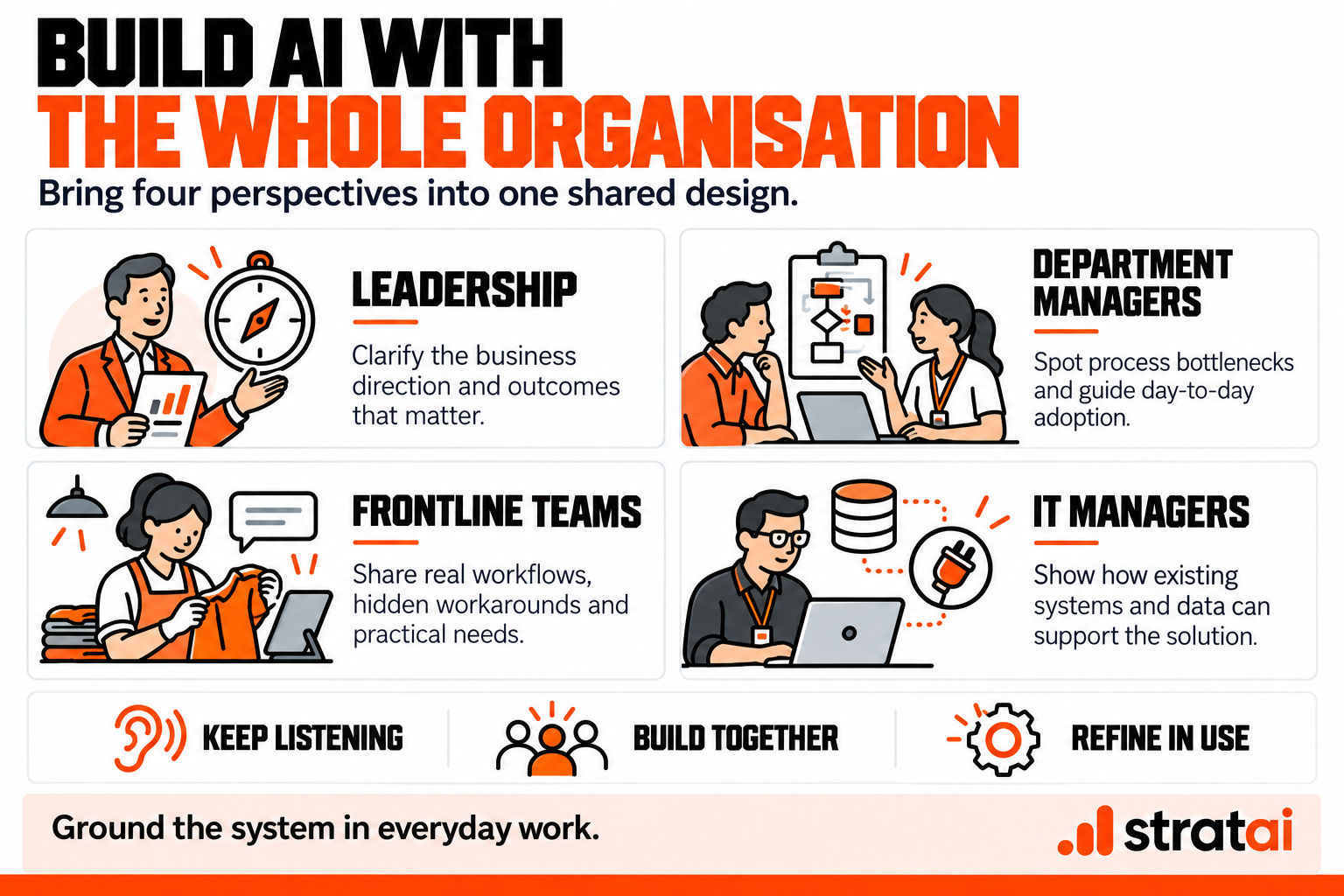
Every manufacturing organisation has four distinct levels of knowledge. Each is real. Each is partial. And none of them, alone, is sufficient to design an AI system that will actually work.
| Level | Strength | Gap | What They Need Instead |
|---|---|---|---|
| MD / Top Management | Vision. Industry depth. Clarity on the 3-year destination. | No full insight into on-ground problems and their complexity. Alone at the top with the vision. | A partner who understands the vision, aligns all stakeholders beneath it, and moves the organisation steadily toward it. |
| Middle Management | Know where the problems are. Motivated to fix them. Their team demands it. | No time to go deep. No cross-department visibility. No technical path to execute the change themselves. | Someone who closes the gap between the problem they can see and the solution they cannot execute. |
| On-Ground Workforce (QCs, Merchandisers) | Know exactly why things do not work. Right about the on-ground reality in most cases. | No decision-making authority. No technical skills. Nobody above them with time to truly hear what they know. | A partner who sits with them, listens without judgment, and turns what they know into a system that works. |
| IT Manager | Broad technical overview. Knows what has been built. | Works with pure tech vendors who lack industry and process context. Ends up facilitating complexity, not simplicity. | A partner with business and domain depth who can translate ground reality into systems that actually simplify. |
The top-down vendor connects to the top row and builds from there. Everything below is treated as an implementation challenge rather than a source of intelligence.
The horizontal partner sits at every row simultaneously. The MD’s vision is the direction. The IT manager’s technical context is the constraint. Middle management’s motivation is the fuel. The on-ground workforce’s knowledge is the raw material. All four are required. None is optional.
70%
of software implementations fail due to poor user adoption. The biggest single reason: difficulty training and onboarding end-users — cited by 36% of organisations.
The system is built. The training is delivered. The users do not adopt it. Not because the technology is wrong — because the system was not designed for the reality of how they actually work.
Source: Gartner 2024 via Whatfix / MeltingSpot Digital Transformation Analysis, 2026
What Sitting Beside Them Actually Looks Like — Tirupur, December
This is not a principle. This is a specific engagement, told as it actually unfolded.
A German buying house in Tirupur. December. They facilitate contract manufacturing for 60-plus European brands across 25-plus contract vendors in India, Bangladesh, and Turkey. They had built their ERP with hope. They had tried to drive adoption. The result: everyone sitting with their own set of frustrations, no real-time single source of truth, and data entry draining the organisation at every level.
| Level | What they wanted | What they were actually experiencing |
|---|---|---|
| MD | Single source of truth. Everyone using the ERP. AI-first by 2027. | No real-time visibility. Adoption incomplete. Vision unrealised. |
| IT Manager | Users adopting what he had facilitated building. | Resistance from every level. His work going unused. |
| Merchandisers | Simpler entry. Core work, not data work. Everything in one place. | Multiple screen clicks for every entry. 50-60 styles managed simultaneously. |
| QC Inspectors | Inspection process supported, not interrupted. | 1.5 hours of data entry after every shift, once inspections were done. |
StratAI entered on a reference from their existing tech vendor. The first thing we did was not build anything. The first thing was to sit with each level — separately, on their terms — and understand what they were actually experiencing.
The QC Story: Designed on the Ground, Not in a Boardroom
The existing QC web application was data-first, not process-first. It had been designed by people who understood data entry — not by people who had stood on a factory floor inspecting garments.
We studied all 17 QC tasks across the engagement. We found 6 unique tasks. The remaining 11 were repetition — different styles, same process. This was not obvious from a requirements document. It was only visible from sitting with the QCs and watching how they actually worked.
FIELD DATA · 17 Tasks → 6 Unique Ones
Studied across all QC inspection workflows on-ground. The remaining 11 were repetition of the same core process across different styles. This insight — invisible from any brief — was the foundation of the entire system redesign.
The decision: move from a web application to a mobile application. Redesign the screens so that data entry happens in real time on the ground during the inspection itself — not 1.5 hours after it. Full reports generated instantly from the data captured during the process.
FIELD DATA · 1.5 Hours Post-Shift → Zero
QC data entry time eliminated entirely. Documentation is now generated during the inspection, not after it. The QC’s shift ends when the inspection ends — not 90 minutes later.
This was possible because we earned the trust of the people who were closest to the problem. We removed doubt from the process. We sat beside them — not as consultants delivering a solution, but as partners trying to understand a reality we did not yet fully know.
A top-down vendor would have asked the IT manager what the QC system needed. The IT manager would have described it accurately at a high level. The 90-minute post-shift documentation problem would have been noted. And then the web application would have been improved — not replaced with a mobile-first, process-first system, because that level of redesign requires a depth of on-ground understanding that a brief cannot convey.
The Merchandiser Story: When the Most Frustrated Person in the Room Has the Answer
Vinod was a senior merchandiser. He was also the most sceptical person in the engagement about the existing software — and for good reason.
The existing system required multiple screen clicks to complete one entry for one style. Vinod and his colleagues were handling 50 to 60 styles simultaneously. The mathematics of this were not sustainable. Every entry was an interruption from the actual work — managing brand relationships, tracking production timelines, coordinating across three countries.
Because of his frustration, Vinod had gone looking for an alternative. He had independently found a competitor product called OZCA — and he showed it to us.
What OZCA showed us: two main screens. One notification-like. One Excel-like. Everything a merchandiser needed in one place, without navigating between systems or clicking through multiple pages for a single entry. Vinod did not show us this to complain. He showed us this because he had already done the work of finding the answer. The most frustrated person in the room had found the solution. Our job was to recognise it and build it.
We studied OZCA end to end. Rather than defending the existing system or dismissing what Vinod had found, we used it as the design benchmark. On top of the existing software, we built a 2-screen view that gives merchandisers everything they need — without changing the underlying ERP infrastructure.
This is what horizontal relationships produce. Vinod’s frustration was not a change management problem to be managed. It was intelligence. The only way to receive that intelligence was to sit beside him — not above him.
“Most systems are designed in boardrooms. StratAI started on the shop floor — and came back to see if it actually worked.”
— Mr. Vinod, Senior Merchandiser, German Buying House, Tirupur
What Horizontal AI Consulting for Manufacturing Produces That Vertical Models Cannot
The Tirupur engagement, six months in, spans every level of the organisation — and was shaped by every level of the organisation.
| System | How horizontal relationships made it possible |
|---|---|
| QC mobile app — process-first, real-time | Designed from sitting with QCs across 17 tasks. Invisible from any brief. |
| 2-screen merchandiser view | Built on Vinod’s independent discovery of OZCA. The most frustrated person had the answer. |
| Voice AI for QC data entry | Emerged from understanding that even the mobile app could be further reduced in friction. |
| Bulk PO and shipment entry automation | Merchandiser pain surfaced through repeated engagement — not a one-time interview. |
| TNA system overhaul | The Time and Action system was misaligned with operational reality. Visible only from being close to the process. |
| Management dashboards and AI chatbot | MD’s vision for a single source of truth — built after the ground-level systems were working, not before. |
| AI design catalogue — 15% projected sales uplift | Emerged in month 5. An unsolicited use case visible only from understanding the business model deeply. |
None of these systems were designed from a brief. Every one of them was designed from a relationship — with the person whose problem it solved, at the level where the problem actually lived.
A top-down vendor engaged with this client would have built a better ERP interface. They would have delivered the scope. They would have closed the engagement. And the QCs would still be spending 1.5 hours after every shift on documentation.
This horizontal way of working is one piece of a larger picture. the complete guide to AI consulting for manufacturing firms in India covers how to evaluate engagement models, pricing, and vendor fit end to end.
We start every engagement on the ground.
→ Book your free half-day plant audit — no commitment, no strings
We sit beside every level. Not above any of them. At the end of it, you can say no. Most don’t.
Frequently Asked Questions
Why do most AI consulting firms in manufacturing take a top-down approach?
Because it is faster and more scalable. Taking a brief from the MD and designing from the top requires one relationship and one conversation. Sitting beside QC inspectors, merchandisers, IT managers, and middle management simultaneously requires time, trust, and genuine curiosity about how work actually happens. Most vendors are not structured to do this — their model optimises for delivery speed, not for the depth of understanding that produces adoption.
What does a horizontal AI consulting relationship actually look like on the ground?
It looks like studying 17 QC tasks to find 6 unique ones before touching any technology. It looks like a merchandiser showing you a competitor product they found themselves, and using it as the design benchmark rather than defending the existing system. It looks like earning trust at every level before building anything. It looks like a system that the people who use it actually helped design — which is why they actually use it.
How does StratAI manage relationships across multiple levels without losing coherence?
By maintaining alignment between levels throughout the engagement, not just at the start. The MD’s vision is the direction. The IT manager’s constraints are the boundaries. Middle management’s motivation is the fuel. The on-ground workforce’s knowledge is the raw material. Every system StratAI builds connects what each level knows into something none of them could have designed alone. This is not relationship management — it is the actual work.
Does sitting beside clients mean StratAI takes longer to deliver?
The month-one diagnostic is slower by design — it is a paid study of the on-ground reality before any system is built. This is not inefficiency. It is the work that prevents the 70% failure rate. The engagements that skip this phase deliver faster and fail more. The engagements that do this work deliver systems that people actually use — which is the only definition of delivery that matters.
How is this different from user research or stakeholder interviews?
User research is conducted at the start of a project and used to inform a design that is then handed over. Horizontal relationships are maintained continuously throughout the engagement. Vinod’s discovery of OZCA happened in month three — not week one. The AI design catalogue use case emerged in month five. The depth of understanding that produces these insights cannot be gathered in a kickoff workshop. It accumulates through sustained presence and genuine partnership.
About StratAI
StratAI builds AI Advantage Systems for mid-market manufacturing companies across India. Official Registered Claude Partner and Anthropic Partner. We start every engagement on the ground — a free half-day plant audit with no commitment — because the only way to build something that works is to understand the reality it has to work in.
12+ retainer clients · 90%+ client retention · stratai.io/contact · palani@stratai.io · +91 99402 25924
“We don’t implement AI for you. We build advantage with you.” — StratAI