Mid-Market Indian Manufacturers Don't Need Enterprise AI Consultants. They Need This Instead.
The gap between AI investment and AI results in Indian manufacturing is not a technology problem. It is a category mismatch. The wrong type of firm is serving the segment — and the damage compounds silently until a board stops believing in AI altogether.
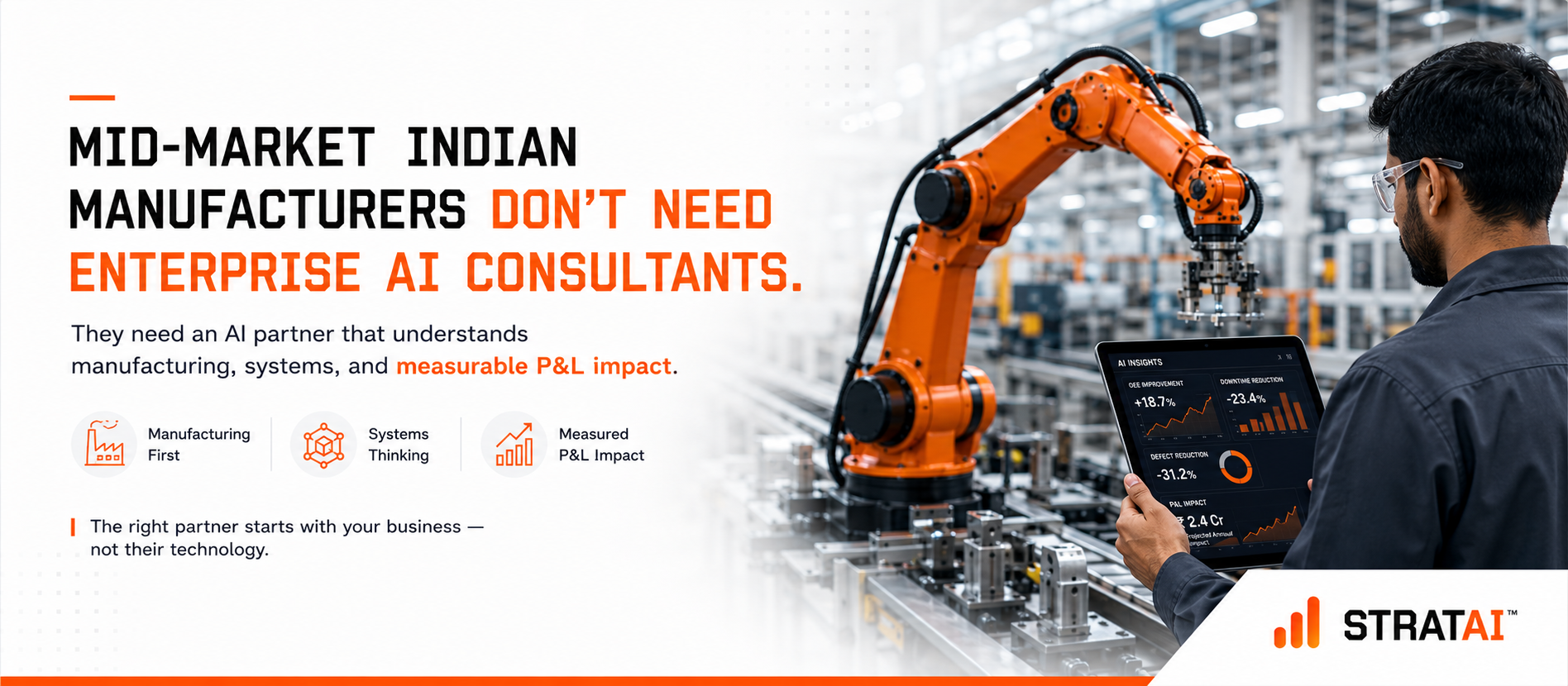
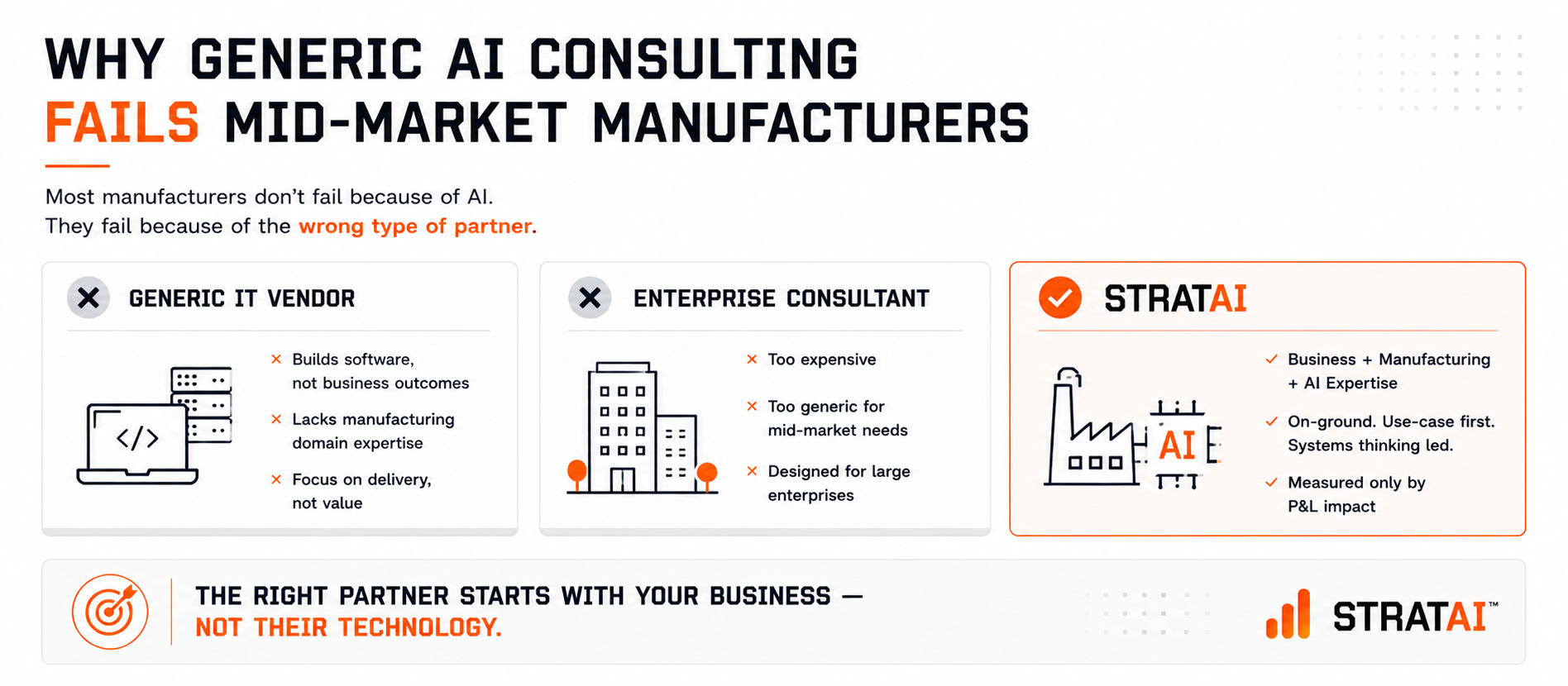
Mid-market Indian manufacturers are structurally underserved by AI consultants. Global firms target enterprises. Top Indian IT firms serve other industries. Generic IT vendors fill the gap without domain knowledge, systems thinking, or change management capability. The right model is on-ground, use-case-first, measured only by P&L impact.
Mid-Market Indian Manufacturers Don’t Need Enterprise AI Consultants. They Need This Instead.
The practical guide to AI consulting for mid-market manufacturers in India — who actually serves this segment, and what the right engagement model looks like.
The gap between AI investment and AI results in Indian manufacturing is not a technology problem. It is a category mismatch. The wrong type of firm is serving the segment — and the damage compounds silently until a board stops believing in AI altogether.
Direct answer: What kind of AI consultant does a mid-market Indian manufacturer actually need?
A mid-market Indian manufacturer needs a partner who brings business consulting depth, manufacturing domain knowledge, and AI capability together in one team — not three separate vendors. Global consultants don’t serve this segment. Top Indian IT firms serve other industries. Generic IT companies fill the vacuum with the wrong model. The right model is on-ground, use-case-first, systems-thinking led, and measured only by P&L impact.
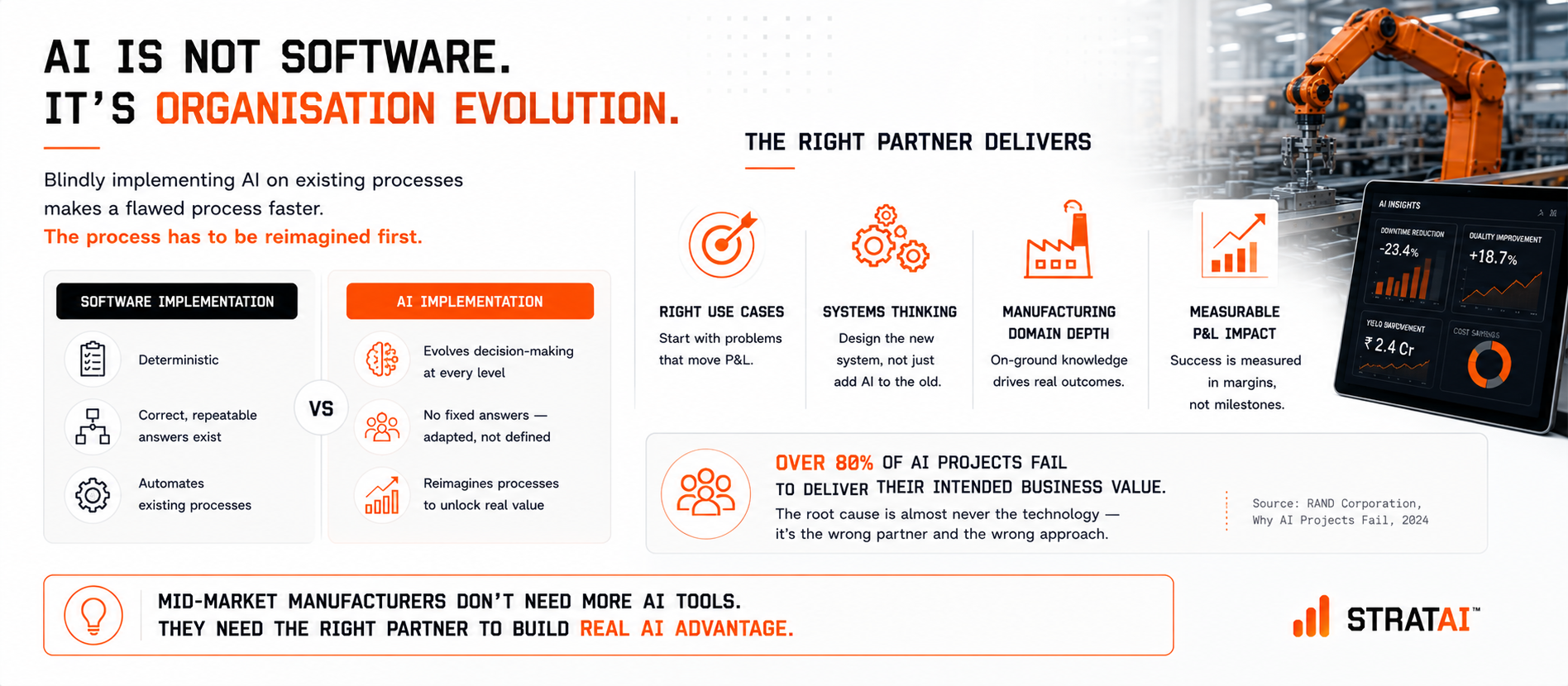
80%+
of AI projects fail to deliver their intended business value.
RAND Corporation’s analysis of documented enterprise AI initiatives found AI project failure rates running roughly twice as high as comparable IT projects without AI — with the root cause almost never being the technology itself.
Source: RAND Corporation, Why AI Projects Fail, 2024
The Structural Gap Nobody Is Talking About
There is a VP of Marketing from a large Indian manufacturing company whose observation has stayed with me since the conversation. He said: the difference between the most successful businesses in any industry and the companies that follow them is that they go ten levels deeper to execute. It is all about execution depth.
Mid-market Indian manufacturing is a segment that needs exactly this depth in its AI consulting partner. And yet, structurally, it is the segment most likely to receive the opposite.
Look at who serves whom. Global consulting firms — McKinsey, Accenture, BCG — target governments, large corporations, and major institutions. Their model requires it. Their fees require it. Mid-market manufacturing, by definition, is outside their commercial aperture.
India’s dominant IT leaders — Wipro, TCS, Infosys, HCL — serve global markets at scale: healthcare, banking, fintech, retail. Their AI practices are built for these verticals. Manufacturing, specifically mid-market Indian manufacturing, is not a focus segment. It is an industry code on a services brochure.
The vacuum this creates is filled by the only firms that remain: generic second and third-tier IT companies with software and AI expertise but no manufacturing domain knowledge, no business consulting depth, and no change management capability. This is not a character flaw in these firms. It is a structural mismatch. They were never built for this segment. They are simply the ones willing to serve it.
SMEs are the fastest-growing AI consulting segment — at 25.7% CAGR — but remain the most underserved.
Finance and banking lead AI consulting market share with 22%. Mid-sized businesses show the fastest growth rate but continue to be underserved by specialist partners, with generic IT vendors filling the gap by default.
Source: SNS Insider, AI Consulting Services Market Report, 2025
Why AI Is Not a Software Implementation — It Is an Organisation Evolution
This distinction matters more than any other in this conversation, and most mid-market manufacturers learn it after they have already signed a contract with the wrong kind of partner.
If your company has implemented an ERP system, you already understand what software implementation looks like. It is genuinely difficult — it demands process documentation, careful change management, and patience before adoption takes hold. But it is, fundamentally, deterministic. You create a Purchase Order this way. You perform a Goods Receipt Note entry like this. There is a correct, definable, repeatable answer for nearly every workflow decision.
AI implementation is not that. AI implementation is the evolution of how your organisation makes decisions — at the individual level, at the departmental level, and at the organisation level simultaneously. The correct answer is not fixed and predefined. The entire point is helping your people make better decisions in situations that were previously ambiguous, judgment-dependent, or entirely manual.
The process has to be reimagined before the AI is touched.
When a new technology arrives, it does not merely automate existing processes — it changes the process itself. Cloud computing did not just move storage online; it made long-distance collaboration seamless and fundamentally reorganised how teams coordinate across geographies. AI does the same. Blindly implementing AI on top of existing processes does not unlock full AI value. It makes a flawed process faster. The systems thinking has to come first.
A systems-thinking approach to AI implementation requires mapping every component of the old system simultaneously: existing software, people, AI technology, required integrations, data silos — document servers, ERP databases, legacy spreadsheets — and then reimagining how those components interact once AI is in the architecture. This is a business design role, not a technical role. And it requires a partner who has sat inside manufacturing operations, not one who has read about them.
The Three Ways Generic IT Vendors Fail Mid-Market Manufacturers
These failure modes appear consistently across engagements where a generic IT vendor has preceded a specialist. They are structural, not incidental — which means they repeat regardless of which vendor is involved.
Failure Mode 1 — ‘What Problem Do You Want to Solve?’
The generic IT vendor arrives and asks the client to define the use case. This seems reasonable. It is actually the first signal of failure.
Three problems cascade from this starting point. First, top management in a mid-market manufacturing company does not have the time — or the AI literacy — to brief a vendor comprehensively on their own operations. The result: the vendor receives a partial, high-level problem statement that reflects what management thinks AI can do, not what the business actually needs.
Second, the vendor — working from an incomplete brief — falls back on presenting their existing solutions. The client, trying to be helpful, starts finding problems that fit those solutions. The direction of the relationship reverses: business finds problems for solutions, instead of solutions finding problems. This is the early signal of failure, and it almost always looks like progress in the first ninety days.
Third, the knowledge required to identify high-value use cases compounds over time, on-ground. A vendor who asks ‘what do you need?’ in week one will never build that knowledge. The right model requires an on-ground team whose understanding of the business — industry, process, people, operational reality — compounds month by month. As that knowledge compounds, the AI value unlock compounds commensurately.
Failure Mode 2 — No Systems Thinking Capability
An average IT vendor does not have the business or domain expertise to understand how AI changes the process itself, not just the task. They are trained to automate existing workflows. They are not trained to reimagine what the workflow should be once AI capability is in the equation.
The result: AI gets implemented on top of existing processes — the way they were designed before AI existed — and the full value of what AI makes possible is never unlocked. The process is faster. The process is not better. And the gap between what was delivered and what was possible becomes the source of quiet disappointment that nobody names directly.
Failure Mode 3 — Excessive Imagination Without Ground Reality
This failure mode is specific to the AI era and is becoming more common as senior leaders become sophisticated users of AI tools personally.
A CEO or Managing Director has a deep thinking session with ChatGPT or Claude. They explore possibilities. They get excited — legitimately — about what AI could do for their business. They arrive at the engagement with an extensive, ambitious list of AI features they want built.
An average AI consulting person, facing a paying client with strong opinions, takes these items and starts building. The vendor is technically capable. The client is financially committed. The features get built.
What never happens: the question of whether any of this will actually be used on the ground.
| Level | Description | What most vendors do |
|---|---|---|
| What can be imagined | Every possibility that AI could theoretically enable — unlimited, unconstrained | Start building here |
| What is feasible | The subset that is technically achievable given your data, systems, and budget | Sometimes filter to here |
| What will be used on ground | The subset that fits your team’s reality, workflows, and actual behaviour | Almost never reach here |
Real AI consulting designs around the third level. Every feature decision should start from what will actually be used on the ground by the actual people whose jobs it changes. AI consulting is a hyper-customised intervention — not a product, not a platform, not a shortcut. Designing for imagination rather than ground reality is the most expensive mistake in mid-market AI.
95%
of generative AI pilots deliver zero measurable return to the income statement.
MIT Project NANDA’s GenAI Divide study, covering 300+ AI initiatives, found only 5% of organizations see measurable P&L impact from generative AI. The failure is almost never the technology — it is misaligned use case selection and the absence of ground-level workflow integration.
Source: MIT Project NANDA, The GenAI Divide: State of AI in Business, 2025
What an On-Ground Partner Sees That an IT Vendor Never Would
The best demonstration of what business-depth AI consulting actually delivers is not a framework. It is a specific use case — one that emerged from six months of on-ground engagement with a client, at a point where an IT-first vendor would have long since delivered their scope and moved on.
The Design Intelligence System — A Buying House in Tirupur
A German buying house facilitates contract manufacturing for 60-plus European brands, working with 25-plus contract vendors across Tirupur, Bangladesh, and Turkey. StratAI has been engaged with this client for over six months — covering QC data capture, merchandiser entry automation, document intelligence, and a complete overhaul of their 17-point Time and Action calendar.
Six months in, during a regular business review, a different opportunity emerged. Not from a client brief. From understanding the business deeply enough to see an asset being underutilised.
The buying house has its own design and development wing housing more than 2,000 T-shirt designs. This collection represents years of design investment — fabric development, shape development, accessory combinations. Design and development has been slow. Their ability to showcase new designs to European brand clients — and therefore generate new sales — is constrained by how long it takes to develop each new design from scratch.
FIELD DATA · 2,000+ Designs — One Asset Being Underutilised
A design and development library built over years. Each design represents real fabric development investment. Currently generating a limited number of commercial configurations from each piece of original work.
The insight that required business depth to see: a T-shirt design is not a single design. It is a combination of components — fabric, shape, accessories. These components can be separated. Once separated, AI can generate several thousand combinations from the same base components: different fabrics, different shapes, different accessories, recombined systematically against each European brand client’s documented aesthetic preferences.
The two-layer system StratAI proposed: first, AI studies each brand client’s website and builds a detailed preference profile — the shapes they have consistently favoured, the colour language, the accessory choices, the silhouettes. Second, AI uses the buying house’s existing component library to generate designs specifically matched to each brand’s documented preferences, using fabrics and shapes they have already developed.
| Before this system | After this system |
|---|---|
| 2,000+ designs, slowly expanded | Several thousand configurations, generated dynamically |
| Generic showcasing to all brands | Hyper-customised presentation per European brand |
| Fabric investment partially utilised | Every developed fabric maximally exploited |
| Design development pace is the bottleneck | AI multiplies existing assets — no new development required |
| Static collection | Dynamic, brand-specific collection updated continuously |
Management’s projection for this single use case: a sales impact of 15% or more. Not from new product development. From making what they already have work several times harder.
Why no IT-first vendor would have seen this: identifying this use case required understanding the business model of a buying house, the economics of fabric development, how European brands evaluate design collections, the operational reality of a design and development wing, and the capability of generative AI to recombine visual components intelligently. It is not a technical problem. It is a business strategy problem that AI can execute — and only a partner with business consulting depth embedded alongside AI capability can identify it.
What the Right Engagement Model Actually Looks Like
The engagement model is where the theory of business-depth AI consulting becomes concrete. Here is exactly how StratAI enters and sustains an engagement with a mid-market manufacturer.
| Stage | What happens | What this achieves |
|---|---|---|
| 1-2-1 Discovery | Direct conversation showing what has been built and delivered for comparable manufacturing clients | Client gets proof of deployment depth, not a sales deck |
| Free Half-Day Plant Audit | On-ground audit of operations, processes, and people — no strings attached, client can say no at the end | Use cases identified from reality, not from a client brief |
| Use Case Selection | StratAI identifies the areas where AI will create measurable value, based on what was observed on the ground | Ground-reality selection, not imagination-level selection |
| Month 1 Paid Diagnostic | Detailed study of agreed focus areas — specific interventions defined, P&L impact projected in concrete terms | Client knows exactly what will be built and what it should deliver before implementation begins |
| Retainer Engagement | Implementation, behaviour alignment, and expanding use case roadmap — measured only by P&L outcomes | Compounding AI value as knowledge of the business deepens over time |
FIELD DATA · 90%+ Retainer Continuation Rate
Across StratAI’s active client base. The measure that matters: not client satisfaction scores, not system delivery milestones — client retention driven by measurable P&L impact month on month.
The Founding Team Combination That Makes This Possible
StratAI’s founding team are mechanical engineers by training — PSG Tech — with professional MBAs from IIM Bangalore and IIM Trichy and postgraduate degrees from international institutions. A decade-plus of business consulting experience across manufacturing contexts.
This combination is not a credential claim. It is the structural reason the business-depth model is possible. Understanding manufacturing operations, understanding business model economics, understanding AI capability, and understanding human behaviour and change management simultaneously — in one team — is what makes the gap between imagination-level and ground-reality use case selection closeable.
The right engagement shape is one part of the decision. the complete guide to AI consulting for manufacturing firms in India covers the rest — pricing, vendor evaluation, and what a properly scoped engagement should deliver.
Start with a free half-day plant audit.
→ Book your plant audit — no commitment, no strings
At the end of it, you can say no. Most don’t.
Frequently Asked Questions
Why can’t a large IT company just serve mid-market Indian manufacturers?
Large Indian IT companies are built for global enterprise clients across banking, healthcare, and fintech. Their delivery model, pricing, and team structures are calibrated for that segment. Mid-market Indian manufacturing requires on-ground presence, manufacturing domain expertise, and the systems-thinking capability to reimagine processes before implementing technology. These are not skills global IT firms develop for this segment, because this segment is not their commercial priority.
What is the difference between AI consulting for a mid-market manufacturer versus an enterprise?
An enterprise has dedicated AI teams, clean data infrastructure, and the runway to absorb a slow engagement. A mid-market manufacturer has none of these — and needs a partner who identifies the highest-value use case quickly without consuming significant management time, builds on-ground rather than remotely, and delivers visible P&L impact within six months, not three years. The engagement model, the use case selection approach, and the change management reality are fundamentally different. A model designed for enterprise will underdeliver in mid-market every time.
How does StratAI identify use cases without asking the client what they need?
StratAI begins with a free half-day plant audit — physical, on-ground observation of operations, processes, and people. This session reveals what management briefs often miss: the frustrations that have been normalised, the assets that are underutilised, and the decision-making bottlenecks that compound daily. Use case identification comes from this observed reality, cross-referenced with AI capability and P&L impact potential. The client’s brief informs the conversation — it does not determine the use case.
What does ‘three levels of use case selection’ mean in practice?
Every AI use case exists at three levels: what can be imagined, what is technically feasible, and what will actually be used on the ground by real people in real workflows. Most generic vendors design for the first or second level. StratAI designs only for the third — what will actually be adopted, used daily, and therefore show up in the P&L. This is why the half-day plant audit includes observation of how people actually work, not just what processes exist on paper.
How long before a mid-market manufacturer sees AI impact in their P&L?
The realistic timeline for visible P&L impact is six months. Month one is the paid diagnostic — study, intervention design, and P&L projection. Months two and three are build and behaviour alignment. Months four and five produce early operational signals. From month six, impact should be measurable against a specific P&L line — rejection rate, throughput, procurement cost, order processing time, or pipeline visibility. This is the 6-Month P&L Horizon that governs every StratAI engagement.
About StratAI
StratAI builds AI Advantage Systems for mid-market manufacturing companies across India. We are an Official Registered Claude Partner and Official Registered Anthropic Partner. Our founding team combines mechanical engineering, IIM MBA credentials, and a decade of business consulting experience — the specific combination that makes on-ground, systems-thinking AI consulting in manufacturing real, not claimed.
12+ retainer clients · 90%+ client retention · stratai.io/contact · palani@stratai.io · +91 99402 25924
“AI doesn’t create advantage by default. Advantage is engineered.” — StratAI
Why can't a large IT company just serve mid-market Indian manufacturers?+
What is the difference between AI consulting for a mid-market manufacturer versus an enterprise?+
How does StratAI identify use cases without asking the client what they need?+
What does 'three levels of use case selection' mean in practice?+
How long before a mid-market manufacturer sees AI impact in their P&L?+

Palaniappan SN is a Business Strategy Consultant who has spent his career at the intersection of business strategy and operational reality — working across management levels from the boardroom to the shop floor to understand where organisations actually win and lose. His conviction is simple: AI should never be an experiment. It should be an advantage. That belief is the foundation of StratAI's AI Advantage Systems methodology — built not from technology-first thinking, but from the ground up, with the discipline to walk away from projects where the conditions for success don't exist.