What AI Consulting Services for Manufacturing Actually Deliver — And Why Most Indian Manufacturers Are Buying the Wrong Thing
AI consulting services for manufacturing are not software implementation with an AI label on it. Most Indian manufacturers are buying the wrong thing — and the cost of that mistake is bigger than the invoice.
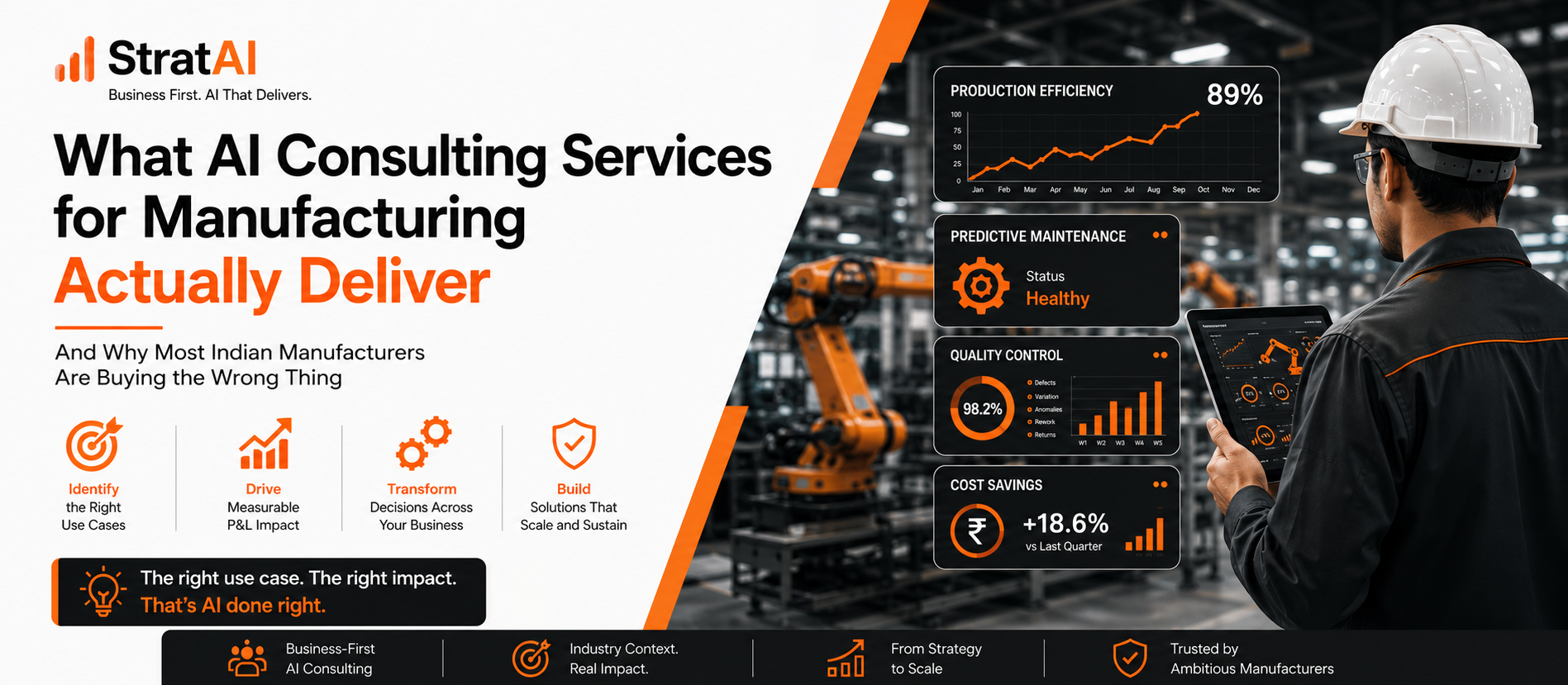
This spoke defines what AI consulting services for manufacturing actually deliver versus what most Indian manufacturers are buying. Covers the two lenses for identifying high-value use cases (Value Unlock + Follow the Pain), a real 6-month engagement case study, and what separates a business consulting partner from a technology implementer.
AI consulting services for manufacturing are not software implementation with an AI label on it. Most Indian manufacturers are buying the wrong thing — and the cost of that mistake is bigger than the invoice.
What do AI consulting services for manufacturing actually deliver?
Real AI consulting services for manufacturing deliver one thing above all else: the correct identification of high-value use cases for your specific business context. Everything else — the build, the technology, the dashboards — is execution. Get the use case right and AI consulting delivers compounding P&L impact. Get it wrong and you get AI for the sake of AI, which is worse than doing nothing, because it erodes your organization's trust in AI itself.
Only 5.5% of organizations report real financial returns from their AI investment.
Out of 1,993 companies surveyed, only 109 reported that more than 5% of their EBIT is attributable to AI use — a figure consistent with separate MIT research finding only 5% of AI pilots generate measurable P&L impact.
Source: McKinsey State of AI 2025, analysis via CoLab Software
What Most Indian Manufacturers Are Actually Buying When They Buy 'AI Consulting'
Here is what is happening across Indian manufacturing right now. The IT services industry — enterprise and mid-market alike — is under real pressure. Traditional software and services revenue is squeezed. And almost overnight, a large share of these companies have rebranded themselves as AI implementation companies.
This is not a conspiracy. It is a survival response. But it has created a serious problem for manufacturers trying to buy AI consulting services: the vendor in front of you is very often a software implementation company wearing an AI label, applying software implementation thinking to a problem that does not work that way.
If you have ever implemented an ERP system, you already understand the comparison. ERP implementation is genuinely difficult — it demands detailed process understanding, careful change management, and real patience before adoption sticks. But it is, at its core, deterministic. You need to create a Purchase Order this way. You need to do Goods Receipt Note entry like this. There is a correct, definable, repeatable answer for almost everything.
AI implementation is not that. AI implementation is the evolution of how your organization makes decisions — at the individual level, at the departmental level, and at the organizational level, simultaneously. There is no fixed correct answer to map against, because the entire point is helping your organization make better decisions in situations that were previously ambiguous, manual, or judgment-based.
A pure-play software implementer has technical skill. What it does not have — and was never built to have — is the business knowledge, change management depth, and process context required to understand your organization holistically before touching anything. That gap is not a character flaw in these vendors. It is a structural mismatch between what they are trained to do and what AI consulting for manufacturing actually requires.
Cost benefits from AI are concentrated in three functions — and manufacturing is one of them.
Manufacturing, software engineering, and IT are the functions where companies most consistently report cost savings from individual AI use cases — even though enterprise-wide EBIT impact remains rare, with only 39% of organizations reporting any EBIT impact at all.
Source: McKinsey Global Survey on the State of AI, November 2025
The One Decision That Determines Whether AI Consulting Delivers — Or Becomes AI for the Sake of AI
If there is a single sentence that should anchor how you evaluate any AI consulting partner for your manufacturing business, it is this: the most critical part of the entire engagement is identifying the high-value use case for your specific context.
Not the algorithm. Not the platform. Not the dashboard. The use case.
Get this right, and AI consulting drives real ROI and visible P&L impact — because the system is solving a problem that was actually worth solving, sized correctly for your operation, and built on a foundation your organization can actually adopt.
Get it wrong, and you get something far more damaging than a wasted budget line. You get AI for the sake of AI — activity that looks like progress but produces nothing your CFO will recognize in a monthly review.
A failed AI consulting engagement does not just waste a budget. It erodes the board's and management's trust in AI itself — at exactly the moment skepticism is already high. That erosion is a backward step that takes far longer to recover from than the original investment, because the next AI proposal that comes across the same board's desk now carries the weight of the last failure.
The Two Lenses: How the Right Partner Finds High-Value Use Cases
This is the part that separates a business consulting partner from a technology vendor. There are two distinct lenses for identifying where AI will actually create value in a manufacturing business — and a tech-first vendor is structurally unequipped to use either one well.
Lens 1 — Value Unlock: Strategic Use Cases Nobody Asked For
These opportunities do not start with a stated complaint. They start with understanding a business model deeply enough to see an asset that is not being fully exploited.
A fabric and furnishings manufacturer with a collection of over one lakh fabrics did not come to us with a problem statement. We studied the industry — how architects and interior designers actually search for, evaluate, and shortlist fabrics — and found that the vast collection, the business's greatest strength, was also its biggest point of friction. Finding a fabric matching a specific architectural brief took a skilled salesperson significant time and still produced uncertain results. Architects gave up. The business stayed out of consideration sets it should have dominated.
The solution: AI-powered digitization of the entire collection with 15-plus searchable attributes per fabric, plus a live pipeline view showing exactly which architects were considering which designs. This is a strategic use case — it compounds over years, not months, because it changes how customers access the business permanently.
Lens 2 — Follow the Pain and Frustration
In every company, at every level, someone is frustrated about something. In most cases, the frustration is legitimate. The skill is recognizing the signal and building a sequence of interventions that turn repetitive, mechanical work into something seamless.
Consider a buying house managing relationships with 60-plus global brands. Their merchandiser team had to study Tech Packs and Purchase Orders in detail for every brand, then manually perform PO entries. This was pure data transfer. No judgment, no expertise, no value add. It consumed a full day of the work week, across 50-plus merchandisers, spread across three countries.
Time consumed by manual PO entry and shipping data transfer — pure data transfer work with zero judgment or expertise required, performed by a high-value merchandising team.
The AI system built for this: merchandisers upload the PO or packing list. AI analyzes the document and captures every variation within 10 seconds, then performs the entry. The merchandiser's role shifts from doer to approver. The high-value part of their role — maintaining brand relationships, ensuring on-time delivery — is now where their time actually goes.
The same use case that delivers massive value at 50-plus merchandisers across three countries would be a poor use case for a company with only 3 merchandisers. Following the pain is not mechanical. It requires judgment about scale and context that a tech-first vendor is not positioned to apply.
What Happened When the Same Company Switched Partners — A Real Six-Month Story
A buying house in the textile sector had already engaged a pure-play tech vendor before StratAI came into the picture. Progress was happening — but it was incremental, touching only trivial aspects of the operation. This was not a failure of competence. The vendor was simply not trained to identify high-value use cases.
Once StratAI came on board — combining business consulting depth with AI implementation capability — the trajectory changed completely. As of this writing, the engagement is six months old. In that time, the impact spans merchandiser entry automation, bulk PO and shipment entry, QC data entry through a mobile application, voice-based QC measurement, management reporting and dashboards, and a complete overhaul of their 17-point Time and Action calendar.
Same company. Same operations. Same opportunity space. Incremental, trivial results under a tech-first vendor. Compounding, multi-system transformation under a business-and-AI-context partner. Nothing changed except who was identifying the use cases.
The client has a stated mission to become an AI-first company by 2027. StratAI is now their go-to partner for that mission — not a vendor on a project list, a partner in a multi-year transformation.
What AI Consulting Services for Manufacturing Should Actually Deliver
Strip away the technology and the jargon, and real AI consulting services for manufacturing should deliver four things — in this order.
| What you should receive | Why it matters |
|---|---|
| Correct use case identification | This is the single highest-leverage decision in the entire engagement — get it wrong and nothing else matters |
| Business and process context before technical design | AI implementation requires understanding your decision-making system at every level — not just your data structure |
| A sequenced roadmap, not a single deliverable | High-value engagements compound — one use case proven well opens the door to the next |
| A partner accountable for P&L outcomes | Technology delivery is not the finish line — measurable business impact is |
If your current or prospective AI consulting partner cannot clearly explain how they identify high-value use cases, they are likely a technology implementer operating under an AI label. That distinction is the single most important thing to understand before you sign anything.
This is one piece of a larger evaluation. the complete guide to AI consulting for manufacturing firms in India covers the full picture — engagement models, pricing, and how to choose a partner who is actually accountable for outcomes.
"Most systems are designed in boardrooms. StratAI started on the shop floor — and came back to see if it actually worked."
— Mr. Vinod, Senior Merchandiser, German Buying House, Tirupur
→ Tell us your biggest operational frustration
We will tell you whether it is worth solving — at no cost or commitment.
Frequently Asked Questions
What is the difference between AI consulting and AI implementation for manufacturing?
AI implementation is the technical build — the system, the integration, the deployment. AI consulting is the business judgment that determines which system is worth building in the first place. A pure technology implementer can execute a use case well once it is defined, but defining the right use case requires business consulting depth, process understanding, and change management expertise — skills outside a technology vendor's core training.
How do I know if my AI consulting partner is actually a tech vendor in disguise?
Ask them to walk you through how they identify high-value use cases — not which technologies they use, but their actual diagnostic process. If the answer focuses on their platform, their algorithms, or their technology stack rather than your business context, your pain points, and your value unlock opportunities, you are likely working with a technology implementer operating under an AI consulting label.
Why do AI consulting engagements in manufacturing often start well and then stall?
Most stalls happen because the engagement began with a use case selected for its technical feasibility rather than its business value. A use case that is easy to build but does not address a real pain point will show technical progress while producing no P&L impact — which is exactly the pattern of incremental, trivial results that signals a use case selection problem, not a technology problem.
What questions should manufacturing CEOs ask before approving an AI consulting engagement?
Ask how the partner identifies use cases, not just what they can build. Ask for a specific example of a use case they recommended against because it lacked scale or business value. Ask how they distinguish a strategic, long-term value-unlock opportunity from a pain point worth solving immediately, since the right answer requires both lenses, applied with judgment.
Is AI consulting for manufacturing only relevant for large operations?
No, but scale changes which use cases make sense. A use case that delivers enormous value across fifty merchandisers in three countries may not justify the same investment for a team of three. The right AI consulting partner applies judgment about scale and context to every recommendation — which is precisely the kind of judgment a tech-first vendor is not equipped to apply.
About StratAI
StratAI builds AI Advantage Systems for mid-market manufacturing companies across India. We are an Official Registered Claude Partner and Official Registered Anthropic Partner. Every engagement begins with identifying the highest-value use case for your specific business context — before any technology decision is made.
12+ retainer clients · 90%+ client retention · stratai.io/contact · palani@stratai.io · +91 99402 25924
"AI doesn't create advantage by default. Advantage is engineered." — StratAI
What is the difference between AI consulting and AI implementation for manufacturing?+
How do I know if my AI consulting partner is actually a tech vendor in disguise?+
Why do AI consulting engagements in manufacturing often start well and then stall?+
What questions should manufacturing CEOs ask before approving an AI consulting engagement?+
Is AI consulting for manufacturing only relevant for large operations?+

Palaniappan SN is a Business Strategy Consultant who has spent his career at the intersection of business strategy and operational reality — working across management levels from the boardroom to the shop floor to understand where organisations actually win and lose. His conviction is simple: AI should never be an experiment. It should be an advantage. That belief is the foundation of StratAI's AI Advantage Systems methodology — built not from technology-first thinking, but from the ground up, with the discipline to walk away from projects where the conditions for success don't exist.