The AI Implementation Roadmap Manufacturing IT Teams Actually Need (Not the One Vendors Sell You)
80% of AI projects fail. Most of them had a roadmap. The roadmap was not the problem — the model behind it was.
Direct answer: What does a realistic AI implementation roadmap look like for a manufacturing IT team?
A realistic AI implementation roadmap for a manufacturing IT team is not a fixed-phase project plan with a handover date. It is a diagnostic month, followed by a first use case built to 80% completion, refined through real user feedback, then extended with a second use case running in parallel — while the first reaches 90-95%. No idle periods. No waiting for perfection before starting the next thing. No scope locked before the reality is understood. The roadmap is not what the vendor designs in a proposal. It is what emerges from the first month inside your actual operations.
80.3%
of AI projects fail to deliver their intended business value — at twice the failure rate of conventional software projects.
The failure is not technical. RAND's analysis of 2,400+ enterprise AI initiatives identifies the dominant failure modes as data ownership gaps, organisational maturity, and use-case drift — not model performance. An IT team that inherits a fixed-scope AI project without influence over use-case selection or engagement model is inheriting a failure pattern, not a roadmap.
Source: RAND Corporation, AI Project Failure Analysis, 2025 via mybusinessfuture.com
Why the Vendor's Roadmap Fails Before Month Three
The standard AI vendor roadmap follows a familiar structure. Discovery phase. Design phase. Build phase. Testing phase. Handover. Each phase has a fixed scope, a fixed timeline, and a fixed deliverable. It looks credible in a proposal. It fails in practice — consistently, predictably, and for the same reasons every time.
Reason 1 — The scope was fixed before the reality was understood
The discovery phase in a project-based engagement lasts two to four weeks. In that time, the vendor interviews stakeholders, reviews existing systems, and produces a scope document. The scope document describes what will be built. It does not describe what the organisation actually needs — because two weeks is not enough time to understand how an operation actually works versus how it is described by the people who manage it.
The QC process that takes 17 tasks to complete but has only 6 unique ones — that insight was not in any brief. It came from sitting with the QC team across multiple production shifts. A fixed scope written in week two cannot contain insights that only emerge in week eight.
Reason 2 — Evolving needs hit a fixed model
Manufacturing operations evolve. A new export market opens. A customer's quality requirements change. A machine is retired and replaced. A department head who resisted the system in month one becomes the system's strongest advocate in month four — and wants it extended to his team. None of this is predictable in a project plan. All of it is normal.
A project-based model has no mechanism for evolution. Every scope change is a change request. Every change request is a commercial negotiation. By the time the change is approved, the moment has passed. This is not a vendor failure — it is a structural failure of the project model itself.
FIELD DATA · 3 Project-Based Engagements Failed · 10+ Retainer Engagements Succeeded
StratAI's own track record across engagement models. The project model failed not because of poor execution — but because evolving manufacturing needs require an engagement model that can evolve with them. The retainer model provides that structural flexibility without requiring a commercial renegotiation every time the reality changes.
Reason 3 — Integration is consistently underestimated
In manufacturing AI deployments, integration with existing systems — ERP, MES, IoT sensors, document servers, email — consumes a disproportionate share of total project resources. A fixed-timeline project that allocates three weeks for integration and encounters a six-week integration reality has only one option: cut scope elsewhere. The use case that gets cut is almost always the one that would have produced the most P&L impact.
58%
of total project resources are consumed by integration in manufacturing AI deployments. 45% of AI project failures occur within the first 0-6 months — during proof of concept.
The integration underestimation is not a planning error. It is a structural consequence of scoping before understanding the actual data landscape. ERP tables that are theoretically accessible turn out to require custom extraction logic. Document servers have inconsistent naming conventions. Email data across 20 people in three countries is not a clean source.
Source: Gartner / Folio3 AI Manufacturing AI Analysis, 2026
The Four Truths That Should Shape Every AI Roadmap in Manufacturing
Before building any roadmap, an IT Head needs four non-negotiable anchors. These are not best practices — they are structural requirements. A roadmap built without them fails at a predictable point.
Truth 1 — AI is system evolution, not software implementation
The project metaphor fails because projects have defined endpoints. AI implementation in manufacturing has no endpoint — it has a compounding trajectory. The right mental model is not ‘we are implementing a system’ but ‘we are beginning to evolve how this organisation uses information.’ An IT Head who frames the engagement as a project will manage it as a project — and encounter every failure mode that comes with that framing.
Truth 2 — Domain expertise in the partner matters more than AI expertise
An AI partner who understands manufacturing operations will identify a use case that moves the P&L. An AI partner who understands only AI will build what they are briefed on — which is almost never the highest-value use case. The IT Head who evaluates vendors primarily on technical capability is optimising for the wrong variable. The variable that determines roadmap success is how well the partner understands the business they are building for — the same discipline behind StratAI's AI transformation strategy engagements.
Truth 3 — The project-based model is designed to fail
This is not a criticism of any specific vendor. It is a structural observation. Fixed scope plus evolving reality plus a commercial model that makes evolution expensive equals stall. The roadmap that works is built on a retainer model — where the engagement can evolve with the business, and where accumulated context from month one informs the use case identified in month five that nobody could see at the start.
Truth 4 — Speed is the enemy of AI ROI
The pressure to show results quickly produces the most reliable failure pattern in manufacturing AI: premature scaling. A use case that works in a controlled pilot with three motivated users does not automatically work for the entire department. The 80-20-80 Model exists precisely to prevent this — build to 80%, get real feedback, refine to 90-95%, then extend. Never scale before the model has earned the organisation's trust at the team level.
The 80-20-80 Model — The Pacing Framework for a Manufacturing AI Roadmap
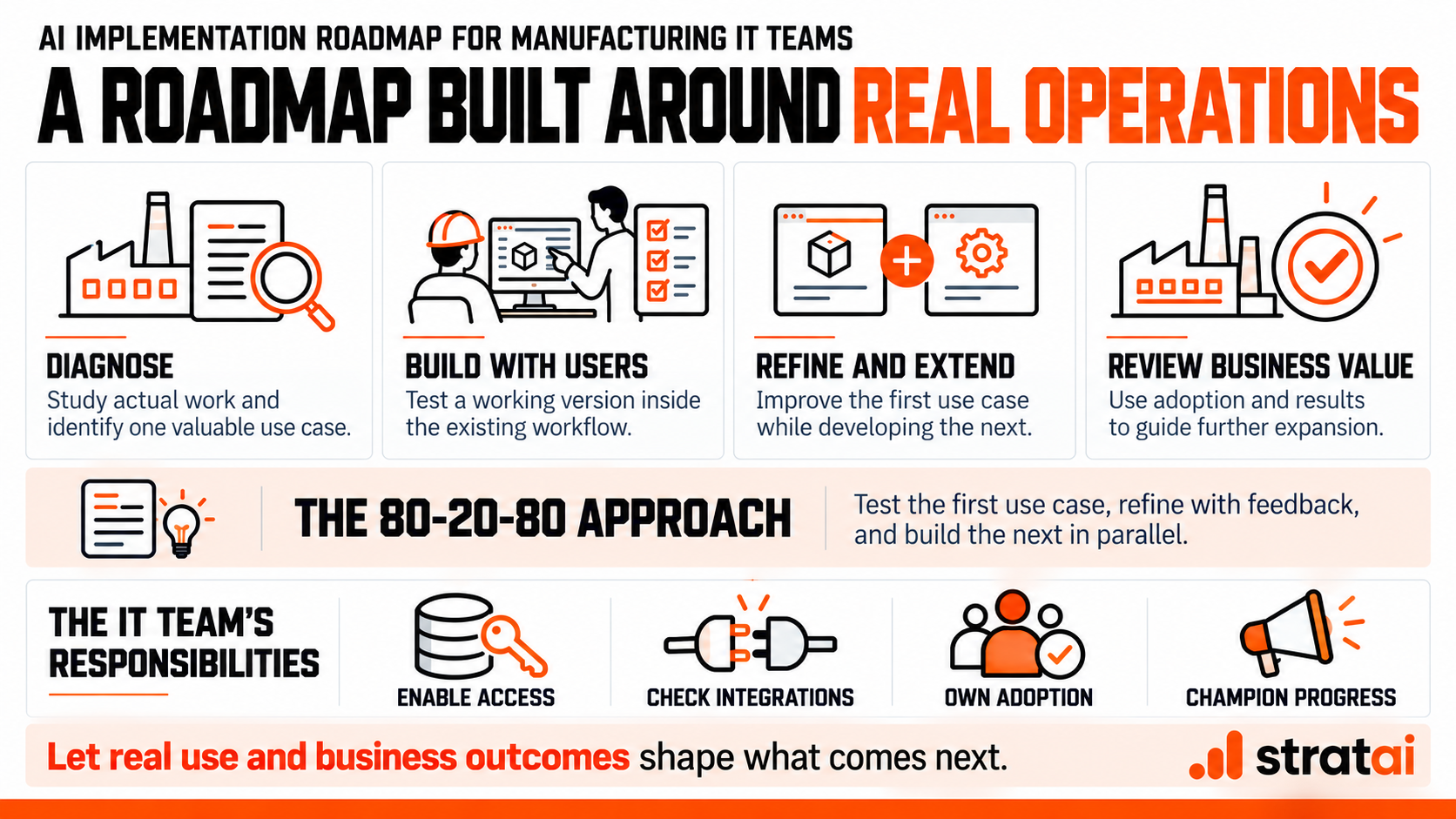
The 80-20-80 Model is the operational principle that governs how StratAI structures every AI implementation roadmap. The logic is simple: build Use Case 1 to 80% completion. Fine-tune toward 90-95%. Simultaneously begin Use Case 2 from 0%. Never wait for perfection in Use Case 1 before starting Use Case 2. Never work on Use Cases 1 and 2 from scratch at the same time.
The 20 in 80-20-80 is not a percentage — it is the principle of parallel progress. At any point in the roadmap, one use case is being refined and one is being built. The organisation is always moving. The partner is never idle. The IT team is never waiting.
Why 80% and not 100%?
A use case at 80% completion is functional, testable, and capable of generating real user feedback. The gap between 80% and 100% is almost never technical — it is discovered through actual use. The edge cases that matter, the variations in the process that were not in the design brief, the workflow changes that real adoption requires — none of these are visible until the system is in use. Building to 100% before user feedback is building a more polished version of the wrong thing.
The Roadmap That Actually Works — Month by Month
This is not a generic framework. It is the structure of every successful StratAI engagement, adapted from what has worked across textile, jewellery, furnishings, commodity processing, and component manufacturing operations in India.
| Phase | Timing | What Happens | IT Manager's Role |
|---|---|---|---|
| Month 1 | Diagnostic | Study the actual processes. Map data sources — ERP, document server, email. Identify the first high-value use case connected to a P&L line. No build yet. | Provide access to relevant teams and systems. Be present during process walkthroughs. This month's output is a use case recommendation — not a scope document. |
| Month 2–3 | Build V1 (80%) | Build the first use case to 80% completion. Get it in front of real users. Gather feedback from the people whose work it changes, not from management. | Facilitate user access for testing. Flag integration points early. A system that integrates cleanly with existing ERP is better than one that is technically superior but requires a parallel stack. |
| Month 3–4 | Fine-tune + start Use Case 2 | Use the feedback from V1 to refine toward 90-95%. Simultaneously begin building Use Case 2 from 0%. This is the 80-20-80 Model in action — never idle, never serial. | Ensure Use Case 1 is embedded in the team's actual workflow before Use Case 2 reaches them. Adoption is an IT function, not just a training function. |
| Month 4–5 | Early P&L signals | The first measurable signals appear. Not full ROI — directional confirmation that the use case is moving the right metric. | Track and document the signals. The business case for continuing and expanding is built on these early numbers, not on the original proposal. |
| Month 5+ | Compound | The relationship deepens. Higher-value use cases — invisible in month one — become visible from accumulated context. Scope expands based on demonstrated results, not projected ones. | Champion the engagement internally. The IT Manager who helped StratAI navigate the organisation in month one becomes the internal authority on AI implementation by month six. |
Nearly two-thirds of organisations remain stuck in the pilot stage — having not begun scaling AI despite years of experimentation.
The pilot-to-production gap is not a technology problem. It is a sequencing problem. Organisations that pilot one use case, wait for it to reach 100% before starting the next, and treat each use case as a discrete project accumulate pilots without ever building a compounding capability. The 80-20-80 Model directly addresses this by making parallel progress structural.
Source: McKinsey State of AI Report, 2025 via bosio.digital
What a Roadmap That Compounds Looks Like — Two Real Cases
B-Arm — 4x Scope Expansion by Month 5
The engagement with B-Arm (Bharath Ram, Founder) began with a defined first use case. By month five, the scope had expanded to four times the original — not through a change request process, but through demonstrated results that earned the confidence to invest further. Each use case that worked made the case for the next one. The roadmap was not fixed in month one. It was earned in months two through four. More detail on how these engagements unfold is in our case studies.
This is what compounding context produces. The partner who understands the business more deeply in month five than in month one sees use cases that were invisible at the start. The IT Manager who facilitated that understanding becomes the internal champion for capabilities that nobody knew were possible when the engagement began.
Listed Cotton Manufacturer — When the Roadmap Pivots to Outbound
A listed cotton value-added product manufacturer — one of the world's two largest in its category — began an AI engagement focused on procurement intelligence and data connectivity. By month five, the accumulated context of the business had revealed a second major opportunity: AI-powered outbound marketing for their B2B sales pipeline. The VP of Marketing was sceptical. The system was deployed in five days. Within two weeks it had generated six confirmed appointments in Indonesia.
That use case was not in the original roadmap. It could not have been — it required the partner to understand the commercial model, the existing tools (Sino-IMEX export-import intelligence, Apollo), and the VP's specific challenge (meetings in Indonesia) to design something that worked. A fixed-scope project plan had no mechanism to surface or activate it.
FIELD DATA · 4x Scope Expansion by Month 5 (B-Arm) · 6 Indonesia Appointments in 2 Weeks (Listed Cotton Manufacturer)
Both outcomes emerged from the same structural condition: a retainer engagement where accumulated context was free to find the next use case without requiring a new proposal, a new negotiation, or a new project initiation. The roadmap compounded because the engagement model allowed it to.
What the IT Head's Role Actually Is in a Working AI Roadmap
The IT Head's role in a successful AI implementation roadmap is not technical project management. It is a combination of four distinct functions — each one more important than the last.
- Access facilitator — The IT Head opens the doors that the AI partner cannot open alone. Access to the QC team. Access to the ERP tables. Access to the document server. Access to the people whose actual workflows the system must fit. Without this, the diagnostic month produces a surface-level understanding that leads to a surface-level use case.
- Integration reality checkpoint — The IT Head is the person who knows whether the ERP table the vendor wants to access actually has the data in the format described. Early flagging of integration complexity prevents the scope cuts that destroy the business case.
- Adoption owner — A system that the relevant team actually uses is the IT Head's responsibility, not the vendor's. Training is one component. The more important component is ensuring the system fits into the actual workflow rather than sitting beside it as an additional step.
- Internal champion over time — The IT Head who helped StratAI navigate the organisation in month one becomes, by month six, the person in the organisation who understands AI implementation most deeply. That understanding is compounding institutional capital. It makes every subsequent use case faster to scope, faster to build, and faster to adopt.
The IT Head who starts this process becomes the person who understands AI most deeply by month six — a different career outcome than managing a vendor project.
We start with a free half-day plant audit — then build your AI implementation roadmap from the ground up.
→ Book your audit — no commitment, no strings
No fixed scope. No project handover. A roadmap that evolves with your operation. We confirm your audit date within one business day.
Frequently Asked Questions
What should a realistic AI implementation roadmap include for a manufacturing IT team?
A realistic AI implementation roadmap has five components: a diagnostic month (study the actual operation before scoping anything), a first use case built to 80% with real user feedback incorporated before refinement, a second use case starting in parallel once the first reaches 80%, a six-month horizon for first P&L impact, and a retainer engagement model that allows the roadmap to evolve with the business. It does not include fixed scope documents written in week two, handover dates, or use cases selected before the diagnostic is complete.
How long does a manufacturing AI implementation actually take to show results?
The minimum realistic timeline is six months. Month one is the diagnostic. Months two and three are the first use case built to 80%. Months three and four are refinement plus the start of Use Case 2. Month four and five produce the first measurable P&L signals. Month six onwards is where impact becomes visible and the roadmap begins to compound. Vendors who promise results in eight weeks are either measuring activity rather than impact or deploying use cases too shallow to create real change.
How should an IT Head evaluate AI implementation vendors for manufacturing?
Three questions that reveal more than any RFP: Do they understand your manufacturing business model — not AI in general, your specific business? Can they name the P&L line the first use case will move, by how much, and by when? Is their engagement model a retainer or a project? A vendor who cannot answer the first question will build the wrong thing. A vendor who cannot answer the second is not accountable to your outcomes. A vendor who proposes a project model is proposing a structure that statistically fails in manufacturing AI engagements. If you want a straightforward gut-check on your own shortlist, get in touch and we'll give you a candid read.
What is the 80-20-80 Model and why does it matter for an AI implementation roadmap?
The 80-20-80 Model is a pacing framework: build Use Case 1 to 80%, fine-tune toward 90-95%, and simultaneously build Use Case 2 from 0%. Never wait for perfection before starting the next use case. Never build two use cases from scratch simultaneously. The model prevents the two most common roadmap failure modes: the pilot that sits at 100% but is never extended, and the organisation overwhelmed by parallel deployments that are all 40% complete. Sequential depth produces adoption. Adoption produces P&L impact.
Why do most AI implementation roadmaps in manufacturing stall between pilot and production?
The pilot-to-production gap has three consistent causes: scope that was fixed before the integration complexity was understood, an engagement model that makes scope evolution commercially painful, and premature scaling before the use case has earned the organisation's trust at the team level. The organisations that close this gap consistently are the ones with a retainer engagement model, a partner with genuine manufacturing domain depth, and an IT Head who owns adoption rather than delegating it to end-user training.
About StratAI
StratAI builds AI Advantage Systems for mid-market manufacturing companies across India. Official Registered Claude Partner and Anthropic Partner. Every engagement begins with a free half-day plant audit. No fixed scope. No project handover date. A roadmap that earns the right to expand.
12+ retainer clients · 90%+ retention · stratai.io/contact · palani@stratai.io · +91 99402 25924
“Speed is the enemy of AI ROI. The roadmap that compounds is the one that earns the right to expand.” — StratAI