OVERVIEW
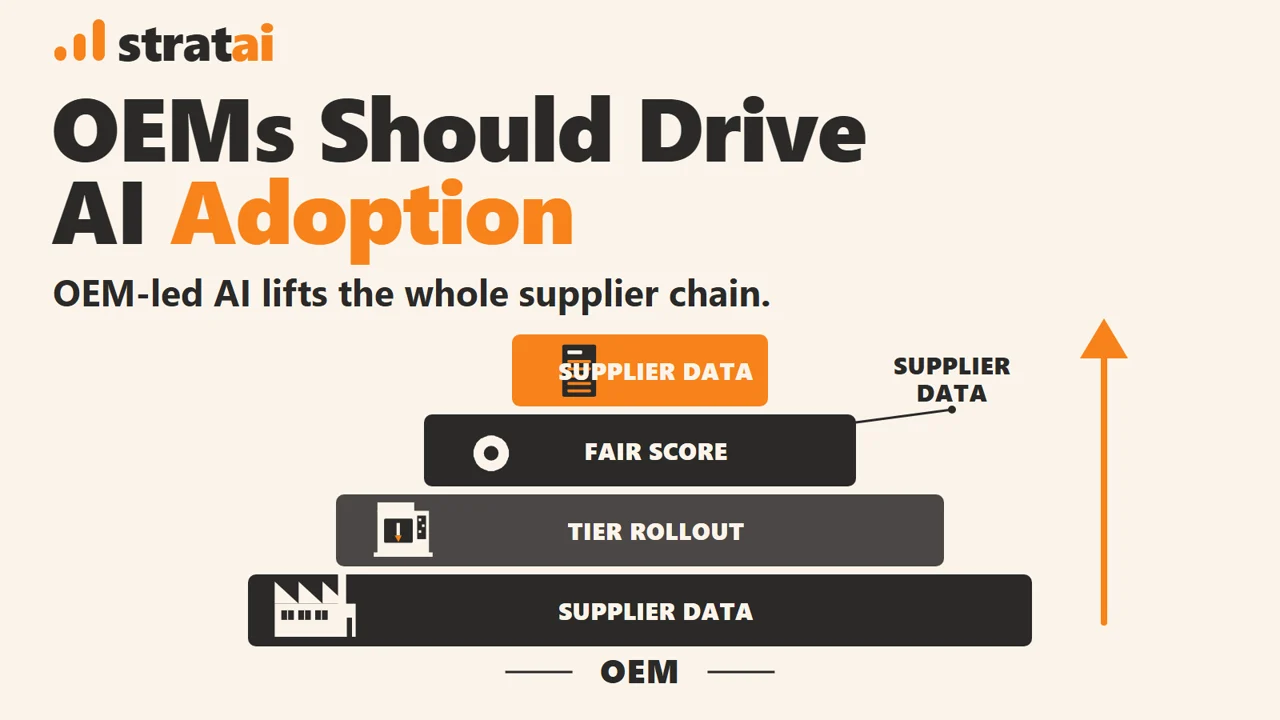
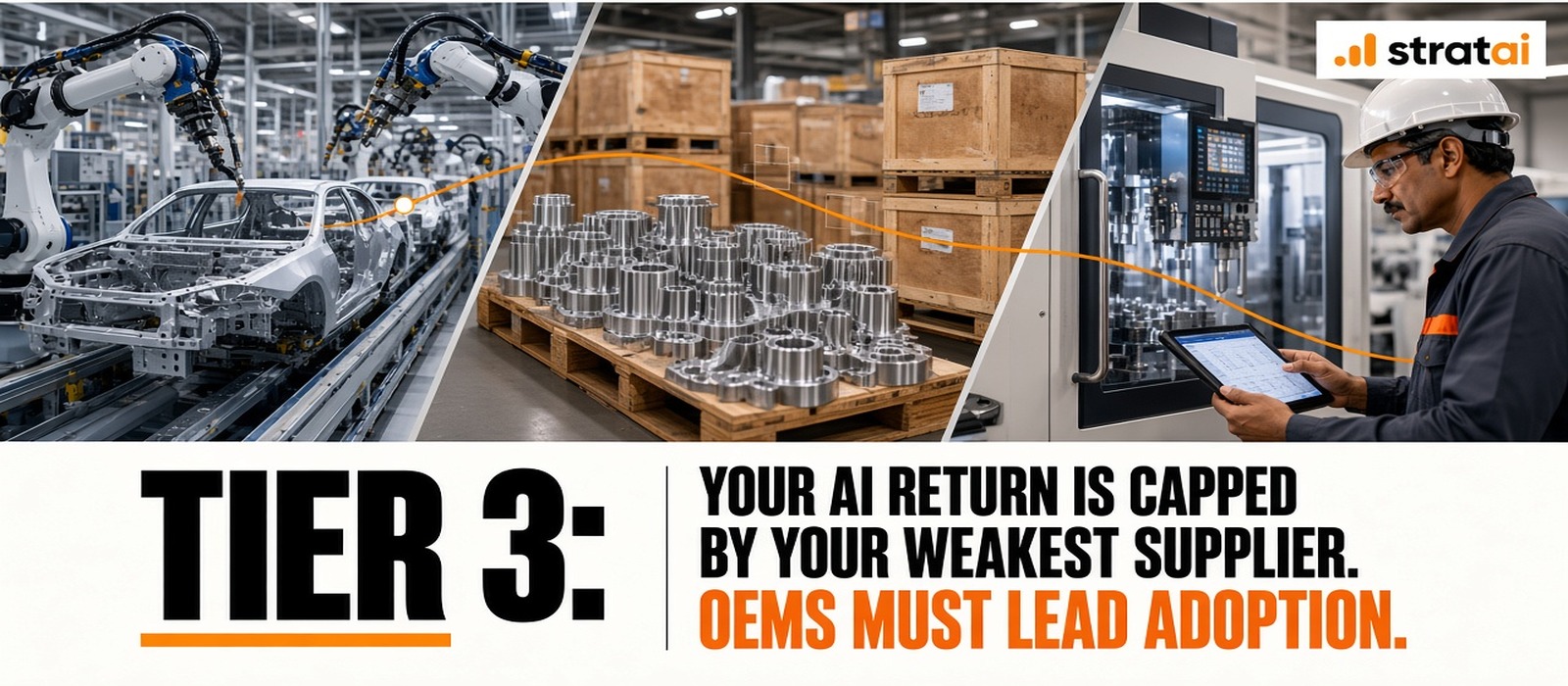
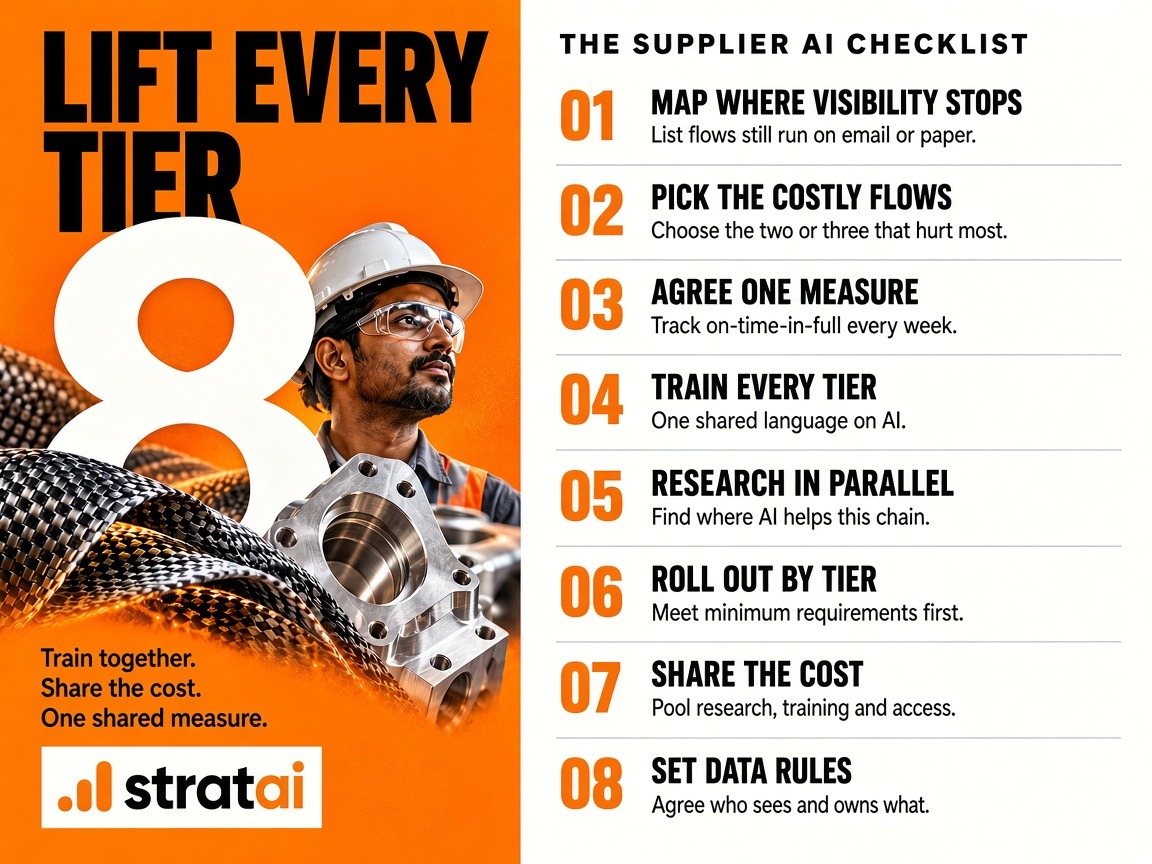
AI in manufacturing is capped by its weakest tier, so OEMs should drive AI adoption across Tier 1, 2 and 3 suppliers. Smaller suppliers rarely have the capability, capital or knowledge to handle AI's security, token cost and accuracy challenges alone, and Eurostat data show large enterprises use AI far more often than small ones. The blog sets out the Train, Research, Roll Out method, evidence from earlier OEM-led supplier programmes at Toyota and Honda, how to drive adoption without squeezing suppliers, and the demand-side case for starting now.
<aside class="direct-answer"><p><strong>Direct answer: Why should OEMs drive AI adoption across their supply chain?</strong></p><p>AI in manufacturing is capped by its weakest tier, so OEMs should drive AI adoption across Tier 1, 2 and 3 suppliers. Tier 2 and 3 firms rarely have the capability, capital or knowledge to handle AI's security, token cost and accuracy challenges alone. The method is Train, Research, Roll Out: the OEM trains suppliers on a standard cadence, researches how AI improves the whole chain, then rolls out by tier. Earlier OEM-led programmes at Toyota and Honda cut supplier defects and lifted productivity. It works best when suppliers share the gains.</p></aside><p>Picture how a schedule change travels through a supply chain today. It leaves the OEM as an email. A person at Tier 1 reads it and passes it on. Then Tier 2. Then Tier 3. Each handoff waits for a human.</p><p>For decades the chain has worked this way: human to human, over email. Feedback is slow. Status sits in inboxes.</p><p>AI agents are now entering that loop. Feedback can get faster and visibility can improve across the whole chain, not just inside one plant.</p><p>That is a large opportunity for AI in manufacturing, and a hard challenge. The firms best placed to seize it are the OEMs. The firms least able to do it alone are Tier 2 and Tier 3. This blog explains why OEMs should drive AI adoption down the tiers, and how.</p><h2>What Changes: From Email Between People to Agents in the Loop</h2><p>In the email era, every handoff depends on a person finding the message, understanding it and acting. AI agents change that. They can read, check and pass information on continuously, and they depend on <a href="https://stratai.io/blog/manufacturing-data-strategy-capture-convert-compound">data captured at the source</a>. Two things improve across the chain: the speed of feedback and the visibility of status.</p><p>The table shows a few flows where this matters. These are illustrations of where speed and visibility count, not findings from a study.</p><table><thead><tr><th scope="col">Flow</th><th scope="col">Today</th><th scope="col">With agents in the loop</th></tr></thead><tbody><tr><td><strong>Forecasts and orders</strong></td><td>Sent as files and emails, reconciled by hand.</td><td>Shared and checked continuously, with differences flagged at once.</td></tr><tr><td><strong>Schedule changes</strong></td><td>Passed by phone and email, tier by tier.</td><td>Reaches every affected tier together, with the impact shown.</td></tr><tr><td><strong>Quality issues</strong></td><td>Found at the OEM and traced back by calls.</td><td>Traced to the source tier quickly, with evidence attached.</td></tr><tr><td><strong>Shipment status</strong></td><td>Asked for, then answered.</td><td>Visible without asking.</td></tr></tbody></table><p>Both gains depend on every tier taking part. An agent that talks to a supplier who still works on paper has nobody to talk to. The wider case for this kind of shift is in <a href="https://stratai.io/blog/ai-consulting-services-decision-making-manufacturing">better decisions at every decision point</a>.</p><h2>The Opportunity and the Challenge</h2><p>The opportunity is large. AI can unlock a great deal of productivity across a chain, and the speed of feedback and visibility are where it starts.</p><p>The challenge is just as real. Three aspects stand out, and each is changing quickly.</p><table><thead><tr><th scope="col">Challenge</th><th scope="col">Why Tier 2 and Tier 3 struggle</th><th scope="col">Why the OEM cares</th></tr></thead><tbody><tr><td><strong>Security</strong></td><td>Connecting systems to AI tools opens new routes for data to leak. A small firm rarely has a security team.</td><td>A weak supplier system is a door into the OEM's own data and operations.</td></tr><tr><td><strong>Token cost</strong></td><td>AI tools charge by usage. A thin-margin firm carries an unpredictable cost line.</td><td>If suppliers cannot afford the tools, the OEM's agents have nobody to work with.</td></tr><tr><td><strong>Accuracy</strong></td><td>AI can be wrong, and checking it takes skill and time.</td><td>An error that enters at Tier 3 travels up the chain to the OEM.</td></tr></tbody></table><p>Tier 2 and Tier 3 suppliers are usually smaller than the OEM and its Tier 1 suppliers, and the data on firm size shows how unevenly AI use is spread.</p><aside class="stat"><p><strong>In 2025, 55% of large EU enterprises used AI, against 30% of medium-sized firms and 17% of small ones.</strong></p><p>Eurostat counts any AI use by EU enterprises with 10 or more employees, not only AI in production, and it measures firm size, not tier. Tier 2 and Tier 3 suppliers are usually smaller firms, so we read it as a proxy. It is EU data and does not cover India or the automotive tiers specifically. Even so, the pattern is consistent: the smaller the firm, the less likely it has started.</p><p><em>Source: </em><a href="https://ec.europa.eu/eurostat/statistics-explained/index.php/Use_of_artificial_intelligence_in_enterprises"><em>Eurostat, Use of artificial intelligence in enterprises, Statistics Explained (data extracted December 2025)</em></a></p></aside><p>In our view, most Tier 2 and Tier 3 firms lack the capability, the capital or the knowledge to handle all three of the challenges above, and the ground moves faster than a small team can follow. That is the gap an OEM can close.</p><h2>Why AI in Manufacturing Needs the OEM to Lead: The Weakest-Tier Ceiling</h2><p>A supply chain gets value from AI only as far as its data and decisions can flow. We call this the weakest-tier ceiling: an OEM's return from AI is capped by the weakest tier it depends on.</p><p><em>Figure 1: The weakest-tier ceiling. Conceptual diagram, illustrative and not measured.</em></p><p>Where data stops, AI stops. A Tier 3 that plans on paper and re-types orders slows every tier above it, and an OEM's own AI sees only part of its chain. The OEM carries the delays and defects that arrive from below.</p><p>The OEM also has what the tiers lack: scale, leverage and the largest stake. And there is a second reason to act at chain level. Cost and risk are lower than at single-company level, because the research and training are carried once. Capability and relevance are higher, because one firm's output is the next firm's input, so what one tier learns helps the others.</p><h3>OEMs have done this before</h3><p>Toyota and Honda built supplier development into how they run their chains. The results, from peer-reviewed and published studies, are below. Read them with care: they are decades old and concern lean and quality, not AI.</p><table><thead><tr><th scope="col">Programme</th><th scope="col">What the OEM did</th><th scope="col">Result</th><th scope="col">Read with care</th></tr></thead><tbody><tr><td><strong>Toyota supplier network</strong></td><td>Built a knowledge-sharing network with rules for participation, treating production knowledge as the network's property (Dyer and Nobeoka, 2000).</td><td>US suppliers cut defects by 50% for Toyota against 26% for their largest US customer, 1990 to 1996 (Dyer and Hatch, 2006).</td><td>Past data. Lean and quality, not AI.</td></tr><tr><td><strong>Honda BP programme</strong></td><td>Joint teams worked on narrowly targeted projects inside supplier plants (MacDuffie and Helper, 1997).</td><td>Suppliers averaged 50% productivity gains on the lines reengineered in 1994.</td><td>Lessons often did not spread beyond the line that was improved.</td></tr><tr><td><strong>Toyota supplier association</strong></td><td>A supplier association that supports information sharing and mutual learning.</td><td>A study found that joining raised a supplier's share of business with Toyota (Gerpisa).</td><td>An association study, not a controlled trial.</td></tr><tr><td><strong>Catena-X</strong></td><td>Automotive companies built a shared data standard and network.</td><td>1,069 OEMs and suppliers were exchanging data by September 2026 (Automotive Logistics).</td><td>About data standards, not AI. Reaching smaller suppliers is the harder task.</td></tr></tbody></table><p><strong>Sources: </strong><a href="https://scholarsarchive.byu.edu/facpub/9798/">Dyer and Hatch (2006)</a>; <a href="https://scholarsarchive.byu.edu/facpub/9233">Dyer and Nobeoka (2000)</a>; <a href="https://cmr.berkeley.edu/1997/08/39-4-creating-lean-suppliers-diffusing-lean-production-throughout-the-supply-chain">MacDuffie and Helper (1997)</a>; <a href="https://www.gerpisa.org/node/6015">Gerpisa study of Toyota's supplier association</a>; <a href="https://www.automotivelogistics.media/supply-chain/more-thannbsp1000-oems-and-suppliers-now-exchanging-data-through-catena-x-network/2746686">Automotive Logistics on Catena-X, September 2026</a>; <a href="https://www.cofinity-x.com/blog/data-space-accelerator-helps-smes-join-catena-x-with-up-to-eu30-000">Cofinity-X Data Space Accelerator</a>; <a href="https://scm.ncsu.edu/scm-articles/article/performance-measurements-and-metrics-developing-collaborative-supplier-partnerships">NC State Supply Chain Resource Cooperative on Honda</a>.</p><aside class="stat"><p><strong>US suppliers cut defects by 50% for Toyota between 1990 and 1996, against 26% for their largest US customer.</strong></p><p>Same suppliers, different customers. The gap came from how much knowledge each customer shared and how it was organised. It is the strongest evidence we found that an OEM's structure for sharing capability moves supplier performance. It is an analogy for AI, not proof. We found no comparable AI programme with published results.</p><p><em>Source: </em><a href="https://scholarsarchive.byu.edu/facpub/9798/"><em>Dyer and Hatch, Strategic Management Journal 27(8), 2006</em></a></p></aside><h2>How: Train, Research, Roll Out</h2><p>The method has three parts, and the order matters. We call it Train, Research, Roll Out.</p><section class="step"><h3>01 — Train</h3><p>Start with all-encompassing training sessions from manufacturing AI experts, open to every tier. The aim is a common language: what AI can and cannot do, where the risks are and what good looks like. Run the sessions on a standard cadence. A standing rhythm keeps interest and traction alive in a way that a one-off event cannot. Toyota's network runs on institutionalised routines, not occasional events.</p></section><section class="step"><h3>02 — Research</h3><p>In parallel, the OEM runs its own research, with consulting support, on how AI can make this particular supply chain more efficient. Parallel matters. Training without research teaches suppliers general tools. Research without training produces answers nobody can use. When the OEM owns the research, suppliers do not each rediscover it, and the cost is carried once.</p></section><section class="step"><h3>03 — Roll Out</h3><p>Then roll out downstream by tier, by the value expected and by each firm's capability. Capabilities are tiered, and bare minimum requirements are fixed for each tier so that nobody is asked to run before they can walk. How to set the tiers and what the minimums should be is the subject of our next post.</p></section><p>The cadence is what holds the three together. Honda found that suppliers varied widely in how far they carried the lessons beyond the line that was improved, and that suppliers became self-sufficient more often when they had a moderate degree of dependency on the customer, neither too high nor too low. Regular, hands-on follow-through is how an OEM builds capability that lasts.</p><h2>Driving Without Squeezing: The Fair Version</h2><p>Driving adoption can also mean pushing cost and risk downstream. That would defeat the purpose. Three design rules keep it fair.</p><table><thead><tr><th scope="col">Rule</th><th scope="col">What it looks like</th><th scope="col">Precedent</th></tr></thead><tbody><tr><td><strong>Share the cost</strong></td><td>The OEM carries research, training and pooled access, so a thin-margin supplier does not bear usage costs alone.</td><td>Honda is reported to split project savings 50/50 with suppliers (NC State). A Cofinity-X accelerator offers up to EUR 30,000 to help smaller firms join Catena-X.</td></tr><tr><td><strong>Set clear data boundaries</strong></td><td>Agree what data is shared, who sees it and who owns the models. Use supplier data only for the agreed purpose.</td><td>Catena-X is built around secure, sovereign and standardised data exchange.</td></tr><tr><td><strong>Build capability, not compliance</strong></td><td>Support suppliers hands-on until they can run the system. Do not hand them a checklist.</td><td>Honda's BP teams worked inside supplier plants.</td></tr></tbody></table><p>Some will argue that suppliers should fund their own AI, that mandates breed box-ticking, or that a supplier serving several OEMs will face several competing programmes. Those points have force. The last argues for shared standards across OEMs, which is the Catena-X approach. And any programme only works if supplier teams trust it and use it, which is <a href="https://stratai.io/blog/ai-consulting-services-culture-manufacturing">the culture that makes the system get used</a>.</p><h2>The Demand-Side Case for Starting Now</h2><p>There is a second reason to start, and it concerns demand, not capability. It is a scenario, not a forecast, and we present it as one.</p><p>An AI transition brings job displacement and the cost of reskilling. If household incomes and confidence are squeezed during that period, spending on discretionary goods can fall. Cars are largely discretionary, because a purchase can be put off. If demand softens, price becomes the lever. An OEM can hold a lower price and keep the industry in equilibrium only if the cost of the whole chain comes down. AI across the tiers is one of the few ways to do that without squeezing supplier margins.</p><aside class="stat"><p><strong>US light vehicle sales fell from 16.1 million in 2007 to 10.4 million in 2009, the largest drop in 40 years.</strong></p><p>That fall came from a financial crisis, with rising unemployment and tight credit (Chicago Fed, 2012), not from AI. It shows how sharply car demand can react to income and credit shocks. It is evidence of the mechanism, not a forecast of what AI will do.</p><p><em>Source: </em><a href="https://www.energy.gov/node/803376"><em>US Department of Energy, Light Vehicle Sales 1970 to 2010 (WardsAuto data), accessed November 2026</em></a></p></aside><p>Estimates of AI's effect on work differ. An IMF analysis of January 2024 found that about 40% of jobs worldwide are exposed to AI, around 60% in advanced economies, and judged that roughly half of the exposed jobs could benefit. It also said AI would likely worsen inequality in most scenarios. The World Economic Forum's Future of Jobs Report 2025 projects a net gain of 78 million jobs by 2030. Exposure is not job loss, and we found no credible forecast of a sharp fall in car demand from AI. Both outcomes are possible.</p><p>The argument for preparing does not need a prediction. A supply chain with lower cost, faster feedback and suppliers able to run AI themselves is more resilient whichever way demand goes. It is better to build that before it is tested.</p><p>Sources: IMF analysis (14 January 2024) as reported by <a href="https://siliconrepublic.com/careers/imf-ai-report-future-of-work">Silicon Republic</a>; <a href="https://www.weforum.org/press/2025/01/future-of-jobs-report-2025-78-million-new-job-opportunities-by-2030-but-urgent-upskilling-needed-to-prepare-workforces/">World Economic Forum</a>, January 2025.</p><h2>Where an OEM Leader Can Start</h2><p>You do not need a full programme to begin. Four steps come first.</p><table><thead><tr><th scope="col">Step</th><th scope="col">Action</th></tr></thead><tbody><tr><td><strong>1</strong></td><td>Map where visibility stops: list the flows still run on email, phone or paper between you and each tier.</td></tr><tr><td><strong>2</strong></td><td>Pick the two or three flows where delay or defects from lower tiers cost you most, and agree one shared measure, such as on-time-in-full.</td></tr><tr><td><strong>3</strong></td><td>Convene a first training session with a small cohort of suppliers from across the tiers, led by manufacturing AI experts.</td></tr><tr><td><strong>4</strong></td><td>Set the cadence, and the cost-sharing and data rules, before the second session.</td></tr></tbody></table><p>On-time-in-full is the measure we recommend tracking weekly, and we explain why in <a href="https://stratai.io/blog/ai-in-manufacturing-production-planning-reimagined-with-ai">production planning reimagined with AI</a>.</p><p>If you are weighing a supplier AI programme, the cheapest first step is a pilot with a small cohort of suppliers across the tiers.</p><aside class="cta"><p><strong>A supplier AI programme starts small: one cohort, one cadence, one shared measure.</strong></p><p><a href="https://stratai.io/contact"><strong>-&gt; Talk to us about a supplier AI pilot -&gt; stratai.io/contact</strong></a></p><p>We start with a conversation about which suppliers, which flows and which risks, not a project.</p></aside><h2>Frequently Asked Questions</h2><h3>Why should OEMs drive AI in manufacturing across their supplier tiers?</h3><p>AI in manufacturing is capped by its weakest tier, because AI adds value only where data and decisions can flow. Tier 2 and Tier 3 firms usually lack the capability, capital and knowledge to handle AI's security, token cost and accuracy challenges alone. Eurostat data show large EU enterprises used AI about three times as often as small ones in 2025. The OEM has the scale, the leverage and the largest stake, and can carry research and training once for the whole chain.</p><h3>How should an OEM start a supplier AI programme?</h3><p>Start with training sessions from manufacturing AI experts, open to every tier, so everyone shares one language. Run the OEM's own research in parallel on how AI can make this supply chain more efficient. Hold both on a standard cadence, so interest and traction continue. Then roll out downstream by tier, by expected value and by each firm's capability, with bare minimum requirements to be met before moving on.</p><h3>What are the main challenges of AI for Tier 2 and Tier 3 suppliers?</h3><p>Three stand out: security, token cost and accuracy. Connecting systems to AI tools opens new routes for data to leak, and small firms rarely have a security team. Tools charge by usage, which is hard to budget on thin margins. AI can be wrong, and checking it takes skill and time. All three are changing quickly, faster than a small team can track alone.</p><h3>Has OEM-led supplier development worked before?</h3><p>Yes, in lean and quality, though not yet for AI. A peer-reviewed study found that US suppliers cut defects by 50% for Toyota between 1990 and 1996, against 26% for their largest US customer. Honda's BP programme reported average productivity gains of 50% on the lines it reengineered in 1994. Both are older programmes about lean, so they are an analogy for AI, not proof.</p><h3>How can an OEM drive adoption without squeezing suppliers?</h3><p>Share the cost, set clear data boundaries and build capability, not compliance. The OEM carries research, training and pooled access so a thin-margin supplier does not bear usage costs alone. Agree what data is shared, who sees it and who owns the models. Support suppliers hands-on until they can run the system. Honda's reported 50/50 split of project savings and Catena-X's support for smaller firms are precedents.</p><h3>Could AI reduce demand for vehicles?</h3><p>It is a scenario, not a forecast. If the AI transition squeezes household incomes, discretionary spending such as car purchases can fall, as it did when US vehicle sales dropped from 16.1 million in 2007 to 10.4 million in 2009. The IMF estimates about 40% of jobs worldwide are exposed to AI, and the World Economic Forum projects a net gain in jobs. Exposure is not job loss, so the argument is to prepare.</p><p><strong>About StratAI</strong></p><p>StratAI helps mid-market manufacturing firms in India build AI Advantage Systems that show up in the P&amp;L, not just in dashboards. We work as an embedded partner, not a project vendor. Official Registered Claude Partner and Anthropic Partner.</p><p><a href="https://stratai.io/contact">stratai.io/contact</a> | palani@stratai.io | +91 99402 25924</p><blockquote><p><em>"A supply chain gets value from AI only as far as its weakest tier can take it. The OEM is the one firm placed to lift all the tiers together."</em></p><footer><strong>Palaniappan SN, Co-Founder, StratAI</strong></footer></blockquote>