AI Shop Floor Integration: Why the Value Is There — And Why Most CEOs Never Unlock It
73% of manufacturers still run outdated QC — and production planning often lives only in the manager's head. Two shop floor AI use cases from 10+ live deployments — quality intelligence and production visibility — and why contextual depth determines whether AI compounds into an advantage or stalls as a tactical win.

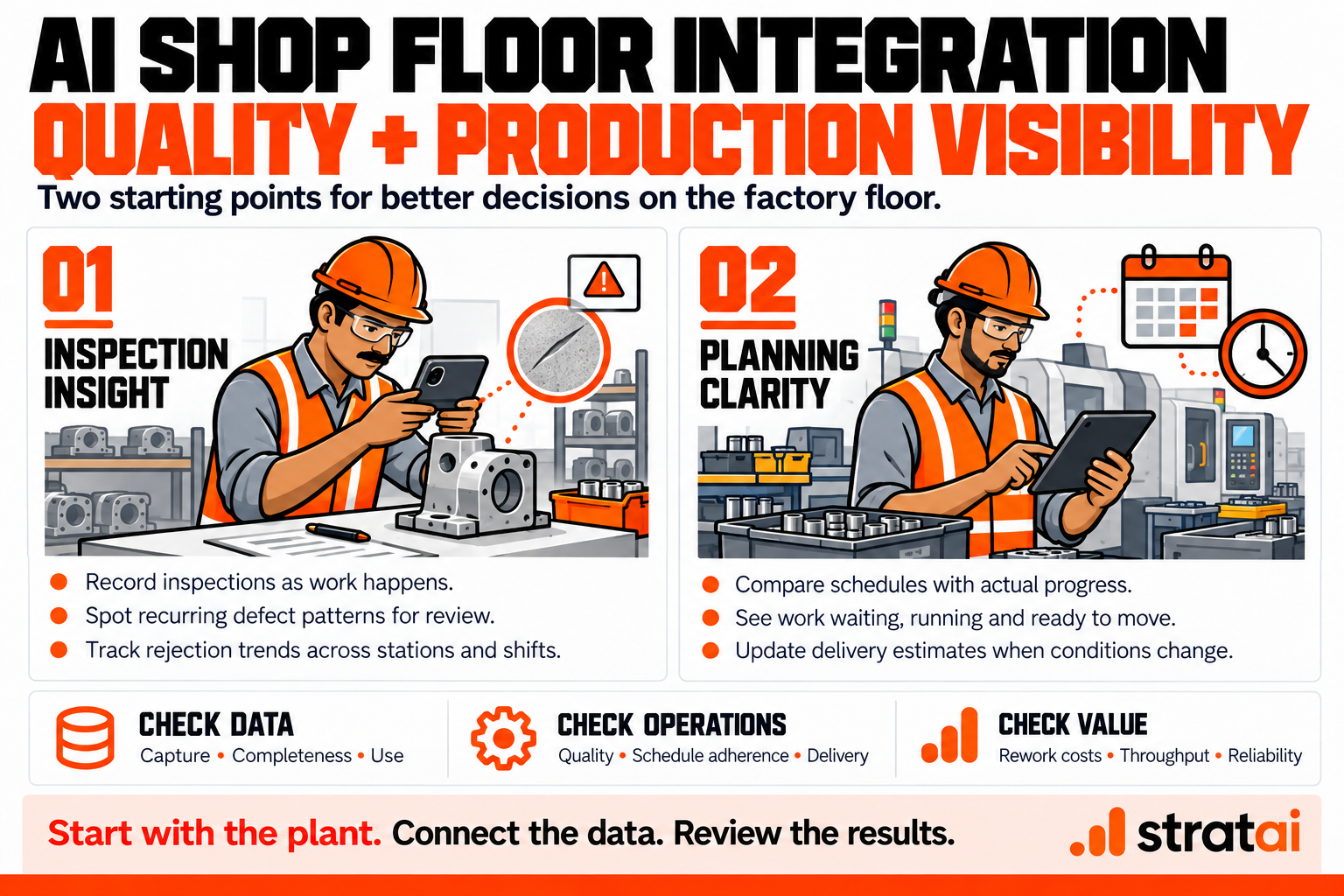
AI shop floor integration connects AI capability to a manufacturing plant's physical operations — quality control, production planning, machine data capture, and workflow coordination — closing the gap between when data is generated and when a decision can be made with it. The two highest-value entry points for most mid-market manufacturers are quality intelligence (mobile-first QC capture, AI defect root cause mapping, live rejection rate tracking) and production visibility (hyper-customised planning with real-time plan vs actuals). Both require deep contextual knowledge of the specific plant, typically built through a diagnostic engagement, before they can be built — which is why most CEOs who rush past that diagnostic step get only tactical wins instead of compounding value.
Every manufacturing CEO knows value is sitting on the shop floor. The data is generated every shift, every station, every machine cycle. The problem is not the data. The problem is that unlocking it requires something most CEOs cannot give the process — time. Time to go deep. Time for the right functional head to sit with the right partner long enough to understand what is actually happening on the floor. The CEOs who make that investment consistently unlock compounding value. The ones who do not get tactical wins and call it a day.
Direct answer: What is AI shop floor integration in manufacturing? AI shop floor integration is the connection of AI capability to the physical operations of a manufacturing plant — quality control, production planning, machine data, and workflow coordination — in a way that closes the gap between the moment data is generated and the moment a decision can be made with it. The two highest-value entry points are quality intelligence (mobile-first QC data capture, AI-powered defect root cause mapping, live rejection rate tracking) and production visibility (hyper-customised planning systems with real-time plan vs actuals, three-state inventory tracking, and AI diagnosis of production deviations). Both require deep contextual knowledge of the specific plant before they can be built. That depth takes time. The CEOs who give it that time are the ones whose shop floors compound in intelligence every month.
73% of manufacturers still rely on outdated quality control systems — costing over $2.5 billion annually in preventable defects. Manual QC costs 15–20% of revenue in rework, scrap, and inspection delays. The QC data exists in every one of these plants. The defect patterns are real and consistent. The root causes are identifiable. The cost is preventable. The gap is not analytical capability — it is the data entry lag and the absence of a system that connects what happens at the inspection station to a decision that reduces the next batch's rejection rate. Source: Optywise AI Analysis, 2025 via DEV Community
The Real Problem: Depth Takes Time — And Most CEOs Rush Past It
Shop floor AI is not a product you install. It is a system you build — on top of a deep understanding of this specific plant, this specific product mix, this specific team's working patterns, and this specific set of failure modes. The AI that works for a cotton spinning mill will not work for a jewellery manufacturer. The QC system that works for a component manufacturer will not work for a garment factory. Context is everything.
What happens when that context is skipped:
Rush through: Scope built on surface-level understanding. Use case solves an adjacent problem — not the core one. Tactical advantage. Competitor replicates it in six months. CEO asks: why didn't it become an advantage?
Build in silos: Different departments get different tools. QC has one AI. Planning has another. They don't connect. Data stays fragmented. Decisions stay disconnected. CEO asks: why is the shop floor still a black box?
The principle that separates compounding value from tactical wins: AI requires contextual depth. Depth requires time. The diagnostic month — the first month of any StratAI engagement — exists for exactly this reason. It is not delay. It is the investment that determines whether what gets built is a tactical tool or a strategic system. The CEOs who understand this give the process the time it needs. The ones who do not build something that works for three months and then gets abandoned.
The Two Highest-Value Shop Floor Use Cases
Most shop floor AI conversations begin with predictive maintenance or computer vision. Both are legitimate. Neither is where the highest value sits for most mid-market Indian manufacturers. The two use cases below are the ones that consistently surface after a genuine diagnostic engagement — and consistently produce the highest return relative to implementation cost.
Use Case 01 · AI-Powered Quality Intelligence
Mobile-first data capture · Defect root cause mapping · Live rejection rate tracking
QC in most manufacturing plants is a documentation function. The QC team approves or rejects. The rejection data goes into a report. Nobody mines the report. Nobody connects the pattern to the root cause. The CEO has accepted a rejection rate as the cost of doing business — 'just deliver defect-free products on time' — without ever asking why the rejection rate is what it is.
The data to answer that question is generated at every inspection station, every shift. It is simply never captured in a way that makes it usable.
The AI system:
→ Mobile app based on image capture — QC enters data at the moment of inspection, not on paper to be entered two days later by someone else
→ AI trained on defect types: machine-specific, product-specific, process-specific, worker-specific
→ Root cause mapping — AI connects defect pattern to cause automatically over time, surfacing what no manual analysis would identify across the volume of data
→ Live rejection rate tracking — not monthly reports, real-time visibility by line, by machine, by shift
→ Incentive layer — QCs rewarded for rejection rate reduction, not just documentation completeness
Why this is the highest-value shop floor use case for most mid-market manufacturers: the return is greatest where gross margins are thin and touch time associated with rework is high. A 1% reduction in rejection rate in a high-volume plant with thin margins can be worth more than any other single operational improvement.
Field observation · In our QC engagement across manufacturing clients: QC measurement time reduced from 3 minutes 45 seconds to 1 minute 45 seconds per piece after mobile-app based capture was implemented. Post-shift manual data entry eliminated entirely. The data that previously arrived two days late now arrives within the shift — at the moment when the next batch can still be adjusted.
Gartner projects over 65% of global manufacturers will adopt AI-based quality systems by 2026. A 1% defect rate in high-volume manufacturing causes millions in losses. The adoption curve is accelerating. The plants that build AI quality intelligence now will have 12-24 months of training data advantage over competitors who start later. AI quality systems improve with data — the longer they run on a specific plant's production patterns, the more precisely they identify root causes and predict failure modes. Starting later means starting from zero against a system that has been learning for two years. Source: Gartner 2026 via DEV Community
Use Case 02 · Hyper-Customised Production Planning Intelligence
Real-time plan vs actuals · Three-state inventory tracking · AI diagnosis of deviations
Production planning in most mid-market manufacturing plants lives in the production manager's head. Or in a spreadsheet that is already out of date. Or in a WhatsApp group where priority changes disappear into scroll history. The CEO has no real-time view of where any order actually is in the production sequence. Delivery commitments are made on estimates. The estimates are wrong more often than anyone wants to admit.
The AI system:
→ Process flow mapped for each product category — specific to this plant, not a generic template
→ Machine and line capacity per station — actual capacity, not nameplate capacity
→ Dual planning window: week ahead + tomorrow, updated continuously
→ Plan vs actuals tracked in real time — every deviation captured as it happens
→ Three inventory states tracked live: inventory waiting for station, inventory at station, inventory waiting for next station
→ Estimated delivery time updated automatically as actuals shift — the CEO sees a live number, not a commitment made three days ago
→ AI diagnosis of what happened — when the day's plan deviates from actuals, the AI surfaces the root cause pattern. Machine downtime? Material delay? Operator absence? The pattern emerges over time.
Why this unlocks compounding value: once AI is trained on the specific context of this plant — its products, its machines, its planning patterns, its typical deviation causes — the insights compound. The AI begins identifying utilisation improvement opportunities that no human planner would notice across the volume and complexity of data a production floor generates in a single week.
Field observation: The production planning system built for a consumer medical devices manufacturer resulted in a 4× scope expansion under the retainer — from a single use case to a comprehensive operations intelligence platform. The visibility that the planning system provided to management was the single factor that earned the trust to expand. For the first time, the CEO could answer 'where is that order?' without asking the production manager.
The Measurement Framework for Shop Floor AI
Shop floor AI use cases have a specific measurement challenge: the improvement compounds over time as the AI learns the plant's context. The metrics that matter in month two are different from the metrics that matter in month eight. Measuring too early produces false negatives. Measuring only at the end misses the leading indicators that tell you whether the system is on track.
Phase 1 — Data quality: Capture rate (% of inspections entered in real time vs on paper), data completeness, system uptime. Is the team actually using the app?
Phase 2 — Operational signals: Rejection rate trend by line, machine, shift. Production plan adherence %. Delivery estimate accuracy. Are the numbers moving in the right direction?
Phase 3 — P&L impact: Rejection rate reduction × rework cost. Delivery reliability improvement × customer retention. Utilisation improvement × throughput. This is where the financial case becomes visible.
The real value only materialises when AI is deployed at scale with precise, real-time operational context — most companies remain stuck at the prototype stage. The gap between prototype and production in shop floor AI is almost entirely explained by contextual depth. A prototype built on generic assumptions about how manufacturing plants operate will not survive contact with the specific reality of this plant's processes, team dynamics, and data patterns. The investment in getting that context right — the diagnostic depth — is the difference between a system that scales and a system that gets abandoned at prototype. Source: Howard Heppelmann, CEO OpsMate AI, Breaking the Bottleneck 2026
What the CEO's Role Actually Is
The CEO does not need to understand the technical architecture of the AI system. That is the implementation team's job. The CEO's role in shop floor AI integration is three things — and only these three things.
01 · Give the diagnostic process the time it deserves
A month of genuine engagement — where the right functional heads are available, where the shop floor is actually observed, where the real data is examined — is not overhead. It is the foundation. Every shortcut taken in the diagnostic phase produces a system that solves the wrong problem.
02 · Review the AI output in actual management meetings
When the CEO opens the production planning dashboard in the weekly operations review — not the Excel report, not the WhatsApp update, the AI dashboard — the signal it sends to every manager in that room is irreversible. The tool becomes mandatory without a mandate.
03 · Give the system time to learn
Shop floor AI compounds. A system that has been running on this plant's data for twelve months knows things about this plant's failure patterns that no human analyst could extract from the same data. The CEO who evaluates shop floor AI at month three and declares it underwhelming is evaluating a student two weeks into the semester.
Tell us what is happening on your shop floor that you cannot currently see. → Book your free half-day audit — no commitment, no strings. We spend the audit understanding your specific plant — not pitching generic AI. We identify the two or three use cases that will produce the highest return given your product mix, your margins, and your current data reality. We confirm your audit date within one business day.
Frequently Asked Questions
What is AI shop floor integration in manufacturing?
AI shop floor integration is the connection of AI capability to the physical operations of a manufacturing plant — quality control, production planning, machine data capture, and workflow coordination. It works by closing the gap between when data is generated on the shop floor and when a decision can be made with it. The two highest-value entry points for most mid-market manufacturers are quality intelligence (mobile-first QC capture, defect root cause mapping, live rejection rate tracking) and production visibility (hyper-customised planning with real-time plan vs actuals and AI deviation diagnosis). Both require deep contextual knowledge of the specific plant before they can be built.
Why does AI shop floor integration require so much diagnostic time?
Because the shop floor is the most context-specific part of any manufacturing business. The defect patterns in a cotton spinning mill are different from those in a jewellery plant. The production planning constraints in a component manufacturer are different from those in a garment factory. AI built on generic assumptions about manufacturing operations will not survive contact with the specific reality of this plant. The diagnostic investment — typically one month — is not overhead. It is what determines whether what gets built is a tactical tool or a system that produces compounding value over time.
What is the ROI of AI quality control in manufacturing?
The return depends on two variables: your current rejection rate and your rework cost per unit. For plants where gross margins are thin and touch time on rework is high, a 1% reduction in rejection rate can produce more financial impact than most other operational improvements combined. The AI system investment typically pays for itself within 4-6 months in these environments — through reduced scrap, reduced rework labour, and reduced material waste. The compounding effect — as the AI learns the specific defect patterns of this plant over 12-18 months — produces further improvement that accelerates rather than plateaus.
How does a production planning AI system work on the shop floor?
A hyper-customised production planning system maps the process flow for each product category, tracks actual machine and line capacity per station, and maintains a dual planning window — week ahead and tomorrow — updated continuously. It tracks three inventory states in real time: waiting for station, at station, waiting for next station. It compares plan to actuals continuously and surfaces the root cause of deviations — machine downtime, material delay, operator absence — automatically. The CEO outcome: a live screen that answers 'where is that order and when will it ship?' without asking the production manager.
How long before shop floor AI produces visible results?
Data quality improvements — the capture rate shift from paper-based to real-time mobile entry — appear within the first month of go-live. Operational signals — rejection rate trends, plan adherence, delivery estimate accuracy — appear within 3-6 months. P&L-level impact — measurable rejection rate reduction, delivery reliability improvement, utilisation gains — appears within 6-12 months for well-implemented systems. The system compounds: month 12 produces more insight than month 6, and month 18 produces more than month 12. The CEO who measures only at month 3 is measuring the wrong point on the learning curve.
About StratAI
StratAI helps manufacturing firms in India build AI Advantage Systems. 10+ live deployments across textile, jewellery, furnishings, commodity processing, and component manufacturing. Official Registered Claude Partner and Anthropic Partner.
stratai.io/contact · palani@stratai.io · +91 99402 25924
"The shop floor generates more intelligence than any other part of your business. The problem is not that the data does not exist. The problem is that nobody has closed the loop between the moment it is generated and the moment a decision can be made with it."
— Palaniappan SN, Co-Founder, StratAI
What is AI shop floor integration in manufacturing?+
Why does AI shop floor integration require diagnostic time before implementation?+
What is the ROI of AI quality control in manufacturing?+
How does a production planning AI system work on the shop floor?+
How long before shop floor AI produces visible results?+

Palaniappan SN is a Business Strategy Consultant who has spent his career at the intersection of business strategy and operational reality — working across management levels from the boardroom to the shop floor to understand where organisations actually win and lose. His conviction is simple: AI should never be an experiment. It should be an advantage. That belief is the foundation of StratAI's AI Advantage Systems methodology — built not from technology-first thinking, but from the ground up, with the discipline to walk away from projects where the conditions for success don't exist.