AI Transformation Will Simplify How Energy Becomes Value. Whether It Serves People Is a Choice.
AI transformation is changing the cost of turning energy into value. The current system, its gaps, how AI simplifies it, and how to make it serve people.
This essay explains AI transformation through a single idea: the energy-to-value equation. It defines value as the need actually and perceptibly met, maps where energy is spent today in approvals, re-entry and coordination that customers never perceive as value, shows how democratised, decentralised and integrated AI shrinks that middle while accountability, quality control and risk management stay, and sets out four choices leaders have for where freed energy goes.
Cook a meal and you can see the whole equation. Ingredients, gas and the effort of the cook go in. A meal comes out.
Trace any of those inputs back far enough and they are all energy. The sunlight that grew the vegetables. The fuel under the pan. The effort the cook spent at the stove. Every task you do, in a kitchen or in a factory, converts energy into something a person needs.
That is what AI transformation is changing at the most fundamental level. Not the tools, the dashboards or the models. The cost of converting energy into value.
In a plant, the energy is material, labour, power and machine time. The question is how much of it reaches the customer as value, and how much is spent on re-typing, waiting and chasing that the customer will never see.
In our initial diagnostic at a buying house in Tirupur, QC executives were spending 1.5 hours after every shift entering data. That is energy, and the buyer never perceives it as value.
This blog sets out the equation, the system we use to run it today, where that system wastes energy, how AI is likely to simplify it, and the question the simplification does not answer: who it will serve. The first four are largely engineering. The last is a choice.
The Equation: Energy In, Value Out
Energy is the ultimate input. In a plant it appears as raw material, labour, power, machine time and the attention of the people who run it. In a kitchen it is the ingredients, the gas and the cook. In a field it is sunlight.
Value is harder to define, and the definition matters. We define value as the actual and perceived need being met, as perceived by the person whose need it is.
Both words carry weight. Perceived need is what the receiver judges. Actual need is what they really require, and it often takes expertise to see. A customer may not know the right specification. A patient may not know the right treatment. The two combine into what we call the four cases of value.
| Perceived need met | Perceived need not met | |
|---|---|---|
| Actual need met | Real value. The receiver gets what they need and knows it. | Hidden value. Preventive quality that nobody notices. |
| Actual need not met | False comfort. A polished report that changes no decision. | Pure waste. |
The efficiency of any system is how much need is met per unit of energy spent. Money is a proxy for that value, and an imperfect one. Energy that never reaches the receiver, whether as an actual need met or a perceived one, is waste. Waiting, re-entry and rework are the usual forms.
The Current System, and What It Gets Right
In a manufacturing business, a customer's need rarely meets the energy that serves it directly. It passes through layers: sales, planning, procurement, approvals, reporting and coordination. Each layer exists for a reason. Information cannot flow cheaply, so people carry it. Trust is hard to establish, so we add checks.
The system also protects things worth protecting, and any honest account of it has to say so.
| What it protects | Why it matters |
|---|---|
| Accountability | Someone owns each decision and its outcome, so mistakes can be traced and learned from. |
| Quality control | Defects are caught before they reach the customer. This protects the customer's actual need even when they never see it. |
| Risk management | Errors are bounded, so one bad decision does not become a crisis. |
In the table above, these are often hidden value: real, and invisible to the customer. Any simplification that removes them has not simplified the equation. It has broken it.
The Gaps: Energy the Customer Never Perceives
Much of what the middle layers consume does not serve the customer's need at all. It is spent on governance. It is spent on internal coordination that exists because of low trust or poor alignment. And it is spent on accountability that has to be demonstrated through paperwork.
The distinction matters. Accountability is valuable. The re-typing, chasing and reporting that we use to prove it often is not.
Two examples from our own work show what this energy looks like.
At the Tirupur buying house, the same diagnostic found 50 merchandisers across three countries typing out tech packs, purchase orders and packing lists from documents that already existed digitally. QC measurement took 3 minutes 45 seconds per piece, on top of the 1.5 hours of entry after each shift. None of that energy reached the buyer as value. After the build, measurement time fell to 1 minute 45 seconds per piece, as measured across live production runs. Post-shift entry was eliminated. As tracked in our engagement, one fifth of a merchandiser's working day was saved per week, across 50 people in three countries.
At a furnishings manufacturer in Coimbatore, in our initial diagnostic, a quote took 30 minutes to 1.5 hours, and every quote had to pass through two people who held the pricing logic in their heads. A customer in the second store often left without a number. After the quoting system, any salesperson could quote, and quote time fell by 50%. The stitching sheet, a production specification that took 1 to 1.5 hours by hand, now generates in two seconds. The full story is in what AI transformation actually looks like in practice.
Look at what was being spent. Knowledge held in two heads. Time spent re-typing what already existed. This is coordination energy, and it was there because information could not flow.
There is a deeper point. Many governance layers exist because trust is low. AI does not remove the need for trust. It changes how trust is built. Instead of a person checking a report afterwards, the record is made at the moment of the work, and anyone can verify it. If that is not designed in, the layers come back.
How AI Transformation Simplifies the Equation
Three properties of AI change the cost of the middle. Intelligence is democratised: expertise held by two people becomes available to everyone who needs it. It is decentralised: it sits at the point of work, not in a relay chain that carries a question up and an answer back down. And, when implemented well, it is integrated: one connected picture instead of silos that people must reconcile in meetings. We describe how this works in a single quality loop in better decisions at every decision point.
Figure 1: Where the energy goes, today and in the AI era. Conceptual diagram.
The simplification happens in the middle. Accountability, quality control and risk management stay. They move into the work: the record is made as the work happens, quality is checked continuously, and risk shows up earlier.
It will not happen overnight. At first we do not know what AI can do. Teams run pilots that do not fit, tools get built twice, and people learn by trying. Efficiency in this exploration phase is often poor, and the energy spent can rise before it falls. Over time, as capability is understood and systems are built around real work, efficiency builds, the middle simplifies, and more value is created per unit of energy.
Figure 2: The exploration dip and the climb. An illustrative shape, not data from any company.
Economists have seen this shape before. In 1990, Paul David showed that electricity took decades to show up in factory productivity, because factories first swapped the motor and kept the old layout. Brynjolfsson, Rock and Syverson formalised the pattern in 2021 as the Productivity J-Curve. We explore it in detail in the productivity J-curve and the future AI factory.
What the Equation Does Not Answer
The economic story is easy to tell, and mostly positive. Higher productivity. More value per unit of energy. Abundance.
But the equation only describes efficiency. It says nothing about meaning, security or relevance. Work gives people more than income. It gives structure, identity, a sense of contribution and a community. When the energy a person spends changes, or is no longer needed, something has to take its place.
How will people derive meaning from life? How will they stay secure? Will they remain relevant?
If the economic side moves at this speed and the political, social, psychological, philosophical and security thinking does not catch up, the future we build is one-dimensional. The same simplified equation could produce an age of abundance with meaning, or an age of abundance without it, in which a loss of human relevance turns into political and social instability. We do not know which. That is the point. The technology does not decide it.
What we hold is a conviction, and we state it as one. The equation will simplify. A good outcome needs a system in which the benefits serve humanity, not only a few.
Making It Serve People: What a Leader Can Do Now
No manufacturer can decide how a society shares the gains of AI. Every manufacturer does decide what happens to the energy freed inside its own walls. Four choices matter, and we call them the four choices for freed energy.
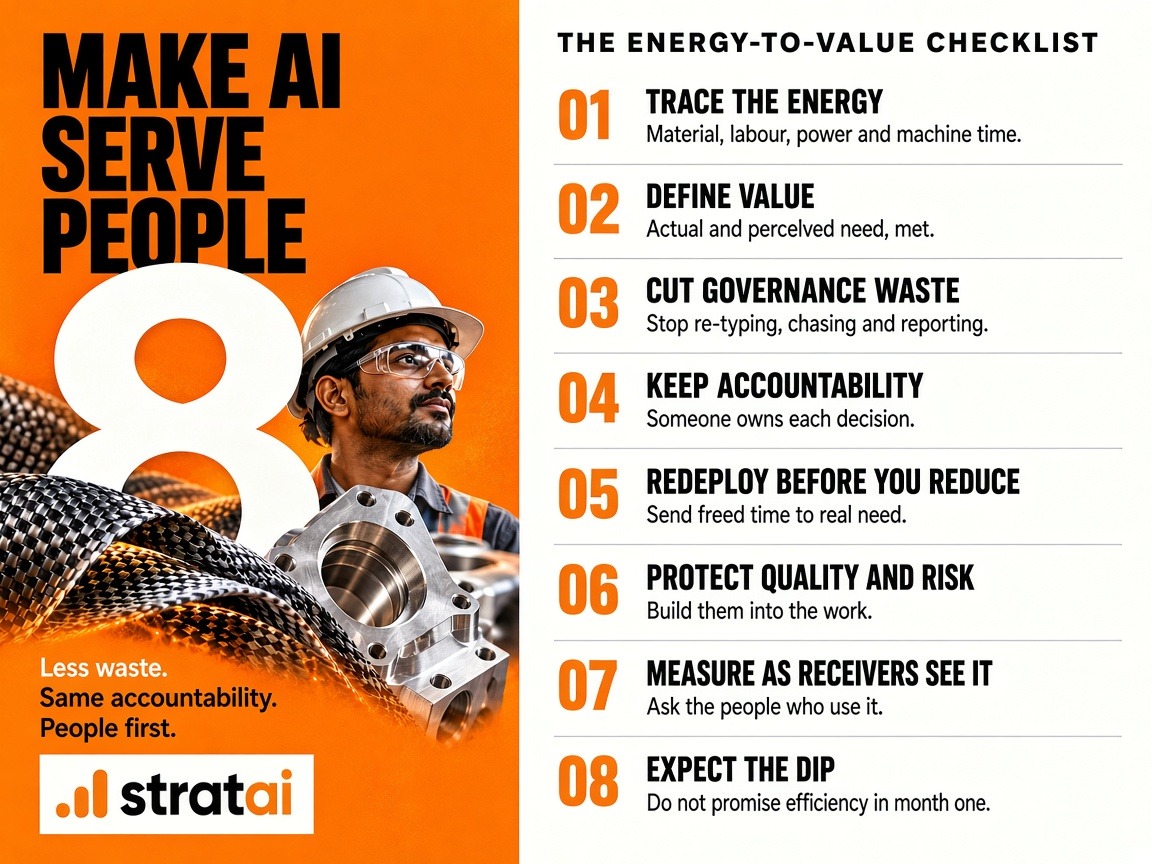
01 — Redeploy before you reduce
When AI frees time, the first question is where that energy can meet a real need better. At the furnishings manufacturer, the two people who had carried the quoting logic embraced the system and moved to higher-value work, including supporting new stores. At the Tirupur buying house, merchandisers now review documents instead of typing them.
In practice: These are observations from single companies. They show what is possible. They are not proof about society, and some firms under severe price pressure may have little room to choose. Choose redeployment wherever the business can afford it, and be open about where it cannot.
02 — Protect what must be protected
Accountability, quality control and risk management are worth keeping. Build them into the work, so that they run as the work happens, instead of stripping them out for speed.
03 — Measure value as the receiver perceives it, including your own people
Ask the people who use the system whether it is being used for each decision, and whether it helps. Let them describe the impact in their own words. The user is the owner of the answer.
We describe the method in how to measure whether AI is changing decisions.
04 — Be honest about the exploration phase
Do not promise efficiency in the first month. Our working rule is that results show up in the P&L from around the sixth month, and that speed is the enemy of AI return. People who are told the truth early can plan. People who are promised miracles lose trust when efficiency dips.
Some things need more than one company. Policy, education, safety nets, and the work of philosophers, psychologists and security thinkers are not things a manufacturer can supply. A manufacturer can refuse to be the reason they arrive late, and can add its voice to the conversation.
The equation will simplify. That part is engineering, and it is already under way. Who the simplified system serves is not engineering. It is a choice, and it is being made now, in the decisions leaders take about where freed energy goes.
If you are about to decide where AI-freed time goes in your plant, it helps to see first where your energy is being lost today.
Frequently Asked Questions
What does AI transformation change fundamentally in how organisations create value?
AI transformation changes the cost of converting energy into value, which we call the energy-to-value equation. Every task turns inputs into something a person needs, and the inputs, whether ingredients, labour, fuel or sunlight, are forms of energy. Value is the actual and perceived need met, as judged by the person whose need it is. AI shrinks the middle layers of approvals, re-entry and coordination that the customer never perceives as value, so more need is met per unit of energy.
How will AI transformation change the energy-to-value equation in manufacturing?
AI makes intelligence democratised, decentralised and, when implemented well, integrated. Expertise that sat with two people becomes available at the point of work, and one connected picture replaces silos reconciled in meetings. This shrinks the middle layers of approvals, re-entry, reporting and coordination that the customer never perceives as value. Accountability, quality control and risk management stay, but move into the work itself. The change is gradual and begins with a period of exploration.
Which parts of the current system should be protected?
Accountability, quality control and risk management. Accountability means someone owns each decision and its outcome. Quality control catches defects before they reach the customer. Risk management bounds the damage of any single error. These often deliver hidden value, real but unnoticed by the customer. The aim of simplification is to remove the paperwork, re-entry and chasing around them, not to remove them, and to build them into the work as it happens.
Why is efficiency poor when a company starts using AI?
At the start, nobody knows what AI can do in their own operation. Teams run pilots that do not fit, tools get built twice and people learn by trying, so the energy spent can rise before it falls. McKinsey's Operations Practice notes that 90% of companies report using AI while only 7% have scaled it. Economists saw the same dip-then-climb shape with electricity and computing, which Brynjolfsson and colleagues called the Productivity J-Curve.
Will AI simplify work at the cost of people's jobs and relevance?
Nobody can yet say. The World Economic Forum's Future of Jobs Report 2025 projects 170 million new roles and 92 million displaced by 2030, a net gain of 78 million, with disruption equal to 22% of jobs. Acemoglu and Johnson argue the outcome depends on choices about how technology is used, not on the technology itself. The hopeful and the cautious readings can both be partly right. Reskilling, security and meaning need attention alongside productivity.
How can a manufacturing leader make AI serve people?
Decide where freed energy goes before it arrives. Redeploy people to higher-value work wherever the business can afford it, and be open where it cannot. Build accountability, quality control and risk management into the work instead of stripping them out. Ask the people who use the system to rate its usefulness in their own words. And be honest that efficiency dips during exploration, so that people are told the truth early and can plan.
About StratAI
StratAI helps mid-market manufacturing firms in India build AI Advantage Systems that show up in the P&L, not just in dashboards. We work as an embedded partner, not a project vendor. Official Registered Claude Partner and Anthropic Partner.
stratai.io/contact | palani@stratai.io | +91 99402 25924
"The equation will simplify. That part is engineering. Who the simplified system serves is a choice, and it is being made now, in the decisions leaders take about where freed energy goes."
What does AI transformation change fundamentally in how organisations create value?+
How will AI transformation change the energy-to-value equation in manufacturing?+
Which parts of the current system should be protected?+
Why is efficiency poor when a company starts using AI?+
Will AI simplify work at the cost of people's jobs and relevance?+
How can a manufacturing leader make AI serve people?+

Palaniappan SN is a Business Strategy Consultant who has spent his career at the intersection of business strategy and operational reality — working across management levels from the boardroom to the shop floor to understand where organisations actually win and lose. His conviction is simple: AI should never be an experiment. It should be an advantage. That belief is the foundation of StratAI's AI Advantage Systems methodology — built not from technology-first thinking, but from the ground up, with the discipline to walk away from projects where the conditions for success don't exist.