AI Transformation for Manufacturing: 10 Qualities You Need in Your Internal Project Champion
Most AI transformations fail not because the technology does not work — but because nobody inside the function owns making it work. 10 criteria for selecting the right functional champion.
10 criteria for selecting a functional AI project champion in manufacturing — the person inside a specific function who is accountable for driving AI adoption within that function. Covers Problem-Solving Mindset, Peer Respect, Time Availability, Institutional Knowledge, Discretionary Effort, Proximity to the Pain, Communication Ability, Resilience to Setbacks, Manager Trust, and Willingness to Be Visible. Includes three cutoff thresholds. Also addresses the IT Manager's role in champion selection and self-development.
Most AI transformations in manufacturing do not fail because the technology does not work. They fail because nobody inside the function owns making it work.
The IT Manager owns the project. The function receives the system. Nobody in the function is accountable for adoption. The system goes live. The function continues doing what it always did — because nobody inside the function was responsible for making it stick.
This is the single most consistent structural gap in manufacturing AI transformation. And it is entirely avoidable — if you select the right person for the right role before the system is built.
Why the IT Manager Cannot Own Functional Adoption
The IT Manager is the right person to lead the overall AI transformation project. They own the architecture, the integration, the data infrastructure, and the vendor relationship. That is exactly where their expertise applies.
But AI transformation does not live in IT. It lives in the functions. A quality AI system lives or dies based on whether the QC supervisor uses it during production. A procurement AI system lives or dies based on whether the sourcing team trusts its recommendations. The IT Manager cannot drive this adoption from outside the function. They can instruct. They can report. They cannot change the daily behaviour of people who take their cues from the people beside them — not the IT department.
What the IT Manager can do — and this is where they add enormous value — is use the 10-criterion scorecard to select the right functional champion for each use case. This is the most important selection decision in the entire AI transformation project.
The Core Insight: AI Cannot Create Cooperation. It Can Only Facilitate It.
AI is not a cooperation engine. It is an information engine. It surfaces data, connects systems, accelerates decisions, and reduces the time between an event and a response. What it cannot do is make people want to work differently.
Cooperation requires trust. Trust requires peer influence. Peer influence requires a champion inside the function who uses the system visibly, speaks about it credibly, and navigates resistance from a position of respect — not authority.
When there is no functional champion, AI enables information flow in theory. In practice, the information lands in a system nobody checks — because nobody inside the function made checking it a normal part of how work gets done.
A curious, engaged team that wants to solve problems can make even an imperfect AI system work. A disengaged team with a perfect system will produce nothing. The functional champion is the person who keeps the team curious and engaged through the friction of building something new.
The 10 Criteria — What to Score and Why
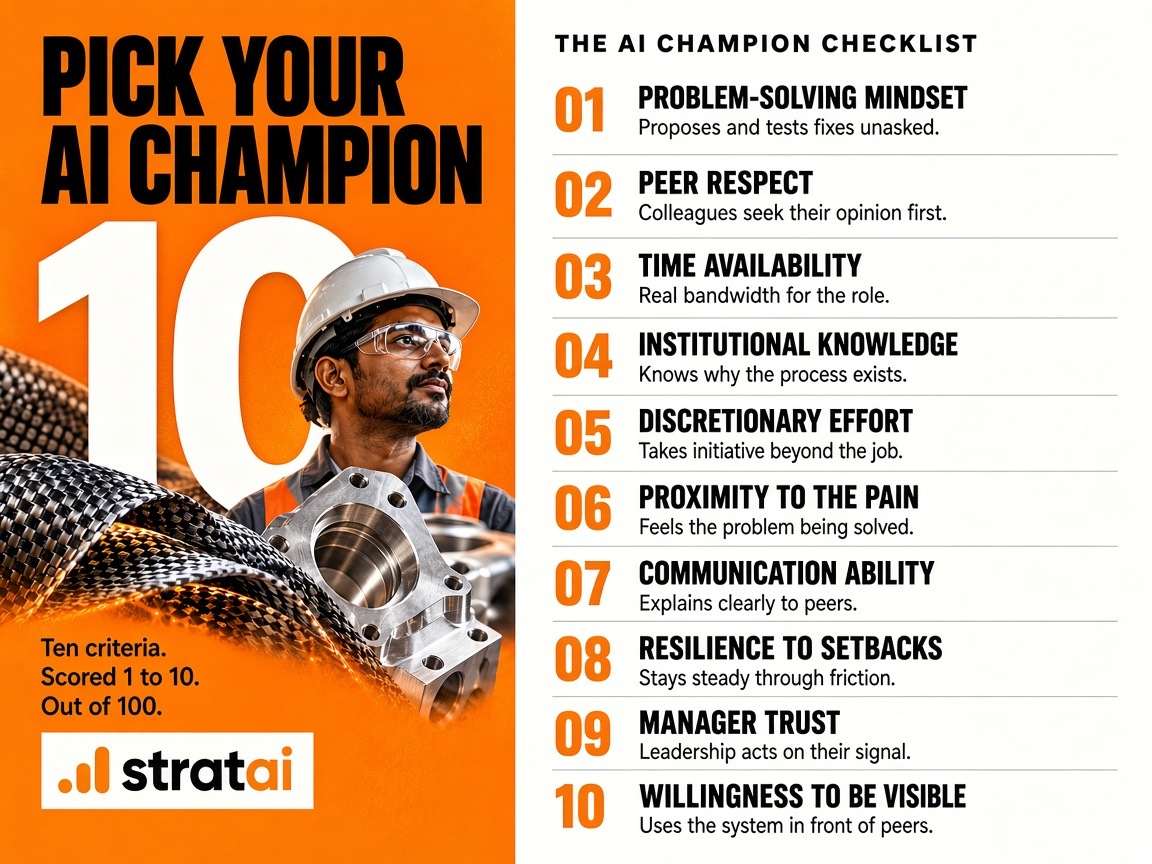
Each criterion is scored 1 to 10. Equal weight. Total out of 100. Score based on direct observation — not HR assessment or self-report. Two people scoring the same candidate independently and comparing notes produces more reliable results than one person scoring alone.
01 — Problem-Solving Mindset
Low (1-3): Reacts to problems by complaining or escalating — rarely proposes fixes.
Mid (4-7): Occasionally suggests solutions when prompted.
High (8-10): Consistently and proactively proposes and tests solutions without being asked.
Watch for: The champion will face problems every day — system errors, adoption resistance, data gaps, workflow friction. A person who escalates rather than solves will become a bottleneck, not a driver.
02 — Peer Respect / Informal Influence
Low (1-3): Peers rarely seek their opinion.
Mid (4-7): Peers consult them sometimes.
High (8-10): Peers actively look to them before deciding or acting.
Watch for: The most important criterion. A champion with formal authority but low peer respect will produce compliance adoption — people use the system when observed, stop when not. Peer adoption follows peer behaviour, not management instruction.
03 — Time Availability
Low (1-3): Already overloaded — no visible slack in workload.
Mid (4-7): Some bandwidth — may need workload adjustment.
High (8-10): Clear bandwidth to take on champion duties without conflict or burnout risk.
Watch for: The most common disqualifier for otherwise strong candidates. The most capable, most respected person in a function is almost always the most overloaded. Assigning the champion role without genuinely freeing up time converts the role into a box-ticking exercise. The fix is a real workload adjustment before the role starts.
04 — Tenure / Institutional Knowledge
Low (1-3): New to role or organisation — limited grasp of current workarounds.
Mid (4-7): Understands current process reasonably well.
High (8-10): Deep grasp of why the current process exists, how it evolved, and where its real gaps are.
Watch for: An AI system built without institutional knowledge will solve the visible problem but miss the workarounds the function has built around it. The champion who understands why the current process exists will catch these gaps during the build phase — before they cause adoption failure.
05 — Discretionary Effort / Ownership
Low (1-3): Does only what is assigned.
Mid (4-7): Occasionally goes beyond scope.
High (8-10): Regularly takes initiative beyond the job description without being asked.
06 — Proximity to the Pain
Low (1-3): Not really affected by the problem being solved.
Mid (4-7): Somewhat affected.
High (8-10): Directly and significantly affected — high personal stake in a better solution.
Watch for: A champion who does not feel the pain the AI system is solving will not communicate its value authentically. The person who has been manually entering data for three hours a day has a fundamentally different motivation to make the solution work than someone who has observed this from a distance.
07 — Communication Ability
Low (1-3): Struggles to explain things to peers in terms they understand.
Mid (4-7): Can explain if asked — not naturally fluent.
High (8-10): Explains clearly and relatably — peers understand easily without needing to ask twice.
08 — Resilience to Setbacks
Low (1-3): Likely to publicly give up or criticise after early friction.
Mid (4-7): Tolerates some friction — may need reassurance.
High (8-10): Stays steady and constructive through setbacks — keeps peers confident during difficulty.
Watch for: Every AI system hits friction in the first 60 days. A champion who publicly criticises the system when it does not work perfectly in week two will destroy adoption faster than any technical failure. The champion must respond to friction by problem-solving — not announcing failure.
09 — Manager / Sponsor Trust
Low (1-3): Limited credibility with leadership.
Mid (4-7): Reasonable standing with management.
High (8-10): High trust — leadership treats their signal as reliable and acts on their feedback.
Watch for: The champion will need management to respond when they identify gaps, request workload adjustments, or flag adoption risks. A champion whose signal is not trusted by leadership will be unable to escalate effectively — and will eventually disengage from the role.
10 — Willingness to Be Visible
Low (1-3): Prefers to work quietly — uncomfortable being a public face for the system.
Mid (4-7): Will participate when asked — not naturally proactive about visibility.
High (8-10): Actively and comfortably uses the system in front of peers — their visible use makes the system legitimate.
Watch for: This is what separates a champion from a coordinator. Peer adoption follows peer behaviour. If the champion uses the system privately but does not demonstrate its value publicly — in team meetings, on the floor, in daily conversations — peers have no social proof that the system is worth changing their behaviour for.
Cutoff Thresholds — What the Score Means
| Score Range | Verdict | Action |
|---|---|---|
| 80-100 | Strong Champion | Proceed with confidence. Assign the role, brief the champion on the engagement model, and begin. Note any criterion scoring below 6 and plan a specific mitigation. |
| 60-79 | Usable with Support | Proceed — but the consulting partner and the CEO or IT Manager provide additional coaching on the criteria where this person scored lowest. Address the gap explicitly, do not assume it will resolve itself. |
| Below 60 | Not Recommended | Select a different candidate. Or identify the single lowest-scoring criterion, address that specific gap first, then re-score. The scorecard tells you what to fix — not just who to avoid. |
A Note for IT Managers — Using This Scorecard for Your Own Development
The 10 criteria are not just a selection tool for functional champions. They are a map of the human capabilities that determine whether any AI transformation project succeeds.
An IT Manager who honestly assesses their own standing on each criterion will find a development roadmap for becoming a more effective overall transformation lead. Peer Respect across functions. Proximity to the Pain — genuinely understanding the functional problem being solved, not just the technical architecture. Willingness to Be Visible — championing the system publicly, not just managing it privately.
The IT Manager who scores strongly across these criteria, and selects functional champions who score strongly within their own functions, has built the human infrastructure that AI transformation actually requires. Technology is the tool. The champion network is the system that makes the tool work.
Frequently Asked Questions
What is a functional AI project champion in manufacturing?
A functional AI project champion is a person inside a specific function — quality, procurement, production planning, logistics — who is accountable for driving adoption of the AI system within that function. They are distinct from the overall IT project lead. The IT Manager owns the architecture and the project. The functional champion owns adoption inside their function through peer influence, visible use of the system, and active navigation of the resistance that every new system generates. Without a functional champion, adoption depends entirely on management instruction — which produces compliance, not genuine behaviour change.
Why is Time Availability the most common disqualifier for otherwise strong champions?
Because the most capable and most respected person in any function is almost always the most overloaded. The qualities that make someone a strong champion — problem-solving mindset, peer respect, discretionary effort — are exactly the qualities that have already made them indispensable in their current role. Assigning the champion role without genuinely freeing up their time converts it into a box-ticking exercise. The fix is a real workload adjustment before the role starts — not an instruction to prioritise champion responsibilities alongside everything else.
Does a champion need to score high on all 10 criteria?
No — and this is the most important point about using this scorecard. These 10 criteria are guidance, not a pass/fail checklist. A candidate who scores 8 on Peer Respect, 7 on Proximity to the Pain, 6 on Time Availability, and 7 on everything else is a strong champion with one known risk (manage their time carefully) and one conscious mitigation. The goal is to match as many criteria as possible so that the gaps you accept are conscious and managed — not accidental gaps that become downstream problems nobody anticipated.
Can the IT Manager be the functional champion?
In most manufacturing environments, no — not as a substitute for a functional champion. The IT Manager's credibility is highest in the technology domain. The functional champion's credibility must be highest among the people who will actually use the system — the QC supervisor, the procurement officer, the production planner. These people take their cues from peers inside their function, not from the IT department. The IT Manager's highest-value role is selecting and preparing the right functional champions, using this scorecard — not substituting for them.
Why is Willingness to Be Visible the final criterion — and why does it matter so much?
The first nine criteria measure the champion's functional capability. Willingness to Be Visible measures something different: whether the champion will use the system publicly, in front of their peers, in the course of daily work. This is the multiplier. A champion who scores strongly on all nine capability criteria but uses the system privately and never visibly endorses it among peers will produce far lower adoption than a champion who scores moderately on capability but is consistently, publicly committed to making the system part of how the team works. Peer adoption follows peer behaviour. Visibility is what makes the champion's endorsement real.
About StratAI
StratAI helps manufacturing firms in India build AI Advantage Systems. 10+ live deployments across textile, jewellery, furnishings, commodity processing, and component manufacturing. Official Registered Claude Partner and Anthropic Partner.
stratai.io/contact | palani@stratai.io | +91 99402 25924
"AI cannot create cooperation. It can only facilitate it — by enabling the information flow that makes cooperation possible. The functional champion is the human condition that determines whether that information ever reaches a decision."
What is a functional AI project champion in manufacturing?+
Why is Time Availability the most common disqualifier for AI project champions?+
Does a champion need to score high on all 10 criteria?+
Can the IT Manager be the functional AI champion?+
Why is Willingness to Be Visible the 10th and final criterion?+

Palaniappan SN is a Business Strategy Consultant who has spent his career at the intersection of business strategy and operational reality — working across management levels from the boardroom to the shop floor to understand where organisations actually win and lose. His conviction is simple: AI should never be an experiment. It should be an advantage. That belief is the foundation of StratAI's AI Advantage Systems methodology — built not from technology-first thinking, but from the ground up, with the discipline to walk away from projects where the conditions for success don't exist.