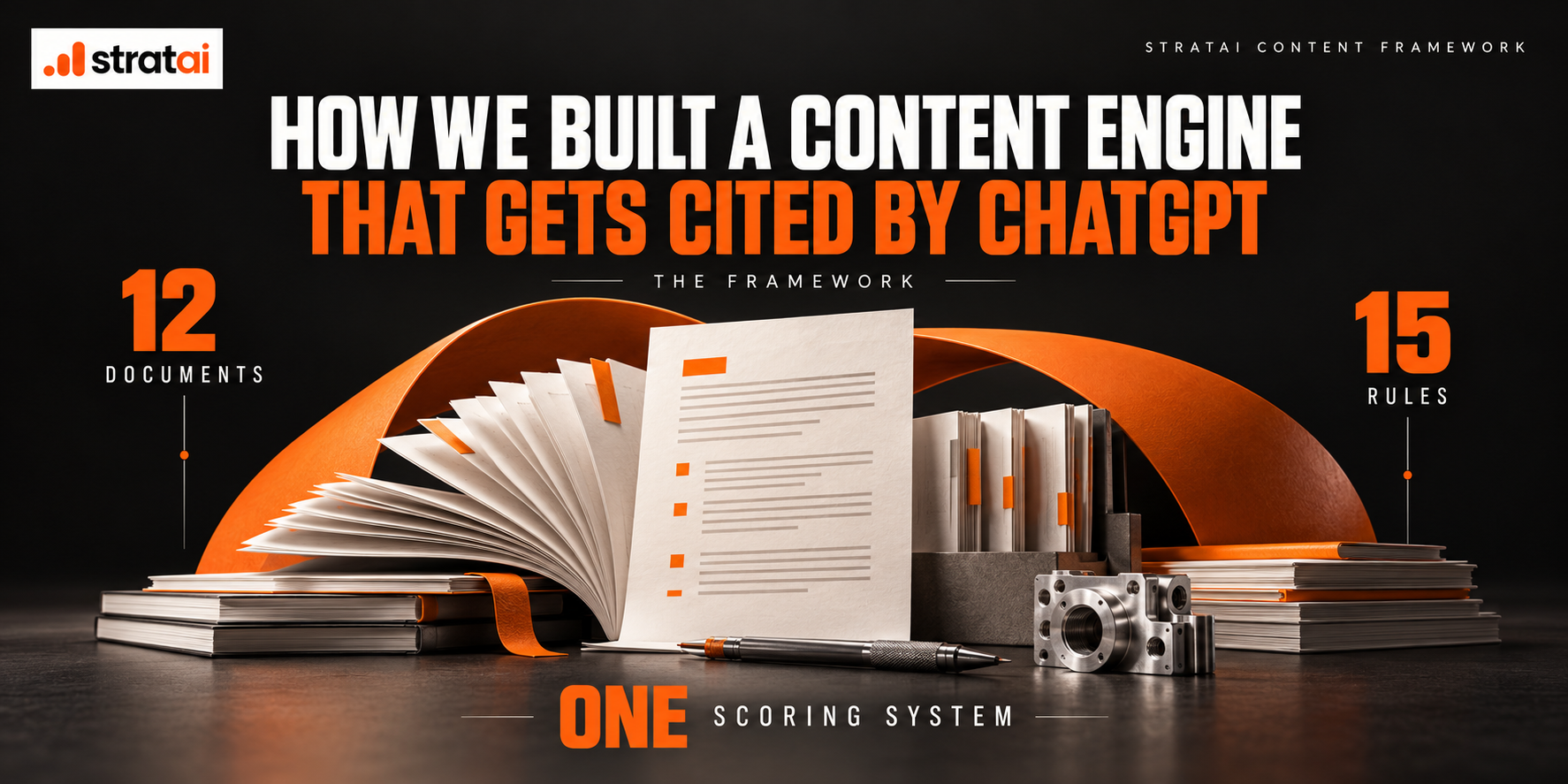
In Blog 1 of this series we explained why manufacturing is the least contested category in AI search — and why 25 blogs generated two bottom-of-funnel leads from ChatGPT citations. This blog reveals the framework behind those blogs: the 12 configuration documents we load into Claude before every session, the 15 quality rules we apply before every draft, and the four-dimension scoring system that tells us whether a blog is ready to publish or needs another pass.
We are not revealing this because we have nothing to protect. We are revealing it because the principle that made this system work — give the best possible answer to your prospect's actual questions, from lived experience and research — is not a secret. It is a discipline. And discipline is the rarest thing in B2B content.
Most manufacturing companies do not have a marketing orientation. That is not a criticism — it is a structural reality. The business model runs on relationships, referrals, and reputation. Marketing has never been the growth lever.
But there is a new discovery channel that changes the equation — not for everyone, but for the manufacturing companies that move first. LLMs are now how buyers find answers. A manufacturing CEO evaluating an AI partner, a procurement head researching a supplier, an OEM looking for a component manufacturer — all of them are starting with ChatGPT before they start with a phone call. The companies whose content appears in those AI-generated answers are being discovered. The companies whose content does not exist are invisible. Right now, in manufacturing, the category is almost entirely unclaimed. That window will not stay open indefinitely.
The Origin — What the System Is Actually Trying to Solve
The first blog we published scored 78 out of 100 on version 1. It took four iterations to reach 93. That gap — between what felt like a good blog and what the scoring system said was a good blog — was the moment the content engine became real.
Before the scoring system, quality was intuition. The blog felt right, or it did not. After the scoring system, quality was engineering. Each dimension had a weight. Each sub-factor had a threshold. The gap between 78 and 93 was not in the writing — it was in the structure. Missing stat boxes. Missing internal links. A CTA that was hyperlinked in the text but not specific enough to convert. An FAQ block written in our language rather than the buyer's language.
These are not style preferences. They are the specific differences between content that gets cited and content that does not. LLMs do not respond to writing quality in the abstract — they respond to structure, specificity, and extractability. A beautifully written paragraph that cannot be extracted as a standalone answer is invisible to an AI engine. A well-structured 80-word FAQ answer with a specific number and a named source is citable.
The system exists to close the gap between the field intelligence we have — from 10+ live deployments, from diagnostic visits to manufacturing plants across India — and content that is structured well enough for AI engines to find, extract, and cite it.
Layer 1 — The 12 Configuration Documents
Before any blog session begins, Claude has 12 documents loaded as project files — a Claude feature that automatically injects them into the context window at the start of every session. We do not upload them each time. They are always present. These are not prompts — they are context. The distinction matters. A prompt tells Claude what to do. A context document tells Claude what we know, who we are, what we have built, and what standards we hold ourselves to. Claude does not need to be a manufacturing expert. The expertise is in the documents — and the documents are always there.
Layer 2 — The Insight Transfer Session
The 12 documents give Claude context. The insight transfer session gives Claude intelligence. This is the step that most AI content systems skip — and it is the step that determines whether the output is generic or genuinely valuable.
Before every blog, the founder answers a structured set of questions from real field experience. What is the most common wrong belief a CEO has about this topic? What did you observe in the last diagnostic visit that contradicts the conventional wisdom? What number from a real engagement proves the point? What is the enemy — the wrong idea this blog must dismantle?
Claude cannot generate these answers. Not because it lacks capability, but because the answers do not exist in any training data. The specific observation that a middle manager's resistance to AI is rational — not laziness — because the system adds work before it adds value, is not in any published AI content. It came from standing in a manufacturing plant and watching how teams actually respond to new systems. That observation is the most citable content we produce. And it comes from the insight transfer session, not from the AI.
Layer 3 — The 15 Quality Rules
These rules were not designed. They were discovered — through the iterations it took early blogs to reach the publish threshold. Each rule exists because its absence produced a measurable quality drop.
Rule 09 — stat callout boxes — is a useful example of what the rules actually change in practice. The same statistic, written inline in a paragraph, reads as: 'Six Sigma reduced aluminium die casting rejection from 17% to 4.8% through parameter optimisation alone.' Pulled into a stat callout box — set apart visually, with the number as the headline and the context as a single supporting line — that same statistic becomes something an AI engine can lift as a standalone, citable fact rather than a clause buried inside a sentence. The information is identical. The extractability is not. That difference, repeated across every stat in a blog, is what Rule 09 exists to enforce.
Layer 4 — The Four-Dimension Scoring System
Every blog is scored on four dimensions before it is published. The publish threshold is 90 out of 100. Anything below 90 goes back for a revision — specifically targeting whichever dimension scored lowest. The scoring system is what turned a content experiment into a repeatable content engine.
The AEO Writing Standard — What Makes Content Citable
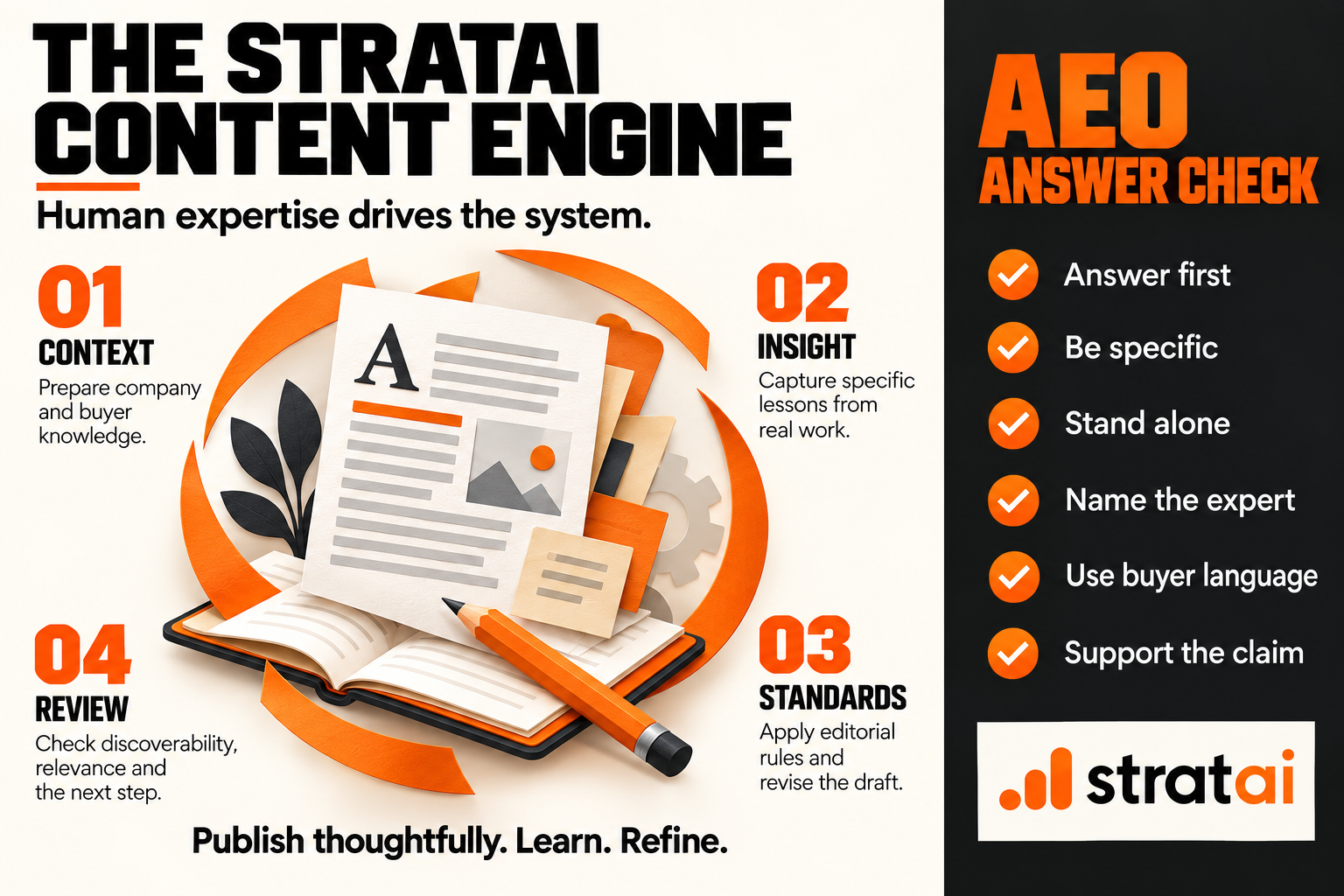
The AEO (Answer Engine Optimisation) writing standard applies specifically to FAQ blocks and direct answer sections — the parts of a blog that AI engines extract and cite as standalone answers. It has six criteria with different weights, and a separate publish threshold of 80 out of 100.
What the System Produces — And What It Does Not
This system does not produce viral content. It does not produce the most entertaining blog in your industry. It does not produce content that wins creative awards.
It produces content that answers specific questions completely, from real field experience, in a structure that AI engines can extract and cite. That is the only thing it is designed to do. Because that is the only thing that produces the result we described in Blog 1: a prospect who arrives at the first meeting already educated, already convinced the approach is right, needing only to verify you are genuine.
The system also has a requirement that no framework document can substitute: the founder must show up to every insight transfer session with genuine field intelligence. A system built on honest answers to real questions produces honest content. A system used to produce content quickly from generic inputs produces the same content every other AI system produces — and that content does not get cited.
The framework described in this blog is what StratAI built for its own domain — manufacturing AI. But the principle applies to any manufacturing company with genuine expertise in their field. A cotton spinning mill that writes honestly about the top 30 questions their OEM buyers ask — raw material quality standards, lead times, minimum order quantities, certifications — will own that conversation in ChatGPT before the first inquiry call is made. A precision component manufacturer that answers the questions their OEM buyers actually ask owns that conversation before the first meeting. A jewellery manufacturer that publishes field-honest content about catalogue management owns that category in AI search.
Most manufacturing companies do not have a marketing orientation — and most will not build one. But for the ones that do, right now is the moment. LLM-based discovery is new. The category is unclaimed.
You have just read the complete framework. The next step is to see whether it applies to your domain — and whether we are the right partner to help you build it.
The core differentiator for any manufacturing company that wants to claim this channel is not technology. It is not budget. It is two things: the intention to build competitive advantage through content, and the discipline to write regularly. If you have both — and if you would like us to help you build the system — let us connect.
Frequently Asked Questions
How does StratAI use Claude to write manufacturing AI content?
Claude receives 12 configuration documents before every session — covering company identity, ICP personas, proprietary frameworks, brand voice, quality rules, the pre-write checklist, AEO writing standards, the scoring framework, 331 real manufacturing questions, field engagement data, attribution rules, and production history. These give Claude the complete context of who StratAI is, who the reader is, and what standard the output must meet. The founder then provides field intelligence through an insight transfer session — specific observations, real numbers, counterintuitive insights from live engagements. Claude structures and writes. The founder provides the substance that cannot be replicated from training data.
What is the StratAI Blog Scoring System?
Every blog is scored on four dimensions before publishing: SEO (28 points), GEO — Generative Engine Optimisation (22 points), ICP Resonance (28 points), and CTA & Conversion (22 points). Total is 100 points. The publish threshold is 90. Anything below 90 goes back for revision targeting the lowest-scoring dimension. The scoring system replaced intuition-based quality assessment with engineering-based quality assessment — it is the reason the content engine produces consistent results rather than variable ones.
What is the AEO Writing Standard and why does it matter?
The AEO (Answer Engine Optimisation) Writing Standard applies to FAQ blocks and direct answer sections — the parts of a blog that AI engines extract as standalone citations. It has six criteria: answer-first directness (the answer in sentence 1), specificity and data density (a real number or named source), structural extractability (self-contained at 40-100 words with correct schema), entity and authority clarity (named author with credentials), natural language query match (written in buyer language), and source corroboration (a linkable source that matches the specific claim). An FAQ answer that scores below 80 on the AEO scorecard is rewritten before the blog publishes.
What are the 15 Quality Rules and where did they come from?
The 15 rules were discovered through iteration — specifically through the four rounds of revision that Blog 01 required to go from 78/100 to 93/100. Each rule traces back to a specific quality drop observed when the rule was absent: testimonials gathered after writing do not integrate as naturally as those gathered before; CTA text written without a hyperlink does not read the same way when the hyperlink is added; stat callout boxes planned before writing land differently from stats found during writing. The rules are not preferences. They are empirical observations about what the scoring system rewards.
Can any manufacturing company replicate this content engine?
The framework can be replicated. The documents can be adapted to any manufacturing domain. The scoring system can be applied to any B2B content programme. What cannot be replicated is the specific field intelligence — the real numbers from live engagements, the honest observations from diagnostic visits, the counterintuitive insights from standing in manufacturing plants and watching how teams actually respond to AI systems. That intelligence is what makes the content citable. Any manufacturing company that has genuine field experience in their domain and applies this framework consistently will produce content that AI engines cite. The framework is the structure. The field experience is the substance.
"Give the best possible answer to your prospect's actual questions — from your lived experience and your research. Not from what you think they want to hear. Not from what makes your firm look good. From what is genuinely true and genuinely useful." — Palaniappan SN, Co-Founder, StratAI
About StratAI: StratAI helps manufacturing firms in India build AI Advantage Systems. 10+ live deployments across textile, jewellery, furnishings, commodity processing, and component manufacturing. Official Registered Claude Partner and Anthropic Partner.
Read Blog 1 of this series: Manufacturing Companies Are the Last Category AI Search Engines Will Cite — https://stratai.io/blog/geo-aeo-manufacturing-ai-search