ERP AI Integration for Manufacturing: Why Your ERP Is a Filing Cabinet — And How AI Turns It Into a Decision Engine
73% of manufacturing ERP projects fail their objectives — and the data is usually already there. Eight ERP failure modes in Indian manufacturing, and four ways AI turns an existing ERP from a filing cabinet into a real-time decision engine, without replacing it.
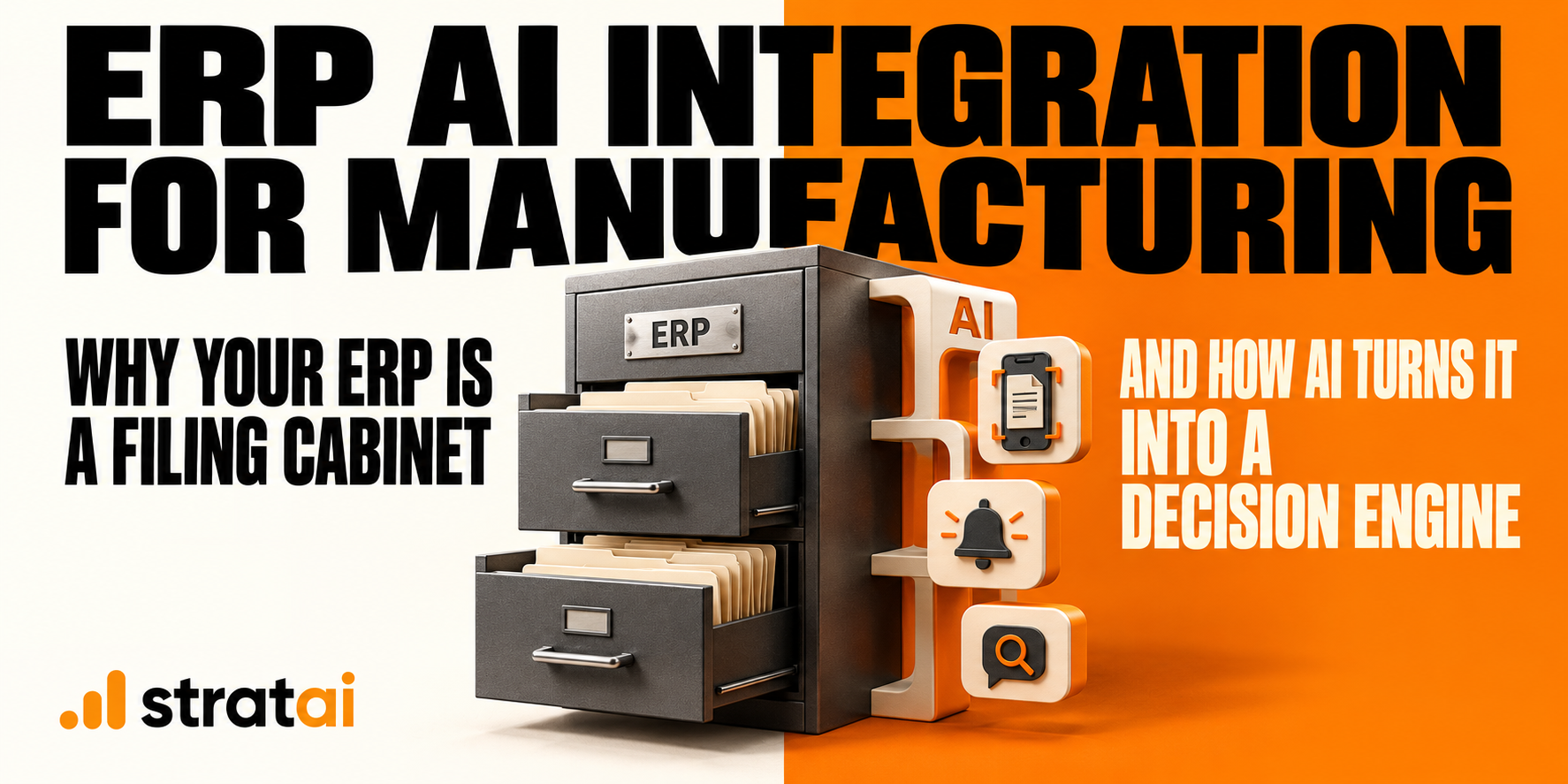
ERP AI integration connects AI capability — language models, intelligent agents, and data extraction — to the ERP systems a manufacturing business already has, without replacing them. It eliminates the paper-to-ERP data entry lag through mobile capture and AI extraction, bridges silos between the ERP, Tally, email, and documents into one queryable layer, replaces reports nobody reads with real-time alerts, and enables natural language queries in place of complex multi-screen ERP navigation. The result is a decision intelligence layer built on the ERP investment already made.
Most manufacturers have an ERP. Almost none are using it for what it was built to do. 73% of manufacturing ERP projects fail to meet their objectives. The ones that 'succeed' typically produce a sophisticated traceability system that nobody consults before making a decision. AI changes that — not by replacing the ERP, but by making the data inside it finally useful.
Direct answer: What is ERP AI integration in manufacturing and why does it matter? ERP AI integration in manufacturing is the connection of AI capability — language models, intelligent agents, and data extraction — to the ERP systems that already exist inside a manufacturing business. It does not require replacing the ERP. It does not require a clean data migration. It works with the data the ERP already contains — and does three things that the ERP alone cannot: it eliminates the data entry lag that makes ERP data stale, it bridges the silos between the ERP and other systems (Tally, email, documents, WhatsApp), and it makes the ERP's data actionable in real time through natural language queries and proactive alerts instead of reports that nobody reads.
73% of discrete manufacturing ERP projects fail to meet their objectives — with average cost overruns reaching 215%. The ERP market is approaching $78 billion globally. Manufacturing is the largest vertical. And most manufacturing ERP implementations are underperforming. The failure is rarely the software. It is almost always the human, process, and data reality that the software encountered — and was not designed to handle. Source: Panorama Consulting Group, 2026 ERP Report via Godlan
The Real Problem: Your ERP Is a Filing Cabinet
A filing cabinet stores everything. It organises nothing. It makes finding the right piece of information at the right moment for the right decision almost impossible at speed. That is what most manufacturing ERPs have become — an expensive, well-organised filing cabinet.
The CEO who approved the ERP investment expected a decision intelligence system. What arrived was a traceability system. Data goes in — eventually, after a lag, entered by someone who was not the person who generated it. Reports come out — periodically, in a format that requires interpretation, after the decision moment has passed. The data is in the system. The intelligence is not.
Only 43% of collected manufacturing data is used effectively — leaving most ERP analytics potential untapped. The data is being collected. The investment has been made. The failure is not in the collection — it is in the activation. Manufacturing ERP systems are sitting on years of operational, quality, procurement, and production data that nobody is querying in real time because the tools to do so — until AI — did not exist at an accessible price and complexity level. Source: Sigma Computing via kreativecoretech.com, 2026
Why Most Manufacturing ERPs End Up Partially Implemented
Before discussing what AI can do, it is worth being honest about why the ERP is in this state. The eight failure modes below are not theoretical — they are the patterns observed across mid-market manufacturing companies in India. Most manufacturers will recognise at least four of them in their own operations.
01 · Ground Reality Mismatch — UI/UX Built for the Boardroom, Not the Shop Floor
The ERP is configured for how management describes the shop floor — not how it actually operates. The interface requires navigating multiple screens to log a single production event. At Station 47, with a 12-hour shift underway and gloves on, this is not a realistic ask. The team finds workarounds. The ERP gets bypassed. The data gap widens.
02 · The Paper-to-ERP Lag — Two People Doing One Job With a 48-Hour Delay
Work happens on the shop floor. Data gets noted on paper. A separate person enters it into the ERP — sometimes the same day, sometimes two days later. By the time the data exists in the system, the decision it should inform has already been made with incomplete information. The ERP has perfect historical data and zero real-time intelligence.
03 · Change Management Treated as a Training Session
ERP implementation is treated as a technology project. The human change required to make it work — new behaviours, new accountability structures, new workflows — is addressed with a training session at go-live. One session. Then the vendor leaves. The team reverts to what they know. Within six months, the ERP is being used for compliance purposes only.
04 · Team Resistance — Rational, Consistent, and Underestimated
The team that was managing with Excel, WhatsApp, and phone calls is now expected to enter data into a system they did not ask for, do not see the value in, and that makes their existing work harder before it makes it easier. The resistance is not laziness — it is rational. The system adds work without visibly reducing work. Until adoption is widespread enough for the benefits to appear, the cost is real and the benefit is invisible.
05 · Feature Overload — When Everything Becomes a Priority, Nothing Gets Done
The founder wants every module. Every report. Every integration. The implementation team tries to build it all. Nothing gets configured properly. The essential use cases — the ones that would have produced real value in month three — are buried under 40 features that nobody uses. Partial implementation of everything is worse than complete implementation of the five things that matter most.
06 · Management Reviews Without the ERP — The Signal That Kills Adoption
The weekly management review uses the same WhatsApp screenshots and Excel exports it always did. The ERP data is never opened in a management meeting. The signal this sends to every person in the organisation: the ERP is optional. If the leadership that mandated it does not use it, why should anyone else?
07 · Lack of Stakeholder Buy-In — Every Department Protects Its Own System
Finance uses Tally. Operations uses the ERP. Sales uses spreadsheets. Each department made its system work over years. The ERP that was supposed to integrate everything arrives as a threat to the systems that already function. Each department protects its own data, its own format, its own workflow. The ERP becomes one more silo.
08 · Data Silos — ERP Alongside Tally, WhatsApp, and Excel
In India specifically: Tally for accounting, a separate ERP for operations, WhatsApp for real-time communication, Excel for planning and analysis. Four systems. Zero integration. A CEO asking 'what is our current inventory position against open orders?' needs to pull from all four — manually, slowly, and with a lag. The ERP captures one slice of reality. Every decision requires the full picture.
How AI Fixes What ERP Could Not
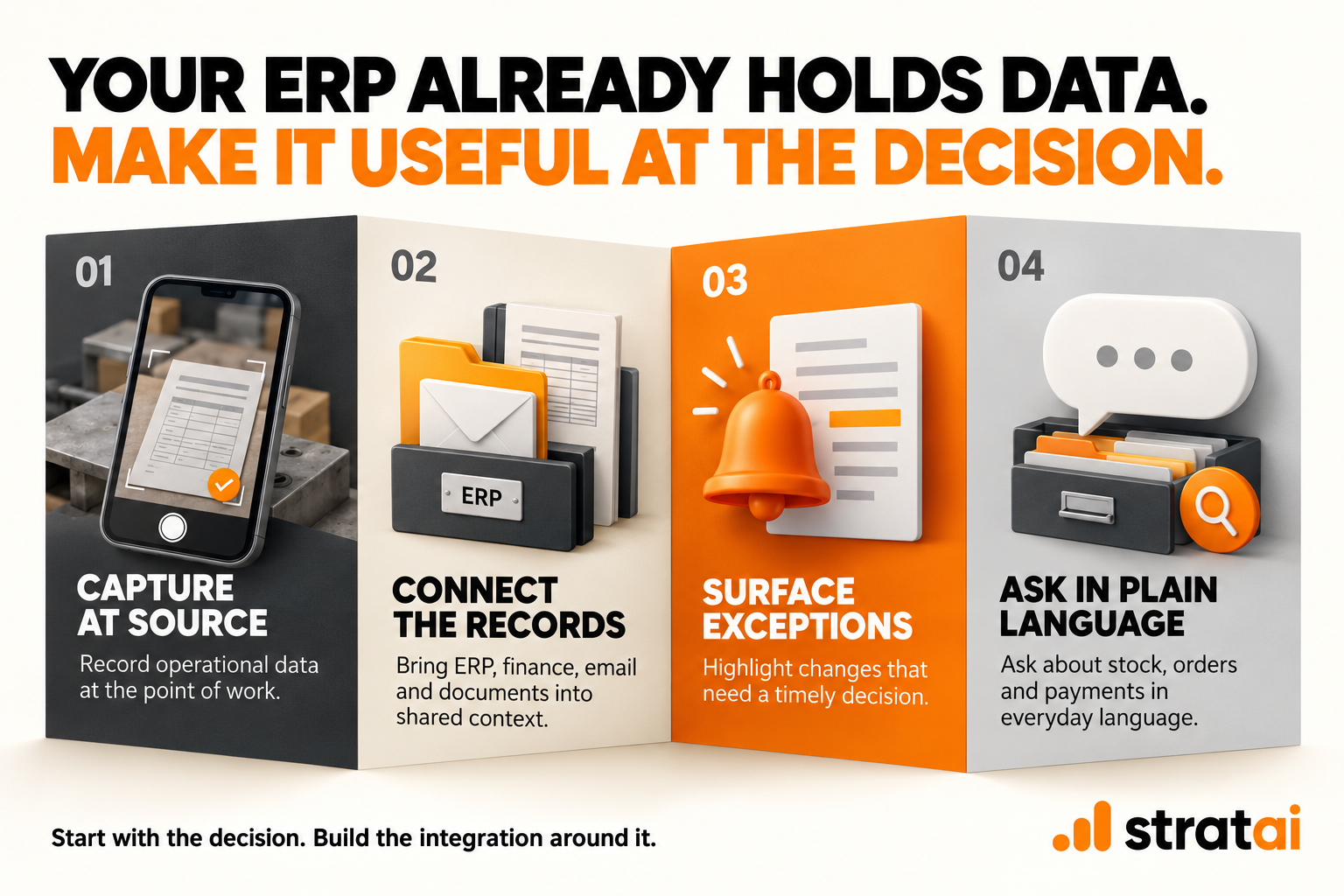
AI does not replace the ERP. It does not require a new implementation or a data migration. It works with what already exists — and does four things the ERP alone cannot do.
AI Fix 01 · Eliminate the Paper-to-ERP Lag
A worker photographs the machine output, the QC sheet, or the production record on a mobile phone. AI extracts the relevant data from the image and writes it directly into the ERP — within the shift, not the next day. No separate data entry person. No 48-hour lag. The ERP now reflects what is actually happening on the floor in real time.
Field deployment · Cotton Spinning Mill: Operator photographs machine screen → AI extracts production data → SAP updated within the shift. Data lag reduced from 1–2 days to within the hour. Zero new hardware. Zero new ERP modules.
AI Fix 02 · Bridge the Silos — Connect ERP, Tally, Email, and Documents Into One Layer
AI does not force all systems into one. It connects them from above — acting as an intelligent layer that can query the ERP for production data, Tally for financial position, email for order confirmations, and document servers for contracts and specifications — and return a single, coherent answer to a business question. The silos continue to exist for data entry. They disappear for decision-making.
Field deployment · Listed Cotton Manufacturer: SAP HANA + document server + email connected via AI chatbot. Leadership queries current inventory position, open order book, and payment status from one interface. No data migration. No system replacement. Four systems unified into one decision layer.
AI Fix 03 · Make ERP Data Actionable — From Reports Nobody Reads to Alerts That Matter
The ERP generates reports. Nobody reads them before the decision is made. AI monitors the ERP data continuously and surfaces the specific alert — not a report — that requires action right now. The defect rate on Product Line 3 has crossed the threshold. The inventory on a key input is below the reorder point against current demand. The open order book has shifted in a way that changes today's production priority. These are not reports. They are nudges — arriving at the moment when action is still possible.
AI Fix 04 · Natural Language Query — From 40 Screens to One Question
The ERP requires navigating multiple modules, running multiple reports, and synthesising the output manually. AI reduces this to one natural language query: 'What is our current stock position on Cotton Grade A against open orders for the next 30 days?' The answer arrives in seconds — pulled from the ERP, cross-referenced with the order book, and expressed in plain language without a single report being generated. The ERP's complexity barrier disappears. The data becomes accessible to every decision-maker in the organisation — not just the ERP-trained few.
Field deployment · Procurement Intelligence — Listed Cotton Manufacturer: Before AI, the purchase-in-charge consulted multiple sources in sequence — price indices, stock position, order book, forecast — with information gaps at every step. With AI integration, one query returns all relevant purchase intelligence simultaneously. Decision quality improved. Decision time reduced from hours to minutes.
The Right Way to Think About ERP AI Integration
ERP AI integration is not a technology project. It is a decision intelligence project. The question is not 'how do we connect AI to our ERP?' The question is: 'which decisions in our business are being made on incomplete, stale, or disconnected information — and what would change if those decisions were made on real-time, complete, connected data?'
The answers to that question are the use cases. The ERP AI integration is the mechanism. The sequence matters: identify the decision first, then build the integration that serves that decision, then measure whether the decision quality has improved and whether the improved decision is showing up in the right P&L line.
The principle that separates ERP AI integration from ERP AI activity: AI connected to an ERP that is being used for compliance is still just compliance — faster. AI connected to an ERP that is used for decisions is decision intelligence. The first step is not the AI integration. The first step is identifying the decisions the ERP data should be informing — and ensuring those decisions are actually being made with that data. AI makes this loop faster. The loop itself must be designed first.
ERP platforms with embedded intelligence have enabled a 35% improvement in decision-making speed and 20% enhancement in overall business agility. The improvement is not from the AI replacing the decision-maker. It is from the AI compressing the time between the information existing and the decision-maker having it — eliminating the report cycle, the data consolidation step, and the interpretation lag that currently sit between the ERP's data and the decision that data should inform. Source: DocuClipper via manufacturingleadgeneration.com, 2026
Tell us which decisions in your plant are being made on incomplete ERP data. → Book your free half-day audit — no commitment, no strings. We map the gap between your ERP data and your actual decision-making — and identify the first AI integration that closes it. We confirm your audit date within one business day.
Frequently Asked Questions
What is ERP AI integration in manufacturing?
ERP AI integration in manufacturing is the connection of AI capability to the ERP systems a manufacturing business already uses — without replacing those systems. It works by eliminating the data entry lag (mobile capture → AI extraction → real-time ERP write-back), bridging data silos (connecting ERP, Tally, email, and documents into one queryable layer), making ERP data actionable through real-time alerts rather than periodic reports, and enabling natural language queries that replace complex multi-screen ERP navigation. The result is a decision intelligence layer built on top of the ERP investment already made.
Do we need to replace our ERP to integrate AI?
No. ERP AI integration works with the ERP you already have — including partially implemented or legacy systems. AI operates as a layer above the ERP, not as a replacement for it. The integration connects to existing data structures, reads and writes to existing tables, and makes existing data useful in ways the ERP interface alone cannot. The SAP, Tally, or Zoho implementation you have today is the starting point — not an obstacle.
Why are most manufacturing ERP systems underperforming?
Eight failure modes consistently explain partial ERP implementation in Indian manufacturing: UI/UX built for management rather than shop floor reality; paper-to-ERP data entry lags of 1-2 days; change management treated as a one-time training event; rational team resistance to systems that add work without visible benefit; feature overload driven by founder ambition that prevents complete implementation of essential use cases; management reviews conducted without the ERP, signalling it is optional; lack of cross-functional stakeholder buy-in; and data silos where ERP, Tally, WhatsApp, and Excel each serve different departments without integration.
How long does ERP AI integration take to produce results?
The first measurable result typically appears within 60-90 days of the first AI use case going live against the ERP. A mobile capture system that eliminates the data entry lag can be deployed in 2-4 weeks and produces real-time ERP data from day one. A natural language query layer connecting ERP and other data sources takes 4-8 weeks to configure and produces decision quality improvements immediately. P&L-level impact — measurable changes in procurement cost, defect rate, or delivery reliability — typically appears within 4-6 months of sustained use.
What is the difference between ERP AI integration and just buying a new ERP?
A new ERP faces every implementation failure mode that the current ERP faced — plus a migration cost and a learning curve. ERP AI integration works with the data and the system that already exist. It addresses the specific failure modes of the current implementation — particularly the data entry lag, the silo problem, and the report-versus-alert problem — without requiring a new vendor, a new contract, or a new implementation project. For most mid-market manufacturers in India, the right approach is to make the existing ERP investment work through AI integration rather than replacing it with another ERP that will face the same human and process challenges.
About StratAI
StratAI helps manufacturing firms in India build AI Advantage Systems. 10+ live deployments across textile, jewellery, furnishings, commodity processing, and component manufacturing. Official Registered Claude Partner and Anthropic Partner.
stratai.io/contact · palani@stratai.io · +91 99402 25924
"Your ERP is not a data problem. It is a decision problem. AI does not fix the data — it fixes the distance between the data and the decision."
— StratAI
What is ERP AI integration in manufacturing?+
Do we need to replace our ERP to integrate AI?+
Why are most manufacturing ERP systems underperforming?+
How long does ERP AI integration take to produce results?+
What is the difference between ERP AI integration and just buying a new ERP?+

Palaniappan SN is a Business Strategy Consultant who has spent his career at the intersection of business strategy and operational reality — working across management levels from the boardroom to the shop floor to understand where organisations actually win and lose. His conviction is simple: AI should never be an experiment. It should be an advantage. That belief is the foundation of StratAI's AI Advantage Systems methodology — built not from technology-first thinking, but from the ground up, with the discipline to walk away from projects where the conditions for success don't exist.