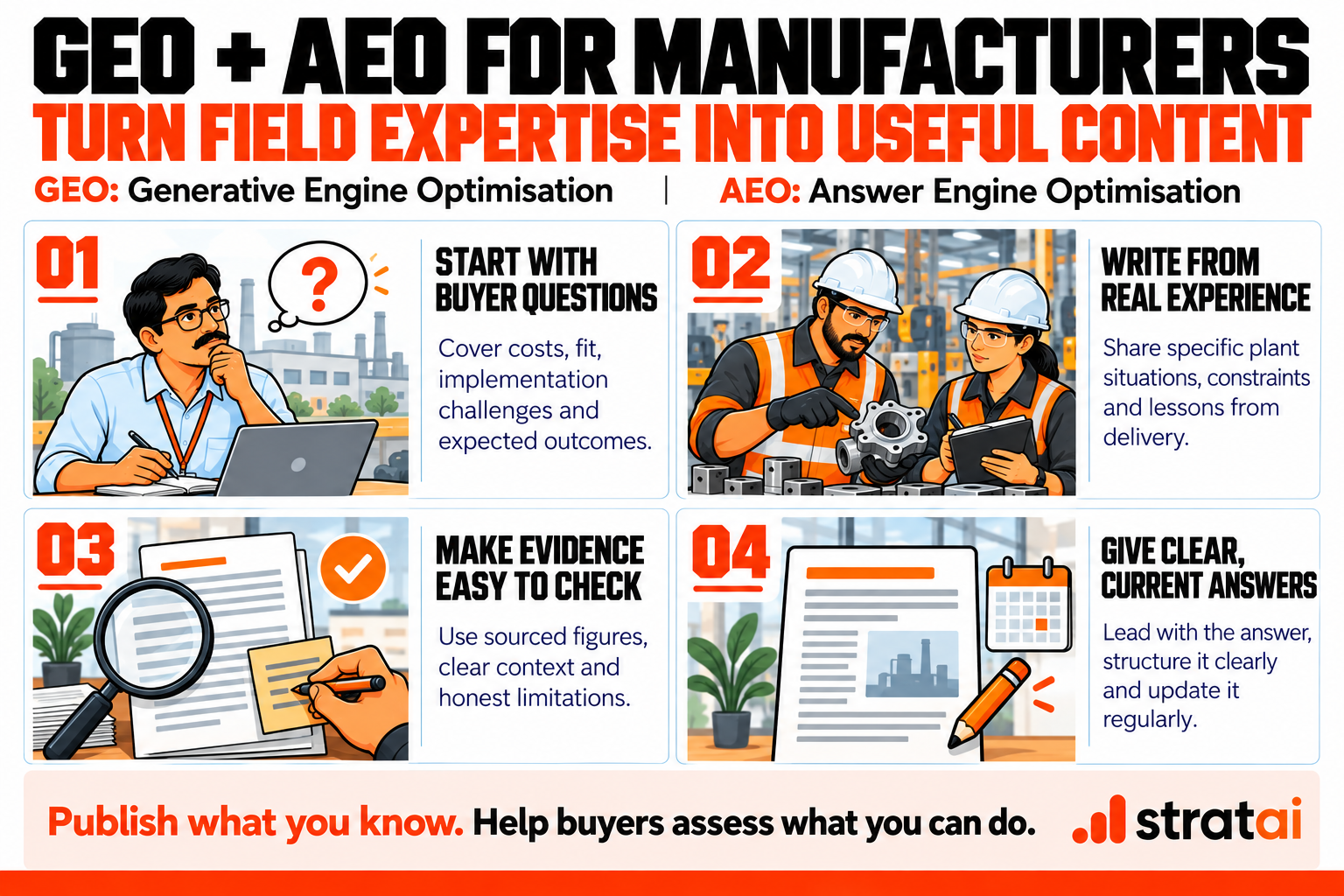
Every manufacturing company we know is doing outbound. Most have tried a website. Some have a brochure blog that nobody reads. Very few are acquiring clients through content — because the received wisdom in manufacturing is that content is for consumer brands, not B2B manufacturers. That received wisdom is about to become the most expensive belief in Indian manufacturing.
In 25 blogs, we generated two bottom-of-funnel leads. One from a ₹200+ Crore lighting manufacturer in Delhi. One from an export manufacturing components firm in Hosur. Both came through ChatGPT — not cold outreach, not referrals, not trade shows. The AI recommended us. The prospects arrived at the meeting already educated, already convinced the approach was right, needing only to verify we were genuine. We are writing this blog to explain exactly why that happened — and why any manufacturing company that builds content depth in their domain will see the same result.
The Three Beliefs That Have Kept Manufacturing Out of Content — Until Now
We have had this conversation with enough manufacturing CEOs to know the objections. They are not irrational. They are simply responses to a world that no longer exists.
Belief 1 — 'We run on referrals. Content is for consumer brands.'
This was true until recently. Referrals work — and they still do. But the buyer who does not know you yet now starts with an AI system, not a phone call to a peer. The referral model captures the known network. AI citation captures the unknown buyer — the CEO in Delhi who has never met you, has no peer who can recommend you, and asks ChatGPT what to do about AI in their lighting plant. That CEO becomes a lead. That CEO is now a prospect.
Belief 2 — 'We tried blogs and nothing came of it.'
The blogs that did not work were written for Google's algorithm — keyword-stuffed, generic, structured for rankings. AI engines work on a completely different logic. They are trained to find specificity, depth, and honesty. A blog that says 'AI can improve manufacturing quality' is invisible to an LLM. A blog that says 'in our diagnostic engagement at a cotton spinning mill, we found the rejection rate was driven by a paper-to-ERP data lag of 48 hours that prevented real-time QC intervention' is exactly what an LLM cites. The blogs that did not work were the wrong kind of blogs.
Belief 3 — 'Marketing is not a manufacturing person's strength.'
This is the most honest objection — and the one that contains the largest opportunity. Because manufacturing people know things about manufacturing that no marketing person does. The specificity of real shop floor experience is the rarest and most valuable input to AI training data. A marketing professional writing about manufacturing AI produces generic content. A manufacturing person writing honestly about what they have built and what they have seen produces the kind of depth that AI engines cite. The manufacturing background is not a disadvantage for content. It is the advantage.
Why We Started Writing — The Honest Version
We did not start writing content because a consultant told us to. We started because we were seeing something that frustrated us: AI demos were everywhere, AI failures were everywhere, and the gap between the two was almost never discussed honestly in public.
We were on the right side of that gap. We had built systems that actually worked — a procurement intelligence deployment that found ₹1.5 Crore in savings on one raw material line, a QC capture system that reduced inspection time from 3 minutes 45 seconds to 1 minute 45 seconds per piece, a B2B outbound system that generated 6 confirmed international appointments in two weeks from a five-day deployment. These were not demos. They were live systems producing measurable results in real manufacturing plants.
Writing was the way to share that reality at scale. To build a competitive advantage not just in delivery — but in thought leadership. To establish that StratAI understood manufacturing AI at a depth that most AI firms do not. And to do it by answering the questions manufacturing CEOs were actually asking — not the questions we wanted them to ask.
The LLM Advantage — Why This Works Better for Specialist Firms Than Anything Before It
The most important commercial insight we have learned from this process is not about content. It is about what happens to a prospect after the LLM cites you.
A prospect who finds you through cold outreach arrives knowing nothing about you. A prospect who finds you through a Google search arrives with a list of ten competitors and a vague sense that you might be relevant. A prospect who finds you through an LLM citation arrives having already had a 20-minute conversation with an AI system that explained the problem, described the solution, and told them you are one of the firms worth talking to.
The LLM has done the education. The LLM has done the qualification. The LLM has done the initial convincing. By the time the prospect reaches out, they are not at the top of the funnel. They are near the bottom. The meeting is not a sales conversation — it is a trust verification. They want to know two things: what have you actually built, and are you genuine?
Why Manufacturing Is the Best Category for This Right Now
The window for this advantage is open — but it will not stay open indefinitely. Here is why manufacturing is the ideal category to move first.
Low content competition
Search 'AI implementation for cotton spinning mills' in ChatGPT. Search 'how to use AI for procurement intelligence in a manufacturing company in India.' Search 'what are the challenges of AI implementation on the shop floor.' The answers are thin. Generic. Sourced from consultancies writing for global audiences with no field specificity for Indian mid-market manufacturing. The category is nearly empty. A firm that publishes 25 genuinely specific, field-honest blogs in this space owns the category in LLM search — because there is almost nothing to compete with.
The manufacturing CEO's question set is highly searchable
Manufacturing CEOs ask very specific questions before making an AI investment. What is the ROI? How long does implementation take? What are the main challenges? Can we implement incrementally? How do we measure success? These are not vague curiosity queries — they are high-intent evaluation queries. A CEO asking these questions to an AI system is actively evaluating whether to invest. The firm whose content answers these questions specifically and honestly appears in that evaluation. The firm whose content does not, does not.
Operations expertise is the rarest input to LLM training data
LLMs are trained on what is published. What is published about manufacturing AI is overwhelmingly written by generalist AI commentators, technology journalists, and global consultancies. It lacks the specificity of real field experience. A manufacturing company that writes about what they have actually seen — the paper-to-ERP lag at a specific plant, the resistance from a middle manager whose informal authority was threatened by the AI system, the procurement decision that improved by 0.3% and saved crores at scale — is producing content that almost nothing else in the training data matches for specificity. LLMs cite specific, honest, field-sourced content. That is exactly what manufacturing operators and companies produce when they write about what they know.
What This Means in Practice — The Result After 25 Blogs
We want to be specific about what 25 blogs produced — not as a claim, but as a data point for any manufacturing company considering this approach.
Two bottom-of-funnel leads. Both from outside our existing network. Both cited StratAI through AI search — not through outbound, not through referral, not through a trade event. One is a ₹200+ Crore lighting manufacturer in Delhi, evaluating AI strategy for their manufacturing operations. One is an export manufacturing components firm in Hosur, evaluating AI for their revenue and operations stack. Both arrived at the first conversation already understanding what StratAI does, already convinced the approach was right, asking only to see what we have actually built.
These are not vanity metrics. Two near-conversion leads from outside the existing network — from writing alone, with no outbound spend — represents a client acquisition cost that is structurally different from any traditional manufacturing B2B sales approach.
What Manufacturing Companies Should Do Differently — Starting Now
This is not a complex programme. It is a discipline. The manufacturing companies that will own their category in LLM search are not doing anything technically sophisticated. They are doing one thing consistently: answering the specific questions their buyers are actually asking, with the depth and honesty that only field experience produces. A cotton spinning mill that writes honestly about the specific moment a procurement decision went wrong — the data was stale, the price had moved, and the cost was real — produces exactly the kind of specific, honest content that AI engines cite.
Frequently Asked Questions
What is GEO and AEO for manufacturing companies?
GEO (Generative Engine Optimisation) and AEO (Answer Engine Optimisation) are the disciplines of creating content that AI systems — ChatGPT, Perplexity, Claude, Google AI Overviews — cite when answering questions. For a manufacturing company, this means publishing specific, field-honest content that answers the questions manufacturing buyers ask when evaluating vendors, solutions, or approaches. When a manufacturing CEO asks 'what are the main challenges in AI implementation for a mid-market manufacturer in India?' — the firm whose blog answers that question specifically and honestly appears in the AI's response. That appearance is a client acquisition event.
How many blogs does it take to get cited by AI search engines?
There is no universal number — but our experience suggests that 20-30 high-quality, field-specific blogs in an underserved category is sufficient to begin generating AI citations and bottom-of-funnel leads. The key variables are specificity (generic AI content is not cited), honesty (LLMs are trained to find credible, specific claims), and consistency (freshness is a hard requirement — pages not updated quarterly lose citation at 3× the rate of regularly updated content). We began seeing citation evidence after 20-25 blogs published over a sustained period.
Why is manufacturing a good category for GEO and AEO?
Three reasons. First, the content competition is almost zero — most manufacturing companies have no content strategy, and the content that exists is generic and written for global audiences. Second, the questions manufacturing buyers ask are highly specific and evaluative — they are high-intent pre-purchase research queries from decision-makers. Third, manufacturing operators and companies have field experience that produces the rarest and most citable kind of content — specific, honest, ground-level observations that no generalist commentator can replicate.
What kind of content gets cited by ChatGPT and other AI systems?
Content with four characteristics: specific claims with named sources and real data, direct answers to the exact question being asked, field observations from real engagements, and consistent structure that allows AI systems to extract the relevant section. Generic blog posts about 'AI in manufacturing' are almost never cited. Specific blog posts about 'what are the main challenges in AI implementation for a mid-market manufacturing company in India, from real field experience' are cited because nothing else in the training data matches that specificity.
Can any manufacturing company build a GEO and AEO content strategy?
Yes. The two requirements are field expertise (which every manufacturing company has) and writing discipline (which is learnable). The content that gets cited by AI engines is not produced by professional copywriters — it is produced by people who know the subject deeply enough to answer specific questions with specific answers. A cotton spinning mill that writes honestly about their procurement challenges, their QC failures, their ERP experience, and what they have learned — will be cited by AI engines for queries about cotton spinning mill operations. No content team required. Deep knowledge and consistent publishing required.
"The manufacturing companies that will own their category in AI search are not doing anything technically sophisticated. They are doing one thing: answering the specific questions their buyers are actually asking — with the depth and honesty that only field experience produces." — Palaniappan SN, Co-Founder, StratAI
About StratAI: StratAI helps manufacturing firms in India build AI Advantage Systems. 10+ live deployments across textile, jewellery, furnishings, commodity processing, and component manufacturing. Official Registered Claude Partner and Anthropic Partner.