What If Your Machine Could Tell You Why It Was Making Bad Parts — Before the Next One Came Off the Line?
Six Sigma reduced aluminium die casting rejection from 17% to 4.8% through parameter optimisation alone. The Machine Knowledge Layer is StratAI's vision for making that continuous — connecting machine manuals, product drawings, IoT parameters, and QC data into one real-time production intelligence system. An honest account of the architecture, and where we are in building it.
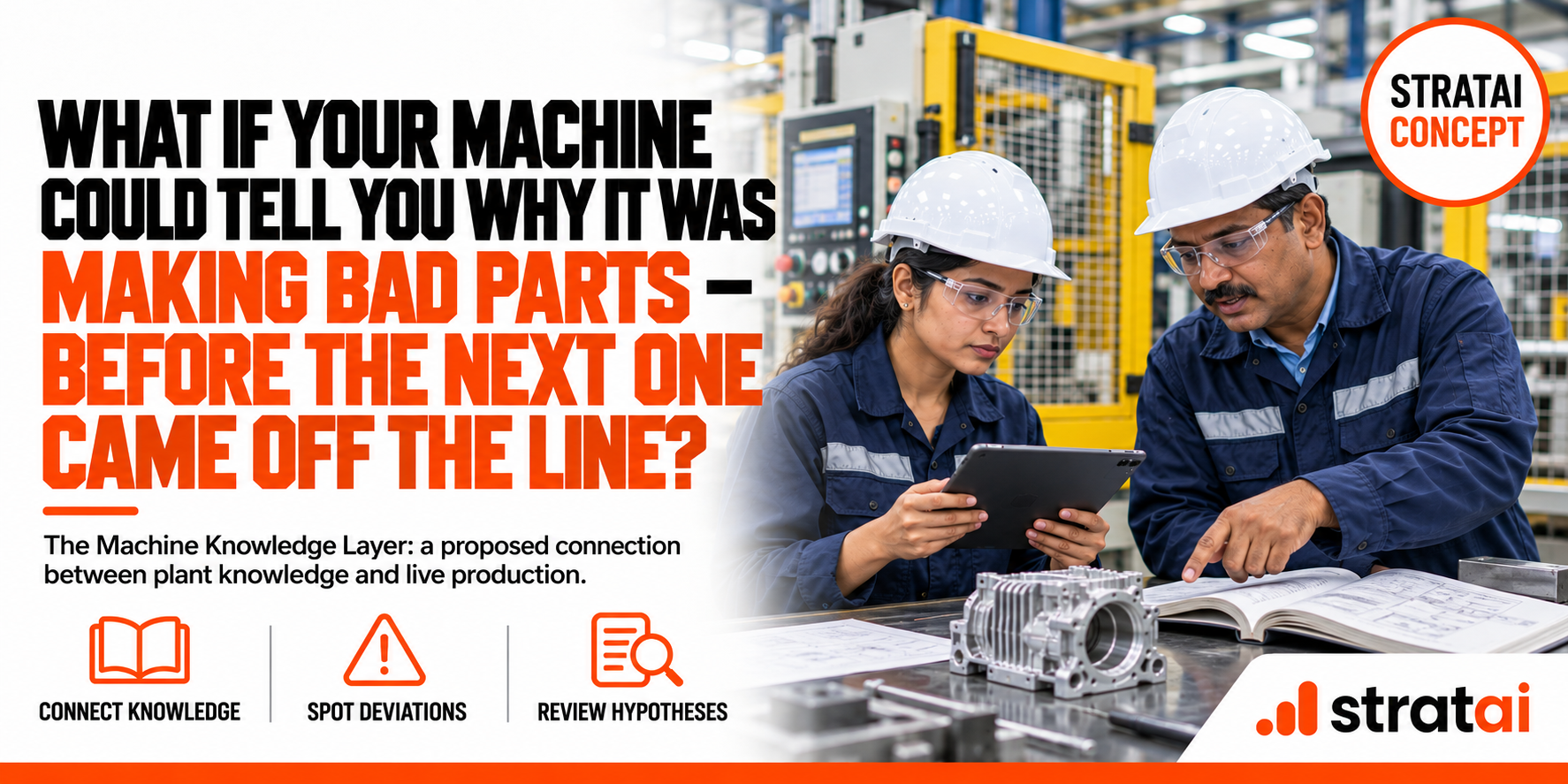
The Machine Knowledge Layer is an AI architecture that connects seven variables — machine manuals, product drawings, tool specifications, machining standards, IoT production parameters, real-time QC defect data, and operator insights — into one 360-degree production intelligence system. It checks parameters before a run, alerts to deviations during a run, and generates root cause hypotheses after a defect. StratAI has built every component in live deployments and is looking for a manufacturing partner to build the first fully connected version with.
An honest note: This blog is different from every other blog on this site. Every other blog describes something StratAI has built and deployed. This one describes something we have not built yet — but believe is one of the most valuable AI systems a mid-market manufacturer could have. We call it the Machine Knowledge Layer. This is our honest thinking about what it is, how it would work, and what it would take to build it. If the problem it solves is real for your plant, we want to build it with you.
The Scene — 11pm on the Shop Floor
Station 7. Aluminium die casting line. The operator has been watching the parts coming off the machine for the last 40 minutes. Something is slightly off — the surface finish on one edge is not quite right. He has seen this before. He thinks it might be a temperature issue. He thinks it might be the die. He is not sure.
The machine manual is on a shelf in the supervisor's office. 340 pages. The relevant section — optimal die temperature ranges for this alloy, and what deviation symptoms look like — is somewhere around page 180. Nobody is going to find page 180 at 11pm.
So he adjusts what he thinks needs adjusting. The next 200 parts come off the line. 30 of them go to rework. 12 are scrapped.
Now imagine a different scene. Same operator. Same machine. Same moment of uncertainty. He takes out his phone and types: 'The edge finish on the last 10 parts looks rough. Machine 7. Die casting. Aluminium A380 alloy.'
The response comes back in seconds. The optimal die temperature for A380 at this ambient condition is between 180 and 210 degrees Celsius. Rough edge finish on this side typically indicates die temperature above 215. Check the temperature log for the last 30 minutes. If it has been running high, reduce by 15 degrees and run 5 test parts before resuming full production.
He checks. It has been running at 218. He adjusts. The next 200 parts are clean.
This is not science fiction. Every piece of knowledge in that response already exists. It is in the machine manual. It is in the ASME standards for die casting. It is in the process specifications for A380 alloy. It is in the institutional memory of the senior QC who has seen this exact symptom on this exact machine seventeen times. The gap is not knowledge. The gap is access — in the right format, at the right moment, by the right person.
The System — What the Machine Knowledge Layer Is
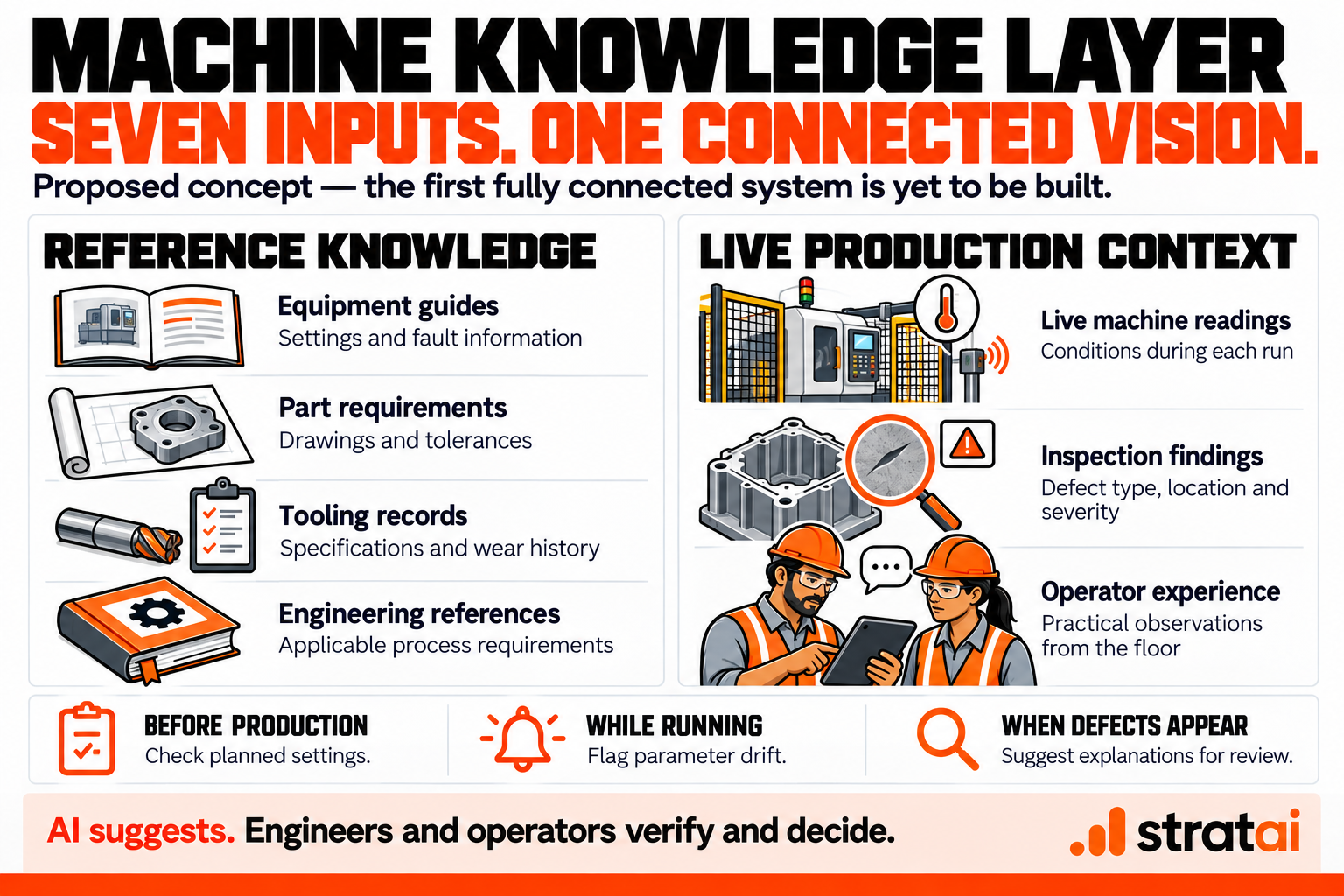
The Machine Knowledge Layer is a 360-degree production intelligence system that connects every variable that influences part quality into one AI layer — and makes that intelligence accessible to the operator and QC at the machine, in real time, in plain language.
It has seven inputs. Four are static — knowledge that already exists but is siloed across manuals, files, standards documents, and toolrooms. Three are dynamic — what is actually happening on the floor right now.
Static Variables · Knowledge that exists but is siloed
01 Machine Data — Operating specs, optimal parameters, fault codes, maintenance schedules. Lives in the manual. Nobody reads it.
02 Product Data — Drawings, tolerances, specifications, quality standards per product. Lives in engineering files. Not connected to the machine.
03 Tool Data — Tool specifications, wear patterns, replacement schedules, optimal parameters per material. Lives in the toolroom. Not connected to either.
04 Standards Data — ASME, machining standards, industry specifications. Referenced manually during audits. Not connected to live production.
Dynamic Variables · What is actually happening
05 Production Parameters — Actual machine settings during a live run via IoT — speed, feed rate, temperature, pressure. Real-time, not logged after the fact.
06 Defect Data — QC audit results mapped in real time — type, location, severity, product, machine, shift, operator. Not in a monthly report.
07 Operator + QC Insights — Experiential knowledge from the people who know this machine best — captured through structured inputs, not lost when they leave.
The architecture principle: Static variables define the envelope — the optimal operating range for this machine, this product, this tool, this standard. Dynamic variables tell you where you are inside — or outside — that envelope right now. AI connects the two. When a dynamic variable moves outside the static envelope, the system knows before the operator does. When a defect appears, the system searches all seven variables simultaneously for the most likely root cause.
What AI Does With All Seven Variables
Before the Run — Parameter Optimisation
A new product run is being set up. The operator enters the planned parameters. The AI checks them against:
— The machine manual — are these parameters within the optimal operating range for this machine?
— The product drawing — do these settings produce the tolerances this product requires?
— The relevant machining standard (ASME or otherwise) — are these parameters compliant?
— The historical defect data — have these parameters produced defects on similar runs before?
— The tool condition — is the tool within the wear range where these parameters are safe?
If any parameter is outside the optimal envelope, the AI flags it before the run begins. Not after the first batch of rejects. Before.
During the Run — Real-Time Deviation Alerts
IoT sensors capture the actual machine parameters during the run — temperature, pressure, speed, cycle time, whatever is instrumented on this machine. The AI compares these continuously against the optimal envelope from the static variables.
When a parameter drifts outside the envelope, the alert arrives at the operator's phone before the drift produces a visible defect. The intervention happens at the moment of cause — not at the moment of consequence.
After a Defect — Root Cause Intelligence
A defect is logged by the QC through the mobile app. The AI immediately searches all seven variables simultaneously: Is the machine running outside optimal parameters? Is the tool near end of life? Is the parameter set wrong for this product at this ambient condition? Has this defect appeared before — and what was the root cause that time?
The AI surfaces the most likely root cause hypothesis. The QC and the operator exercise their judgment — they decide whether the hypothesis is right and what to do. The AI does not make the fix. It makes the diagnosis faster and more complete than any human analysis could at speed.
Six Sigma applied to aluminium die casting reduced rejection rate from 17.22% to 4.8% — a 72% reduction — through systematic parameter optimisation alone. This result was achieved with manual analysis and structured experimental design over months of work. The Machine Knowledge Layer makes this analysis continuous and real-time — every run is an experiment, every defect is a data point, and the optimal parameter envelope narrows automatically with every cycle. What Six Sigma achieves in months, the Machine Knowledge Layer embeds in the daily operation of the plant. Source: Nataraj M., Academia.edu, Six Sigma in Aluminium Die Casting, 2022
The Compounding Effect — Why High Volume Amplifies the Value
The Machine Knowledge Layer is most powerful for a moderate range of products produced in high volume. Here is why: once the AI has optimised the parameters for a specific product on a specific machine, that optimisation applies to every subsequent run of that product. One-time optimisation. Perpetual downstream benefit.
In aluminium die casting specifically — or any high-volume precision manufacturing — the economics are stark. A 1% reduction in rejection rate across thousands of parts per month changes the unit economics of the entire operation. The AI layer does not need to eliminate all defects to produce significant value. It needs to move the rejection rate consistently in the right direction.
5% of all castings are scrapped due to poor quality — wasting an estimated $100 million per year in remelting costs alone, plus significant energy losses. This is the cost of operating without a systematic connection between the knowledge of optimal parameters and the actual parameters being run. The knowledge to prevent most of this waste already exists — in machine manuals, in standards, in the heads of experienced operators. The Machine Knowledge Layer makes that knowledge available at the moment of decision rather than after the moment of loss. Source: US Department of Energy / Worcester Polytechnic Institute, Aluminium Die Casting Research
Most industrial QC systems reduce all generated data — sometimes gigabytes per part — to a simple good/bad decision. All other data is dismissed, despite containing valuable information to optimise production. The Fraunhofer / RONAL GROUP research demonstrates what is possible when that dismissed data is systematically used: training a neural network on serial production and X-ray inspection data to predict defect patterns before they appear. The Machine Knowledge Layer applies the same principle without requiring X-ray infrastructure — starting from the data that any manufacturer already generates. Source: Fraunhofer EZRT / RONAL GROUP, Cast Control Project, Research and Review Journal of Nondestructive Testing, 2023
How to Start — Targeted, Not Plant-Wide
The Machine Knowledge Layer does not need to be implemented across the entire plant. It should not be. The right starting point is the defect hot spots — the specific machines, products, and processes with the highest rejection rates and the highest downstream cost of those rejections.
01 · Identify the defect hot spots
Which machine-product combinations have the highest rejection rates? Which defects carry the highest downstream cost — either in rework time or in the cost of the parts that are scrapped? Start there.
02 · Give priority to upstream processes
A defect caught and fixed at the casting stage saves every subsequent machining, finishing, and assembly operation that would have been performed on a defective part. Upstream intervention compounds its savings downstream.
03 · Start with special purpose machines
Their operating parameters are more fixed, their manuals are more specific, and the cost of running them outside optimal parameters is highest. The signal-to-noise ratio for the AI is better. The ROI per implementation hour is higher.
04 · Test with a few products and machines first
Build the working model. Refine it. Scale only what has been proven on this specific plant's data. The temptation to scale before the model is refined is the most common implementation failure in systems of this complexity.
What makes this difficult — and why that matters: This is not an easy use case to implement. It requires management vision — a CEO who sees the long-term value of systematic production intelligence and gives the engagement the time it needs. It requires QC and operator support — the people who generate the dynamic data must believe the system is for them, not surveillance on them. It requires a working model to be tested, refined, and proven before scaling. And it requires the intellectual honesty to start small, learn from the data, and expand only when the system has earned the right to expand. Without any of these, a use case of this depth and potential impact becomes impossible to implement. With all of them, it becomes compounding competitive advantage.
The Honest Position — We Have Not Built This Yet
Every other blog on this site describes something StratAI has built and deployed in a live manufacturing environment. This one is different. The Machine Knowledge Layer, as described above — with all seven variables connected, with real-time IoT parameter monitoring, with AI-driven root cause hypothesis generation — is not a system we have built yet.
What we have built are the components. We have built mobile-first QC data capture systems. We have built document intelligence systems that extract and structure information from machine manuals and technical documents. We have built real-time ERP connectivity layers. We have built natural language query interfaces on top of manufacturing data. Every component of the Machine Knowledge Layer exists in our live deployments. The architecture to connect them into a single 360-degree production intelligence system is where we are going next.
We are being honest about this for one reason: if you are a mid-market manufacturer with a defect hot spot — a machine-product combination where rejection is high, where the parameters are poorly controlled, where the knowledge to fix it exists somewhere but is not being used — we want to build this with you. Not for you. With you. Because the system will only work if the people who run your machines believe in it, contribute to it, and use it.
The global aluminium die casting market is valued at $86 billion in 2024, growing to $127 billion by 2030. Defects in die-cast components can cause liability issues, profit losses, and irreversible brand damage. The market is growing. The quality bar is rising with it — particularly in automotive and EV applications where defect tolerance is near zero. The manufacturers who build systematic production intelligence now will have a structural advantage over those who continue to rely on manual analysis and tribal knowledge. The Machine Knowledge Layer is the system that builds that advantage. Source: ResearchAndMarkets / NextMSC, Aluminium Die Casting Market, 2025
If your plant has a defect hot spot — we want to build this with you. → Book your free half-day audit — no commitment, no strings. We map your highest-priority machine-product defect combination, assess the data already available, and design the first version of the Machine Knowledge Layer for your specific operation. We confirm your audit date within one business day.
Frequently Asked Questions
What is a Machine Knowledge Layer in manufacturing AI?
A Machine Knowledge Layer is an AI system that connects all the variables that influence part quality — machine manuals, product drawings, tool specifications, machining standards, real-time IoT machine parameters, live QC defect data, and operator insights — into one connected intelligence layer. It makes this knowledge accessible to operators and QC teams in plain language, at the machine, in real time. The system checks parameters before a run, alerts to deviations during a run, and generates root cause hypotheses when defects occur. It is most powerful for high-volume production of a moderate range of products where one-time parameter optimisation produces compounding downstream savings.
Has StratAI built the Machine Knowledge Layer?
Not as a complete integrated system — not yet. We have built every component separately in live deployments: mobile-first QC data capture, document intelligence from machine manuals, real-time ERP connectivity, and natural language query interfaces on manufacturing data. The Machine Knowledge Layer connects these components into one 360-degree production intelligence system. This is the direction we are building toward — and we are looking for the right manufacturing partner to build the first complete version with. If your plant has the right defect hot spot and the management commitment to make it work, we want to have that conversation.
Which manufacturing environments are best suited for a Machine Knowledge Layer?
High-volume production of a moderate product range — where one-time parameter optimisation produces compounding savings across every subsequent run. Aluminium die casting is an ideal environment: tight tolerances, temperature-sensitive parameters, tool wear as a primary defect driver, and defects that propagate expensively downstream. Component manufacturing, precision machining, and any process with well-defined optimal parameter ranges and high rejection cost are strong candidates. The system is least suited to highly custom one-off production, where volume does not justify the optimisation investment.
What does it take to implement a Machine Knowledge Layer?
Four things, in order of importance: management vision (a CEO who gives the engagement the time to go deep and build correctly), QC and operator support (the people who generate dynamic data must believe the system is for them), a willingness to start small and refine (test with two or three machine-product combinations before scaling), and a clear defect hot spot to start with (the highest rejection rate, highest downstream cost combination in the plant). Without all four, a use case of this depth becomes very difficult to implement. With all four, it becomes compounding competitive advantage.
Why start with upstream processes rather than downstream?
A defect caught at source saves every subsequent operation that would have been performed on a defective part. In aluminium die casting: a rejected casting that is caught at the casting stage saves the machining, finishing, and inspection time that would have been spent on a part that was never going to pass. A rejected casting caught at final inspection has consumed all of that time and material. Upstream intervention compounds its savings. Downstream intervention recovers only the final inspection cost.
About StratAI
StratAI helps manufacturing firms in India build AI Advantage Systems. 10+ live deployments across textile, jewellery, furnishings, commodity processing, and component manufacturing. Official Registered Claude Partner and Anthropic Partner.
stratai.io/contact · palani@stratai.io · +91 99402 25924
"Every variable that causes a defect is knowable. The machine knows its optimal parameters. The drawing knows the required tolerance. The standard knows the acceptable range. The tool knows its wear state. The only thing missing is a system that connects all of them — and checks, in real time, whether this run is within the envelope that produces a good part."
— Palaniappan SN, Co-Founder, StratAI
What is a Machine Knowledge Layer in manufacturing AI?+
Has StratAI built the Machine Knowledge Layer?+
Which manufacturing environments are best suited for a Machine Knowledge Layer?+
What does it take to implement a Machine Knowledge Layer?+
Why prioritise upstream processes over downstream in defect reduction?+

Palaniappan SN is a Business Strategy Consultant who has spent his career at the intersection of business strategy and operational reality — working across management levels from the boardroom to the shop floor to understand where organisations actually win and lose. His conviction is simple: AI should never be an experiment. It should be an advantage. That belief is the foundation of StratAI's AI Advantage Systems methodology — built not from technology-first thinking, but from the ground up, with the discipline to walk away from projects where the conditions for success don't exist.