AI in Manufacturing: Why Most CXOs Invest — And Never See It in the P&L
The gap between AI investment and P&L impact is not a technology problem. It is an expectations problem — and a systems problem. Here is the honest breakdown.

Most manufacturing AI investments fail to show up in the P&L not because the technology is flawed but because the implementation model is wrong. AI is not a product you install — it is a system you evolve. The minimum honest timeline for P&L impact is six months, and only if the first three months are done right. The project-based vendor model, speed-over-understanding decisions, and misaligned expectations are the three primary failure drivers. The companies that win choose domain-first partners, commit to a retainer model, and apply the 80-20-80 build framework across use cases.
The gap between AI investment and P&L impact is not a technology problem. It is an expectations problem — and a systems problem. Here is the honest breakdown.
The call lasted forty minutes.
The manufacturing company on the other side of the screen was serious — mid-sized, well-run, genuinely curious about AI. They had done their research. They had a budget. They had a mandate from the board.
Then came the question that changed everything.
"When are you expecting to see results?"
A brief pause. Then the senior leader leaned forward and said, with complete sincerity:
"Yesterday."
We thanked them for their time. And we walked away from the project.
Not because the opportunity wasn't real. It was. Not because the company wasn't capable. They were. We walked away because no system built in a rush, against a yesterday deadline, ever shows up in a P&L. And we were not willing to be another vendor who promised the impossible, collected the retainer, and disappeared after month four.
That conversation stays with us. Because it is not an outlier. It is the norm.
Across manufacturing boardrooms in India and globally, the pattern repeats with near-perfect consistency: AI gets approved, AI gets implemented, AI gets demoed at the quarterly review — and the P&L doesn't move. The CEO gets frustrated. The CFO pulls the budget. The vendor gets blamed. And the company concludes that AI doesn't work for manufacturers like them.
The truth is more uncomfortable. AI works. The approach doesn't.
80% of AI projects fail — twice the failure rate of non-AI technology projects. The number has not improved as investment has grown.
The Expectation Gap: Why AI in Manufacturing Rarely Shows Up in the P&L
Before we talk about what makes AI work in manufacturing, we need to be honest about what is breaking it.
When a manufacturing CEO signs off on an AI investment, the mental model in the room is usually software implementation. You buy it. You install it. You use it. You see results. That model works for ERP. It works for CRM. It works for most enterprise software. It does not work for AI Advantage Systems — and the reason is fundamental, not technical.
AI is not a product you install. It is a system you evolve.
The difference matters more than most CXOs realise at the time of signing.
A software implementation has a finish line. You go live, you train the team, you move on. An AI system has no finish line. It has a direction. It learns from your processes, your data, your people, and your feedback. It improves over time. It adapts as your business changes. It compounds.
But compounding takes time. And time is the one thing most manufacturing CXOs are not willing to give AI.
The expectation in the market is: implement AI, see impact in a few weeks. The reality is that for AI to show up in your P&L, the minimum honest timeline is six months — and that is only if the first three months are done right.
Six months is not a vendor excuse. It is the architecture of how AI actually creates business value.
The first three months are spent doing the work that nobody sees — and the work that determines everything. User interviews. Process mapping. Identifying where the real friction lives, not where management assumes it lives. Building something at 60%, showing it to the people who will actually use it, watching them react, rebuilding based on what you learn. That cycle — build, show, learn, rebuild — is not waste. It is the system learning how your business actually works.
Results appear in months four through six. And they appear only because months one through three were done right.
30% of AI projects are abandoned after proof of concept. Poor data quality, escalating costs, and unclear business value are the primary reasons — none of which are technology failures.
The 4 Truths Every Manufacturing CXO Must Accept Before Investing in AI
After working with manufacturing companies across sectors and geographies, we have identified four truths that separate the CXOs who see AI in their P&L from those who don't. None of these are comfortable. All of them are non-negotiable.
Truth 1: AI Is Not a Software Implementation. It Is a System Evolution.
When you implement an ERP, you configure it to match your business. When you build an AI system, the system must be continuously calibrated to match the way your business actually operates — not how it operates on paper, but how it operates in reality.
This means the relationship with your AI partner cannot be project-based. A project has a start date and an end date. AI system evolution has a start date and a continuous improvement cycle. The engagement model that works is a retainer — not a one-time project.
The best approach we have seen in practice follows what we call the 80-20-80 Model: build use case one to 80% completion, begin fine-tuning it toward 100%, and simultaneously begin building use case two from 0% to 80%. Never wait for perfection before moving to the next lever. Always be in motion across the system.
Truth 2: Domain Expertise Matters More Than AI Expertise.
This is the truth that most AI vendors do not want you to hear, because it disqualifies most of them.
The team implementing AI in your manufacturing business must understand manufacturing before they understand AI. They must understand your specific business model, your supply chain structure, your rejection patterns, your procurement cycles, and how people actually behave on your shop floor — before they write a single line of code. You can see this principle at work across our manufacturing case studies — and in our detailed guide on how to test for domain expertise in your next vendor meeting.
A team with deep AI expertise but shallow domain knowledge will build a system that is technically impressive and operationally useless. It will get demoed, approved, started, and quietly abandoned by month four — because it was built for a manufacturing company in theory, not yours in practice.
Truth 3: The Project-Based Model Is Designed to Fail.
The standard AI vendor model looks like this: scoping phase, build phase, delivery phase, done. The vendor moves on. Your team is left holding a system they do not fully understand, with no one to call when something changes in your business.
Six months later, the system is being used by three people instead of thirty. A year later, it is not being used at all. The P&L never moved.
The project-based model fails because AI systems require continuous context. Your business is not static. Your processes evolve. Your team changes. Market conditions shift. An AI system calibrated to your business six months ago needs to be recalibrated to your business today. That recalibration cannot happen if your AI partner has moved on to the next project.
The only model that works for AI in manufacturing is a long-term partnership. A partner embedded in your business. Who knows your operations the way your own team does. Who evolves the system as your business evolves.
Truth 4: Speed Is the Enemy of AI ROI.
The entrepreneurial instinct that built your manufacturing business — move fast, make decisions, execute — works against you in AI implementation.
The fastest way to get AI into your P&L is to slow down in the beginning. Spend the first ninety days doing the work that nobody wants to do: understanding the real problem, not the presenting problem. Mapping the actual process, not the idealized process. Building relationships with the people on the ground who will make or break adoption.
The companies that rush this phase — that skip the user interviews, that take management's description of a process at face value, that prioritise speed over understanding — are the companies whose AI never shows up in the P&L.
Good things take time to build. In any business, interventions show up in the P&L only when they align with strategy, integrate with existing processes, and navigate the human behavioural change required for adoption. AI is no different. It is more complex.
Only 6% of companies see significant financial returns from AI. Of the 88% of organisations now using AI in at least one function, only 6% report EBIT impact of 5% or more.
What It Actually Looks Like When AI Shows Up in the P&L
Theory is one thing. Reality is another. Here is what the process looks like in practice — drawn from a live StratAI engagement.
We work with a German-based buying house that serves the European garment market, operating out of Tirupur — the garment manufacturing hub of India. They work with over 25 contracted factories and serve more than 50 global brands. Their business runs on two critical roles: QC executives who work inside contracted factories ensuring output quality, and merchandisers who coordinate every aspect of each style — serving as the single point of contact between the customer, the vendor, the QC team, and the supplier.
When we came in, the first question we asked was not "where can we use AI?" The first question was "where is the real friction for your people?"
The answer came from the ground — not from management.
In our initial diagnostic, we found that every QC executive was spending one and a half hours after their working day manually entering QC data — not because they wanted to, but because the system required it. That data entry happened after the work was done, which meant it was often rushed, sometimes incomplete, and always a source of exhaustion and frustration.
Our process audit revealed that QC measurement for each garment piece was taking three minutes and forty-five seconds per piece. For a 500-piece order, QC executives were required to measure 70 pieces. That is over four hours of measurement time per order — for a single order.
Separately, the merchandising team — 50 people across three countries — was spending significant portions of their week manually entering data from documents that already existed digitally: Tech Packs, Purchase Orders, Packing Lists. Information sitting in PDFs, being typed by hand into systems.
The first three months were spent in endless user interviews. Understanding the pain. The complexity in the problem. Trying to simplify it. Changing it in a way that reduces friction for the user. Showing them the UI. Getting feedback. Rebuilding. Finishing one use case and starting the next while fine-tuning the first.
What we built was not glamorous. It was not the kind of AI that gets written about in technology magazines.
We introduced voice-based AI for QC measurements — reducing the per-piece measurement time from three minutes forty-five seconds to one minute forty-five seconds, as measured across live production runs. We built an integrated data capture system that eliminated the post-shift data entry entirely. We built a document intelligence layer that converts uploaded Tech Packs, POs, and Packing Lists into structured digital entries that merchandisers review and approve in a single screen — instead of typing.
The saving, as tracked in our engagement: one-fifth of a merchandiser's working day, per week, across 50 merchandisers in three countries.
Results began appearing at month four. Not because we were slow. Because months one through three were spent doing the work that made month four possible.
Fast forward six months. The same team will be able to take 25% more load. They will win better styles from their customers because delivery will improve and their people will have time to build relationships instead of entering data. That is when the impact of AI will be fully visible in their P&L.
"Most systems are designed in boardrooms. StratAI started on the shop floor — and came back to the shop floor to see if it actually worked. That's the difference."
"For the first time, we are not just managing requests from multiple stakeholders. We are actually acing them. StratAI made that possible."
"They earned something most vendors never do — our trust. Now they are part of every key decision we make."
The Domain-First Principle — How to Choose the Right AI Partner
At StratAI, we call this the Domain-First Principle. It is the single most important filter a manufacturing CXO can apply before engaging any AI partner. Learn more about how we apply it in our AI Transformation Strategy approach.
The Cost of Getting This Wrong
Three years from now, every manufacturing company will have attempted AI. The landscape is moving too fast for it to be optional.
The companies that win will not be the ones that moved first. They will not be the ones that signed the biggest contracts with the most impressive-sounding vendors.
They will be the ones that moved right. The ones that chose partners with real domain expertise over partners with polished demos. The ones that committed to a six-month horizon when every instinct said to demand results by next quarter. The ones that understood that AI is a system evolution — not a software purchase.
The cost of getting this wrong is not just a wasted budget. It is a lost window. The manufacturing leaders who build real AI Advantage Systems in the next 18 months will have a compounding operational advantage that becomes harder to close with every passing quarter.
A competitor who has genuinely embedded AI into their quality control, procurement, and sales processes — and has been running those systems for 12 months — is not six months ahead of you. They are structurally ahead of you. Their systems are learning. Yours haven't started.
What to Do on Monday Morning
If this has landed the way it was intended, you are not thinking about which AI vendor to call. You are thinking about two more fundamental questions.
The first: What are my real expectations, and are they honest? If you are expecting results in weeks, you are not ready for AI. Not because AI is not ready for you — but because you will pull the plug at month three, one month before results would have appeared. Audit your expectations before you evaluate any vendor.
The second: Does the partner I am considering understand my business — or just AI? Ask them about your specific business model. Ask them about your production process. Ask them about the people on your floor and how they work. If their answers are generic, their system will be generic. Generic systems do not show up in P&Ls.
AI doesn't create advantage by default. Advantage is engineered — system by system, decision by decision, visible only when it shows up in the P&L.
The manufacturing leaders who will win with AI are not the ones who invest the most. They are the ones who go in with a clear manufacturing AI strategy — and the patience to execute it right.
Most manufacturing CXOs we speak with have invested in AI — and are not sure whether it is working. If that is where you are, the right next step is clarity, not another vendor conversation.
StratAI works with manufacturing leaders to diagnose where the highest-leverage AI opportunity sits in their specific business — and build the system that makes it show up in the P&L.
→ Let's map your first AI Advantage SystemNot ready for a conversation yet?
Answer 23 questions about your business and get a personalised AI readiness score, your biggest P&L gap, and 3 specific next steps — in under 5 minutes.
→ Take the AI Readiness Assessment and get detailed Feedback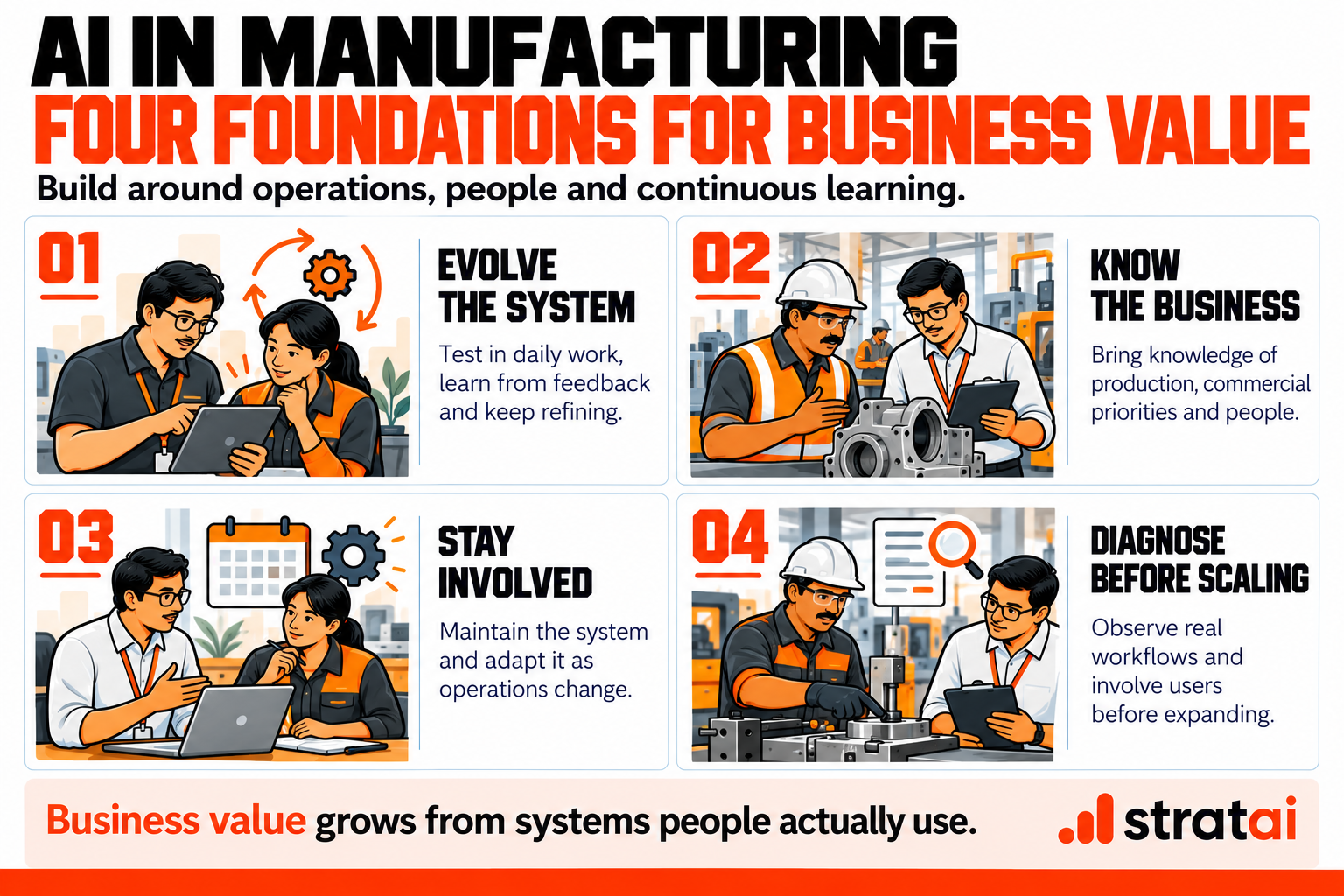
Why does AI in manufacturing take 6 months to show up in the P&L?+
What is the biggest reason AI projects fail in manufacturing?+
What is the Domain-First Principle in AI implementation?+
Should manufacturing companies use a retainer or project model for AI?+
Where should a manufacturing company start with AI?+
Why do so few companies see real ROI from AI?+

Palaniappan SN is a Business Strategy Consultant who has spent his career at the intersection of business strategy and operational reality — working across management levels from the boardroom to the shop floor to understand where organisations actually win and lose. His conviction is simple: AI should never be an experiment. It should be an advantage. That belief is the foundation of StratAI's AI Advantage Systems methodology — built not from technology-first thinking, but from the ground up, with the discipline to walk away from projects where the conditions for success don't exist.