Your AI Vendor Knows Technology. The Question Is Whether They Know Your Business.
Most AI failures in manufacturing are not technology failures. They are domain failures. Here is how to tell the difference — and how to test for it before you sign the contract.
Most AI failures in manufacturing are domain failures, not technology failures — vendors who know the technology but not the business. The 5-Layer Domain Test evaluates a vendor across Industry Fundamentals, Business Model, Strategic Context, Function-Specific Process Knowledge, and Human Behaviour & Change Management. Most existing ERP data is post-mortem — it explains what happened, not what to do next — so an AI built only on that data gives faster post-mortems, not better decisions. The clearest signal of a domain-first partner: they ask what you would NOT automate, and why, and they spend time on your shop floor before proposing anything. A retainer-based partner is incentivised to deliver an outcome; a fixed-cost vendor is incentivised to deliver scope.
Most AI failures in manufacturing are not technology failures. They are domain failures. Here is how to tell the difference — before you sign the contract.
The founder called us after seeing a post on LinkedIn. He ran a consumer medical devices company — a mid-sized Indian manufacturer that made certain products in-house and imported others. He had just closed a funding round. He was ambitious, clear-eyed, and impatient in exactly the way visionary founders are.
Our first engagement was building an AI-based procurement planning system. Seven to eight data uploads from Amazon, Flipkart, and Meesho — all feeding into a planning engine that weighed ACOS, return rates, listing reviews, stock levels, and competitor pricing.
Then something happened that had nothing to do with AI.
As we moved deeper into the business, we noticed the management structure was task-based — functional for survival stage, but incompatible with the scaling ambition the founder had just raised capital to pursue. You cannot build an intelligent AI layer on top of a management architecture not built to scale.
We raised this with the founder. Not as a scope change. Not as an upsell. As an observation from people who had spent enough time inside his business to see what he was too close to see himself. He acted immediately. We recommended OKR — Objectives and Key Results — as the management framework. He agreed. Read the full case study →
A vendor who only understood AI would have built the procurement system, handed it over, and moved on. In twelve months, they would have had the same structural problem — just with better data about it.
95% of GenAI pilots fail to deliver measurable P&L impact. The reason is almost never technology. It is the absence of domain understanding.
The Demo Is Not the Delivery
Every AI vendor can build a compelling demo. The demo is easy — you control the data, the scenario, the outcome. The day after go-live is a completely different problem. After go-live, the system must work with your data, your people, your existing systems, your business context.
Most AI vendors are solving for the demo — not for the day after go-live. The gap between these two objectives is where most manufacturing AI projects die.
In our previous blog on why AI investment fails to show up in the P&L, we described the 4 Truths manufacturing CXOs must accept before investing in AI. Truth 2: domain expertise matters more than AI expertise. This blog is the practical application — what domain expertise actually looks like, how to test for it using the 5-Layer Domain Test, and what happens when it is absent.
42% of companies abandoned most AI initiatives in 2025 — up from just 17% the previous year.
The 5 Layers of Domain Knowledge — And Where Vendors Fail at Every One
When we say domain expertise, most people assume we mean industry knowledge — knowing how manufacturing works in general. That is Layer 1 of 5. The other four are where the real difference between a vendor and a partner lives.
| # | Layer | What it means | Where vendors fail |
|---|---|---|---|
| 01 | Industry Knowledge | Your specific sector. How it competes. Where margins live. | Most vendors know manufacturing generically. Not your industry specifically. |
| 02 | Business Model Understanding | How your company makes money — and where it quietly loses it. | Vendors see the org chart, not the P&L logic. |
| 03 | Strategic Context | What stage of life is this business in? AI built for scaling looks completely different from survival mode. | Vendors propose without knowing if the company is ready. Result: technically right, organisationally wrong. |
| 04 | Function-Specific Process Knowledge | How procurement actually works — not how the SOP says it works. | The gap between boardroom description and floor reality is where most AI projects die. |
| 05 | Human Behaviour & Change Management | Who resists change and why. Who holds informal authority no org chart shows. | Entirely ignored by most vendors. Yet it is the single biggest reason AI adoption fails after go-live. |
The Post-Mortem ERP Problem — Why Your Existing Data Is the Wrong Foundation
Your ERP was designed for data capture and reporting — not a decision-first, process-first mindset. The result: the overwhelming majority of data in your ERP is post-mortem. It tells you what happened. It cannot tell you what to do next.
Post-mortem data used to power AI gives you faster post-mortems. It does not give you better decisions. A vendor who does not understand how your ERP is currently used — and where it fails you — will build AI on top of the wrong data foundation.
The 5-Layer Domain Test — How to Evaluate Every AI Vendor
| Ask this | What the answer reveals |
|---|---|
| What do you know about our industry, business model, and strategy? | A vendor who has done their homework answers with specifics. A vendor solving for the demo gives generic manufacturing answers. |
| What have you done in a similar space? Can I speak to two references from comparable implementations? | Same industry, same business stage, similar operational complexity. Not their best client — their most relevant client. |
| What would you NOT automate in our business — and why? | This is the question that separates domain experts from technology sellers. A vendor who understands your business immediately names two or three things. A vendor solving for the demo will struggle. |
| Will you work on the ground — on our shop floor, with our team? | Any vendor who proposes without spending time in your operations is designing for a business they have imagined, not the one you run. |
| What are the top three challenges you expect in implementing this — and how will you handle them? | Specific challenges show domain awareness. Generic answers show the opposite. |
Score your vendor across all 5 layers. Get an AI-generated verdict: Strong Domain Fit, Probe Further, or Insufficient — plus specific follow-up questions for your next meeting.
→ Run the 5-Layer Domain TestThe technology can be improved. The domain understanding must already exist.
Rate up to 3 vendors across all 5 layers. Get a ranked verdict, your biggest domain risk, and 2 specific follow-up questions per vendor — based on your actual scores.
→ Run the Scorecard — FreeWhat a Domain-First Vendor Actually Does — Before They Propose Anything
In our medical devices engagement, we did not propose an OKR framework in the first meeting. We saw the need after weeks of working inside the business. The retainer model made all of this possible. On a fixed-cost project, raising the OKR observation would have triggered a scope change discussion. On a retainer, it was simply the right thing to do.
A vendor on a fixed-cost project is incentivised to deliver the scope. A partner on a retainer is incentivised to deliver the outcome. Those are not the same thing.
Specialised vendor-led AI projects succeed 67% of the time vs 33% for internal builds. The difference is domain specificity, not technology access.
What to Do Before Your Next Vendor Meeting
Stop leading with technology questions. The first filter is domain knowledge. Run the 5-Layer Domain Test in your next vendor meeting. Score every vendor on all five layers. Ask them what they would not automate. Ask them whether they will spend time on your shop floor before submitting a proposal.
The right AI partner will ask more questions than they answer in the first meeting. That intellectual curiosity about your business is the single clearest signal of domain depth.
Your AI investment will show up in the P&L only if it is built on accurate understanding — of your industry, your business model, your processes, your people, and the stage of life your organisation is actually in. Technology is the tool. Domain knowledge is what makes the tool useful.
Vendor evaluation is one part of getting an AI consulting engagement right. the complete guide to AI consulting for manufacturing firms in India covers the rest — how to scope the engagement, structure pricing, and hold the partner accountable for outcomes, not just delivery.
StratAI works with manufacturing leaders to identify where AI can create real competitive advantage — starting with a deep understanding of your business, your stage, and your people. Not a demo. Not a proposal. A genuine diagnostic.
→ Let's map your first AI Advantage SystemA 30-minute conversation. No pitch deck. Just clarity on where AI can move your P&L.
Not ready for a conversation yet?
Use the 5-Layer Domain Test Scorecard to evaluate your current or prospective AI vendor. Score /10 per layer. Get an instant AI-generated verdict — Strong Domain Fit, Probe Further, or Insufficient — plus specific follow-up questions. Takes 15 minutes. Saves 12 months with the wrong partner.
→ Run the 5-Layer Domain Test and get your vendor verdict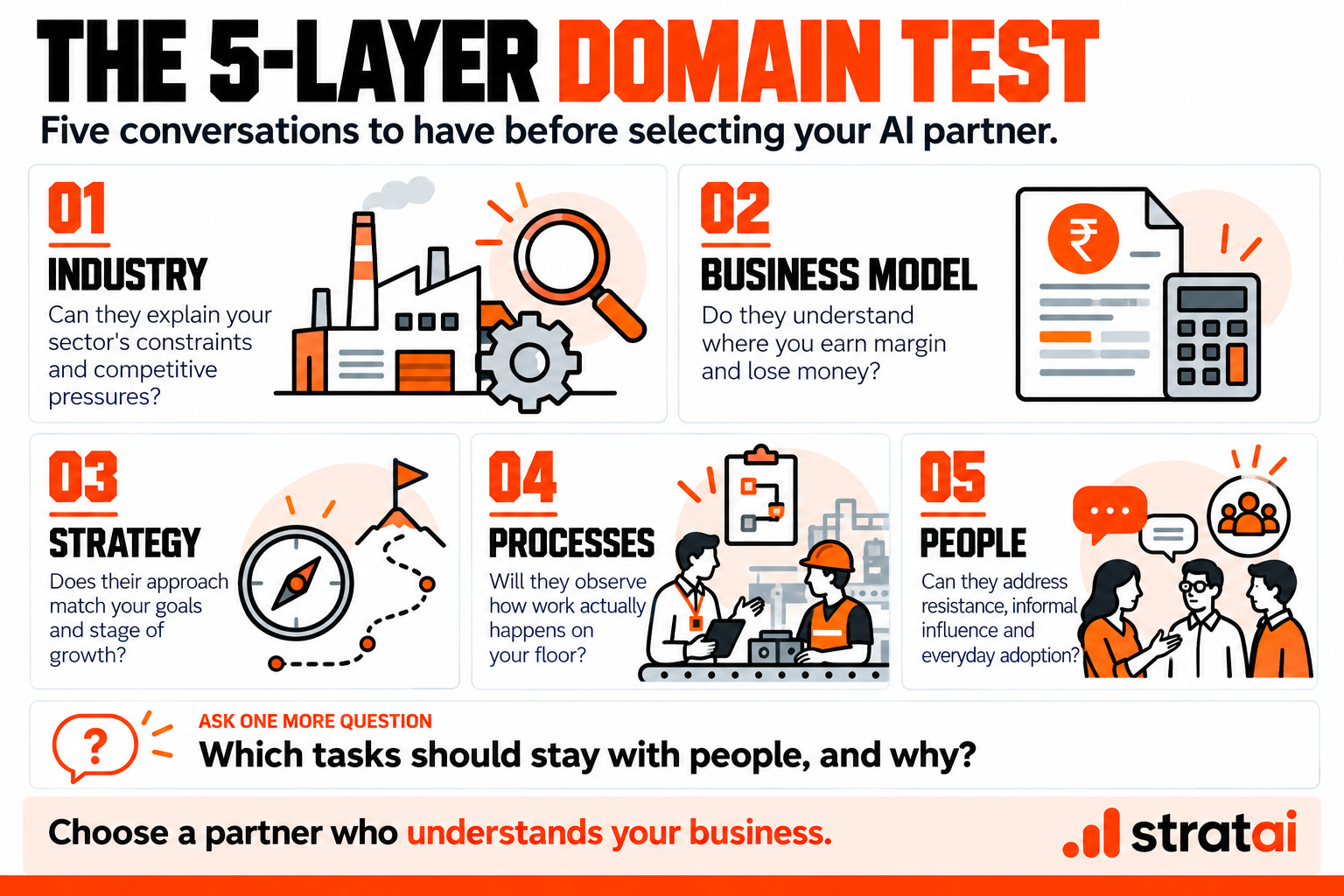
How do I evaluate an AI vendor's domain expertise in manufacturing?+
What is the Domain-First Principle in AI partner selection?+
Why do most AI vendors fail to understand the businesses they work with?+
What is the post-mortem ERP problem and how does it affect AI implementation?+
Should I choose a retainer or fixed-cost model for AI implementation?+
How long should an AI vendor spend understanding my business before proposing?+

Palaniappan SN is a Business Strategy Consultant who has spent his career at the intersection of business strategy and operational reality — working across management levels from the boardroom to the shop floor to understand where organisations actually win and lose. His conviction is simple: AI should never be an experiment. It should be an advantage. That belief is the foundation of StratAI's AI Advantage Systems methodology — built not from technology-first thinking, but from the ground up, with the discipline to walk away from projects where the conditions for success don't exist.