AI Use Cases for Manufacturing Companies — Part 2: The Revenue-Side Use Cases Most Manufacturers Have Never Considered
Every AI conversation in manufacturing starts with cost. But the highest-ceiling AI use cases in manufacturing — the ones that can recover an entire year's consulting investment from a single conversion — are on the revenue side. And most manufacturers have never been shown them.
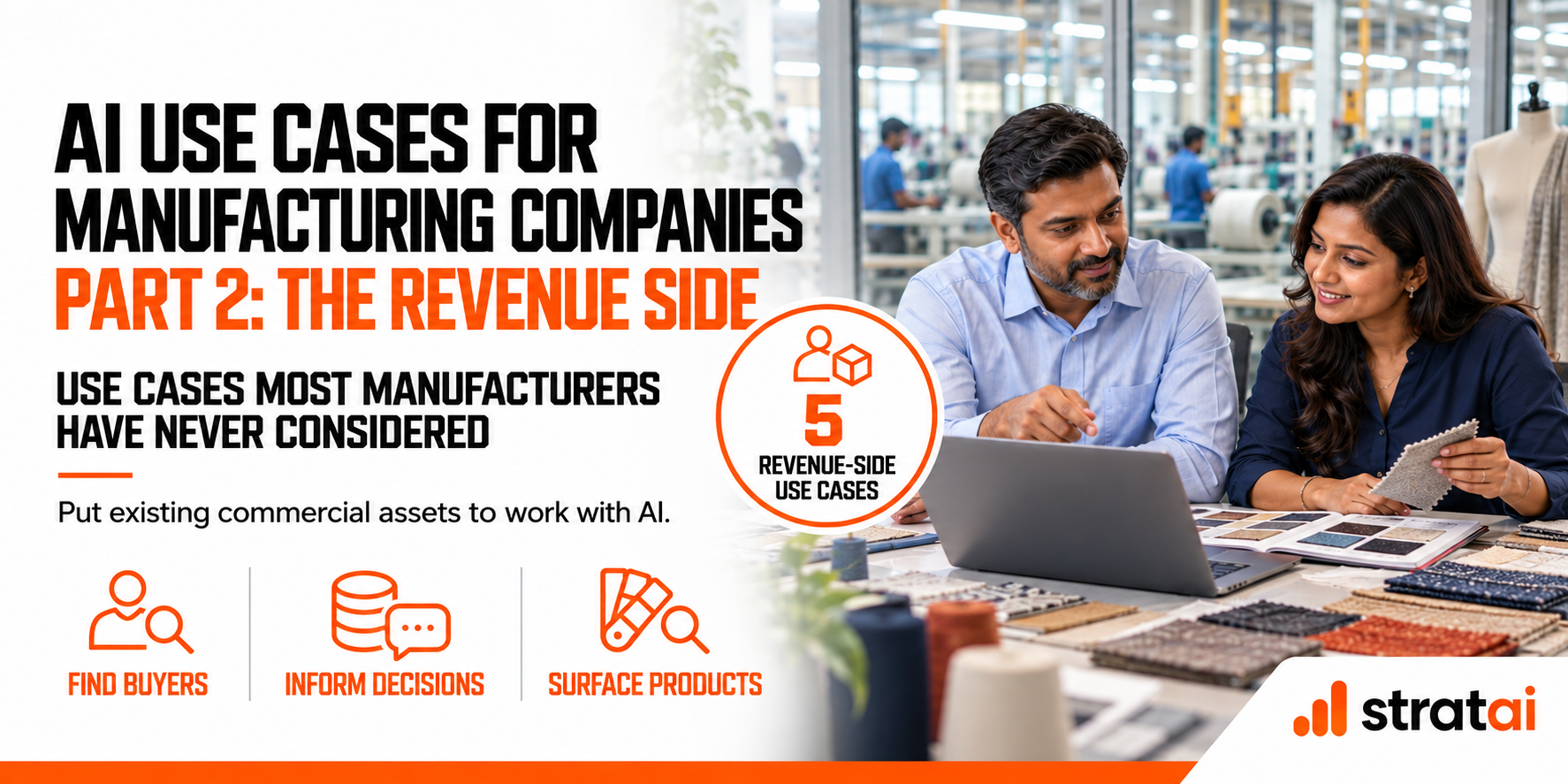
Five revenue-side AI use cases already deployed in Indian manufacturing: AI outbound marketing (6 meetings in Indonesia in 2 weeks), AI content marketing, data silo-breaking for real-time decision intelligence, AI-powered NPD (15%+ projected sales uplift from existing designs), and AI cataloguing (1 lakh fabrics, results in under 1 minute). All five create revenue from assets manufacturers already own.
AI Use Cases for Manufacturing Companies — Part 2:
The Revenue-Side Use Cases Most Manufacturers Have Never Considered
Every AI conversation in manufacturing starts with cost. Quality. Throughput. Waste reduction. Procurement. These are real use cases with real impact. But the highest-ceiling AI use cases in manufacturing — the ones that can recover an entire year’s consulting investment from a single conversion — are on the revenue side. And most manufacturers have never been shown them.
Direct answer: What are the revenue-side AI use cases for manufacturing companies?
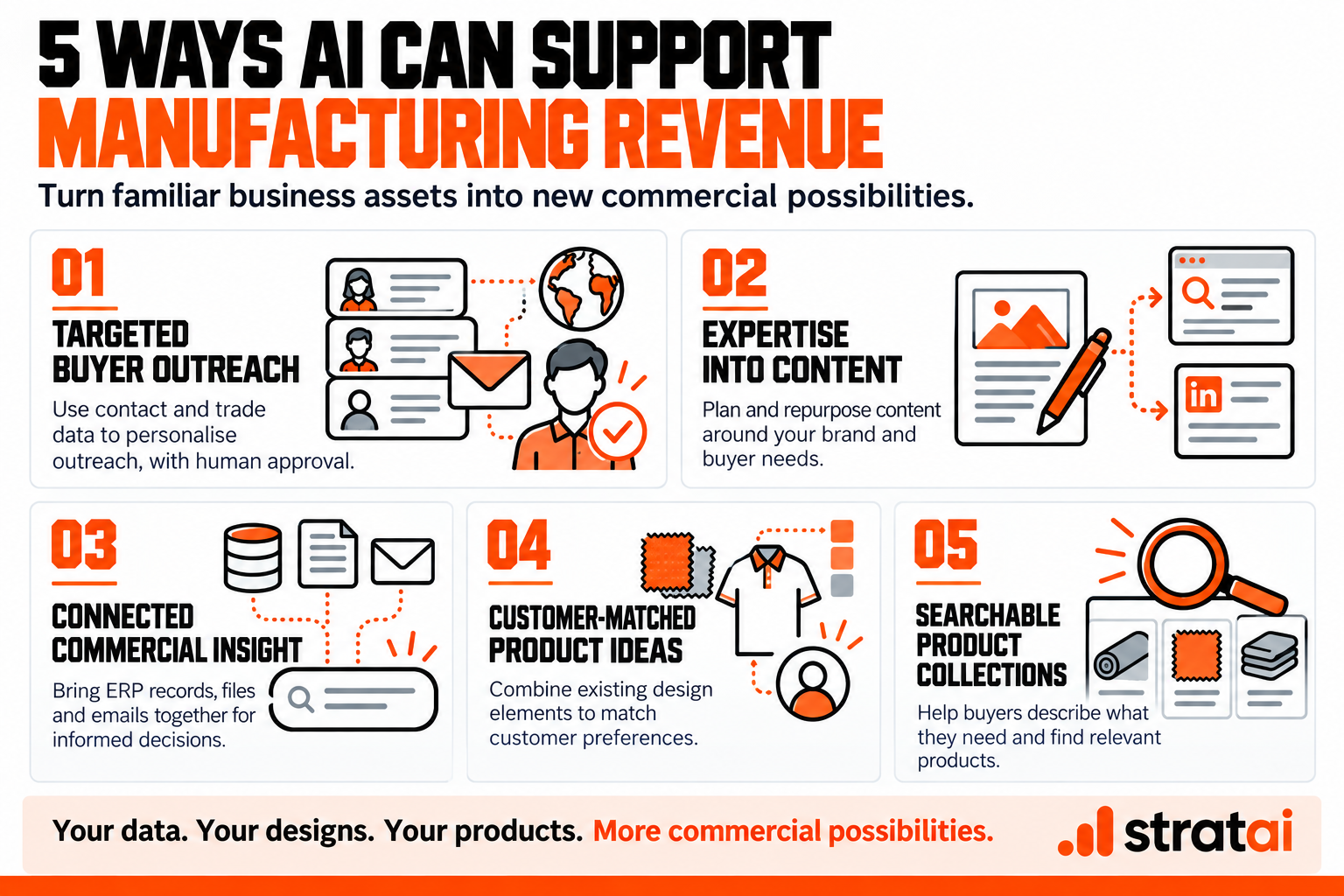
The five revenue-side AI use cases already deployed and generating results in Indian mid-market manufacturing are: AI-powered outbound marketing (using existing export-import and CRM data), AI content marketing (becoming an early-mover in an industry that has historically ignored it), breaking data silos for real-time decision intelligence (query-based access to SAP, documents, and email across all roles), AI-powered new product development (multiplying what exists rather than creating from scratch), and AI-powered cataloguing (making large collections commercially accessible at scale). Every one of these creates revenue from assets the manufacturer already owns.
83%
of AI-using sales teams report revenue increases — versus 66% among teams not using AI.
The gap between AI-enabled and non-AI revenue teams is not marginal. It is structural — and it compounds over time as AI systems accumulate data, learn from wins, and operate consistently regardless of team capacity or changing priorities.
Source: InsightMark Research, AI in B2B Sales and Marketing Statistics and Facts, 2026
Why Revenue-Side AI Is the Underdiscussed Opportunity in Manufacturing
The manufacturing AI conversation is dominated by operational use cases because they are the easiest to quantify. Defect rate reduced by 18%. Machine downtime cut by 30%. Procurement cost improved by 0.3%. These are real. They matter. They belong in the conversation.
But there is a reason the most compelling return on investment story in any StratAI engagement comes from the revenue side: manufacturing businesses typically have very high customer lifetime value, very high ticket sizes, and very long customer relationships. In this context, a single new customer acquired through an AI-powered outbound system can recover an entire year of consulting investment — manifold.
The five use cases below are not theoretical. They are running in active engagements. Each one creates revenue from something the manufacturer already owns — data they have already collected, designs they have already developed, relationships they have already built, products they have already created. The investment in the asset has already been made. AI is the mechanism that makes it work at a scale and consistency that human-dependent systems never could.
USE CASE 01 · AI-Powered Outbound Marketing
A listed cotton value-added product manufacturer — one of the world’s two largest in its category, serving global retail majors — had access to two powerful commercial intelligence platforms. Sino-IMEX, which provides export-import intelligence from bills of lading, giving them a detailed view of which companies are buying what, from whom, and in what volumes. Apollo, one of the most comprehensive B2B contact and company databases available. Between the two platforms, they had the raw material to build a highly targeted outbound system.
They were using less than 20% of their credits in both.
FIELD DATA · Less Than 20% of Credits Used — Across Both Platforms
Sino-IMEX and Apollo sitting largely idle. Not because the platforms were wrong. Because execution required sustained human attention — and human attention goes where current priorities are, not where data opportunity is.
StratAI built an AI-powered outbound system trained on the company’s own winning manual outbound campaigns from their most successful periods. The VP of Marketing was sceptical: ‘We already have Apollo — what difference is this going to make?’
He was about to travel to Indonesia. He set a clear benchmark: ‘Get me one meeting while I’m there.’ The system was deployed in five days.
FIELD DATA · 6 Confirmed Appointments in Indonesia · 2 Weeks · Deployed in 5 Days
Direct meetings confirmed plus warm responses from additional prospects. One conversion from a single one of these relationships recovers the entire annual consulting investment — manifold. The customer lifetime value and ticket size of this manufacturer’s B2B relationships makes each appointment disproportionately valuable.
The lesson that goes beyond this case study: any system with deep human dependency for its own execution will be underutilised — because human priorities shift. The data and the platform exist. The value is there. But consistent execution requires consistent human attention, and that is always the first thing to go when other priorities arrive. An AI-powered system — with human oversight at the approval layer — leverages data and compute consistently, without requiring the team to choose between this and their next priority.
AI-personalised outbound achieves 15–25% response rates versus 3–5% for traditional approaches.
The gap between AI-personalised outreach and standard outbound is not incremental. It is the difference between a system that treats every prospect as a segment of one — using their purchase history, company profile, and buying signals — and a system that treats a list as a list.
Source: InsightMark Research, AI in B2B Sales and Marketing Statistics and Facts, 2026
USE CASE 02 · AI-Powered Content Marketing
The manufacturing industry has historically been among the worst in the world at proactive marketing. Most manufacturers have no blog, no SEO strategy, no GEO presence, no LinkedIn authority. Their marketing is relationship-driven and referral-driven — which is fine when markets are stable, but leaves them invisible to the buying committee member who is researching AI vendors, evaluating suppliers, or looking for expertise before they make first contact.
StratAI’s proprietary content marketing framework for manufacturers involves configuring the following elements in detail, manually, before AI touches a single word: Company, Brand, Brand Persona, Products, ICP, Ethical Framework, Value Proposition, Blog Process, and Repurposing workflow. Each of these is a live document that defines how the brand thinks, speaks, and positions. Once configured, AI is set up as a detailed blog researcher and writer operating within this framework.
| What AI handles in content marketing | Why this matters for a manufacturer |
|---|---|
| Blog research and first-draft writing | Consistent content at a cadence no human-only team can sustain |
| SEO keyword cluster architecture | Topical authority builds over months — compounding organic reach |
| GEO optimisation for AI citation | 94% of B2B buyers now use AI tools during their purchase process — you need to be cited |
| LinkedIn post repurposing | Every blog becomes multiple posts — distribution without additional creation effort |
| UTM tracking across all content | Full content funnel traceable to pipeline and revenue |
| CRM integration | Content impact visible in deal attribution — not just traffic and impressions |
| Analytics consolidation | Entire content performance in one view — no fragmented reporting across platforms |
The early-mover advantage in manufacturing content marketing is significant and time-limited. Most manufacturers are not in this space at all. A manufacturer who builds SEO and GEO presence now will be cited by AI engines for key industry queries before any competitor exists on that surface. The gap, once built, compounds.
65% of companies report AI-generated content improved their SEO in 2025. Blog production time dropped from 8–10 hours to under 2 hours.
Content that previously required a full day of skilled writing time now takes under two hours — while maintaining quality, keyword precision, and brand voice. For manufacturers who have historically produced no content at all, this is a structural change in what is possible.
Source: InsightMark Research, AI in B2B Sales and Marketing Statistics and Facts, 2026
USE CASE 03 · Breaking Data Silos for Real-Time Decision Intelligence
The same listed cotton manufacturer has its commercial data distributed across three main sources: SAP (transactions, orders, production), a local document server (contracts, reports, correspondence), and email across 20-plus people in business development, customer support, and growth. The data exists. The intelligence is there. But extracting it requires navigating three separate systems, knowing where to look, and waiting for someone to compile a report.
As a one-time activity, StratAI bridged all three data sources, contextualised and structured the data, and connected it to a role-based AI chatbot. The MD can now type a query directly: ‘Are we on track with respect to our forecast?’ The system reads the year-to-date target, pools live data from the SAP purchase order table, and answers — with full detail and the ability to handle follow-up questions in the same conversation.
FIELD DATA · One Query. Live SAP Data. Instant Answer.
No dashboard. No report request. No lag. The MD’s question answered in real time from the source data — with follow-up capability in the same conversation. Now rolling out to all roles across the organisation.
Why this belongs on the revenue side: real-time commercial intelligence does not just save time — it changes what decisions are made and when. A BD leader who knows in real time that a key account is below forecast can act on that today, not next week when the report arrives. The revenue impact of faster, better-informed commercial decisions is structurally significant — especially for manufacturers operating in fast-moving global markets.
USE CASE 04 · AI-Powered New Product Development
A buying house in Tirupur that facilitates contract manufacturing for 60-plus European brands across 25-plus contract vendors has a design and development library of over 2,000 T-shirt designs. This library represents years of investment — fabric development, shape development, accessory combinations. It is also significantly underutilised, because showcasing 2,000 designs to a diverse set of European brand clients requires understanding each brand’s preferences deeply and finding the right combination for each one.
StratAI’s approach: a T-shirt design is not a single design. It is a combination of components — fabric, shape, accessories, colours. Decompose every design into its components. Then use AI to research each European brand client’s website, study their documented preferences — the shapes they have consistently chosen, the colour language, the accessory profiles — and generate custom design combinations specifically matched to each brand’s aesthetic.
| Before AI-powered NPD | After AI-powered NPD |
|---|---|
| 2,000+ designs, limited showcase capability | Several thousand combinations generated dynamically |
| Generic presentation to all brand clients | Hyper-customised selection per European brand |
| Fabric investment partially utilised | Every developed fabric fully exploited across combinations |
| Design development pace the bottleneck | AI multiplies existing assets — no new development cost |
| Static library | Dynamic, brand-specific catalogue updated continuously |
Management’s projection for this system: a 15% or greater improvement in sales from the design and development portfolio — from what they already own, not from new investment in new fabrics or new shapes. The development investment has already been made. AI is making it work several times harder.
USE CASE 05 · AI-Powered Cataloguing
Symphony Furnishings has a collection of over one lakh fabrics — more than 100,000 individual items, each with its own texture, colour family, pattern type, weight, use case, and price point. This collection is the company’s primary commercial asset. It is also, at its current scale, extremely difficult for a customer to navigate.
An architect looking for a fabric that matches a specific brief — ‘European contemporary style, natural tones, subtle texture, suitable for commercial hospitality’ — cannot browse 100,000 items. Without AI, they either work with whatever the salesperson remembers, or they leave with something that does not quite fit. The collection’s depth, which should be an overwhelming competitive advantage, becomes friction.
StratAI digitised the entire collection with 15-plus searchable attributes per fabric. Architects now describe what they need in natural language — the same way they would describe it to a skilled salesperson — and get matched results in under a minute. The touch-and-feel evaluation still happens in person. But AI determines which fabrics are worth touching, eliminating the hours that previously went into physical search.
FIELD DATA · 1 Lakh+ Fabrics · 15+ Attributes Each · Results in Under 1 Minute
An architect who previously spent hours browsing or relied entirely on salesperson memory now gets a curated shortlist in under a minute from a natural-language prompt. The evaluation becomes faster, more accurate, and more satisfying for the architect — and more likely to result in a sale.
The strategic layer that makes this a revenue use case: Symphony’s AI catalogue creates a live pipeline view of which architects are considering which fabrics, at what stage of their project, for what type of space. This turns the cataloguing system into a sales intelligence tool — one that shows the business owner where the next conversion is most likely to come from, and which architect relationships are actively progressing.
An architect who has a positive discovery experience with Symphony’s AI catalogue does not just buy one fabric. They return for the next project. And the next. The catalogue becomes a relationship asset — one that makes every subsequent interaction easier and every subsequent sale more likely. AI cataloguing, done well, does not just solve a search problem. It changes the nature of the commercial relationship between a manufacturer and its best customers.
The Pattern Across All Five Revenue-Side AI Use Cases for Manufacturing Companies
Every one of these revenue-side AI use cases shares a single underlying characteristic: it creates new commercial value from assets the manufacturer already owns.
The listed cotton manufacturer already had Sino-IMEX and Apollo. The data was there. The commercial intelligence was there. AI made it work consistently, at scale, without human execution dependency.
The buying house already had 2,000 designs. The creative investment was there. AI multiplied the number of commercially viable combinations from those designs several times over.
Symphony Furnishings already had a lakh fabrics. The product was there. AI made every item in the collection accessible to every architect who needed it.
This is the most important insight in this blog: the barrier to revenue-side AI impact in manufacturing is not investment in new assets. It is recognising what you already have — and finding the right partner to unlock it.
These revenue-side use cases are one half of the picture. the complete guide to AI for manufacturing companies covers the full range — including the shop floor use cases that make up the other half — and how to think about where to start.
94%
of B2B buyers used generative AI tools during their purchase process in 2025.
Your B2B buyers are researching you, your products, and your category using AI before they make first contact. A manufacturer with no content presence, no GEO citation, and no AI-powered commercial intelligence is invisible to this buyer — not because they lack a good product, but because they have not built the systems that make them findable.
Source: 6sense, 2025 Buyer Experience Report
Tell us what you already have. We will show you what it is worth.
→ Book your free half-day plant audit — no commitment, no strings
At the end of it, you can say no. Most don’t. We confirm your audit date within one business day.
Frequently Asked Questions
What is the difference between revenue-side and cost-side AI use cases in manufacturing?
Cost-side AI use cases reduce what you spend — on defects, downtime, procurement, and waste. Revenue-side AI use cases increase what you earn — through better outbound conversion, more content presence, faster commercial decisions, better utilisation of existing designs, and making large collections commercially accessible. Both matter. But the ceiling on revenue-side use cases is significantly higher for manufacturers with large customer lifetime values and complex B2B relationships, because a single new customer acquired through an AI system can return many times the system’s cost.
How long does it take to see revenue impact from AI-powered outbound marketing for a manufacturer?
In the case of the listed cotton manufacturer described in this blog, 6 confirmed meetings were generated in Indonesia within 2 weeks of the system going live — from a 5-day deployment. Timeline depends on deal cycle length, market, and product complexity. For manufacturers with long B2B sales cycles, the meetings and pipeline are the early signal. Revenue follows the cycle — but the pipeline impact is immediate and measurable from week one.
Can a manufacturing company with no existing content start AI content marketing?
Yes — and starting from zero is often an advantage because there is no legacy content to unlearn. The StratAI framework begins with manual configuration of the brand’s identity, ICP, and value proposition before AI writes a word. The result is content that reflects the manufacturer’s genuine expertise and market positioning. The early-mover advantage in manufacturing content marketing is particularly significant because most manufacturers produce no content at all — making the first entrant the default authority for key industry queries in AI search.
What data is needed to build an AI-powered decision intelligence system?
The most common sources are ERP data (SAP, Oracle, or local systems), a document server or shared drive, and email across commercial teams. These three sources — already present in most mid-market manufacturers — contain enough commercial intelligence to build a meaningful query-based chatbot for the MD and senior leadership. The one-time activity of bridging and contextualising these sources is what makes the system possible. No new data collection infrastructure is required.
Is AI-powered cataloguing only relevant for companies with very large product ranges?
The highest-impact cases involve collections of 10,000 items or more, where volume makes manual navigation genuinely difficult. But the strategic layer — creating a live pipeline view of which customers are considering which products — is valuable even for smaller ranges. A catalogue of 500 items with 15 searchable attributes and a live pipeline view changes the nature of the commercial relationship with customers regardless of collection size.
About StratAI
StratAI builds AI Advantage Systems for mid-market manufacturing companies across India. Official Registered Claude Partner and Anthropic Partner. Every engagement begins with a free half-day plant audit — identifying the highest-value use case, revenue-side or cost-side, before any technology decision is made.
12+ retainer clients · 90%+ client retention · stratai.io/contact · palani@stratai.io · +91 99402 25924
“The highest-ceiling AI use cases in manufacturing are not where most people are looking.” — StratAI
What is the difference between revenue-side and cost-side AI use cases in manufacturing?+
How long does it take to see revenue impact from AI-powered outbound marketing for a manufacturer?+
Can a manufacturing company with no existing content start AI content marketing?+
What data is needed to build an AI-powered decision intelligence system?+
Is AI-powered cataloguing only relevant for companies with very large product ranges?+

Palaniappan SN is a Business Strategy Consultant who has spent his career at the intersection of business strategy and operational reality — working across management levels from the boardroom to the shop floor to understand where organisations actually win and lose. His conviction is simple: AI should never be an experiment. It should be an advantage. That belief is the foundation of StratAI's AI Advantage Systems methodology — built not from technology-first thinking, but from the ground up, with the discipline to walk away from projects where the conditions for success don't exist.