AI for Manufacturing Companies: The Complete Guide — What Works, What Doesn't, and What Actually Shows Up in Your P&L
A manufacturing MD was recently told by a generic IT vendor that AI simply “wasn’t built for an industry like his.” That is exactly the kind of well-intentioned advice that keeps mid-market manufacturers two years behind the competitors who ignore it. 88% of organisations use AI in at least one business function. Only 6% achieve meaningful P&L impact. This guide is about how to be in the 6%.
AI for manufacturing companies means using AI to unlock value from information that already exists inside the business — improving information flow, eliminating non-value-added recurring work, and surfacing high-ROI opportunities that were previously invisible. It operates on the information layer (ERP, documents, data flows), not on production machinery, and works best when a company starts with one use case tied to a specific P&L line rather than attempting company-wide deployment at once. Only 6% of organisations using AI achieve meaningful P&L impact; average ROI in manufacturing runs around 200% when use cases are selected and sequenced correctly, with realistic P&L impact appearing from month six of a sustained engagement.
AI for Manufacturing Companies: The Complete Guide — What Works, What Doesn't, and What Actually Shows Up in Your P&L
A manufacturing MD was recently told by a generic IT vendor that AI simply “wasn’t built for an industry like his.” That is exactly the kind of well-intentioned advice that keeps mid-market manufacturers two years behind the competitors who ignore it. 88% of organisations use AI in at least one business function. Only 6% achieve meaningful P&L impact. This guide is about how to be in the 6%.
Direct answer: What does AI for manufacturing companies actually mean?
AI for manufacturing companies means using AI to unlock value from the information that already exists inside your business — improving information flow, eliminating non-value-added recurring work, and surfacing high-ROI opportunities that were previously invisible. It does not mean AI controlling your machinery. It does not mean AI running your entire company from day one. It means starting with one use case connected to a specific P&L line, building it deeply, and letting the knowledge of your business compound into higher-value use cases over time.
88% vs. 6%
of organisations use AI regularly — but only 6% achieve meaningful enterprise-wide impact, defined as more than 5% EBIT contribution from AI.
The gap between AI activity and AI advantage is not closing. It is widening. The 6% who produce real P&L impact are not using more sophisticated AI — they are making better decisions about which problems to solve, in what sequence, with what kind of partner.
Source: McKinsey State of AI 2025
The Two Things AI for Manufacturing Is Not
Before understanding what AI for manufacturing companies actually is, it helps to clear away the two misconceptions that stop manufacturing leaders from starting — or lead them to start badly.
Misconception 1 — AI Is Not Relevant to My Industry
This comes from conflating AI with robotics, autonomous machinery, or large-scale industrial automation. That AI exists — but it is built into the machinery itself, by the machinery manufacturers. A textile mill that buys a new spinning machine with AI-assisted tension control is getting AI from the machine OEM. That is not the AI this guide is about.
The AI that mid-market manufacturing companies need is different. It lives in the information layer of your business — not in the physical production layer. It works with the data you already have: your ERP, your orders, your procurement records, your quality logs. It makes that data work for you in real time rather than sitting in a system that nobody queries until something goes wrong.
Every manufacturing company, regardless of industry or product, has an information layer. AI is relevant to all of them.
Misconception 2 — AI Will Run My Entire Company
This is the opposite extreme — and equally damaging. A senior leader who wants AI in every department simultaneously achieves none of them well. Resources spread thin. Implementation loses depth. The use cases that actually matter get less attention than the ones that looked impressive in a demo.
AI amplifies the decisions, processes, and information flows that already exist in a company. The amplification is real and significant — but it requires focus. One use case built deeply and adopted fully creates more P&L impact than ten use cases built shallowly and never embedded. This is the core argument of the 7 Don'ts blog in this series: excessive imagination is one of the most reliable ways to ensure AI never shows up in your P&L.
| What AI for manufacturing is NOT | What AI for manufacturing IS |
|---|---|
| AI controlling your production machinery | AI improving the information flow around your production |
| AI running your entire operation from day one | AI solving one specific, high-value problem at a time |
| A one-time technology implementation | A continuously compounding capability built over time |
| A replacement for domain expertise | An amplifier of the domain expertise you already have |
| Something only large companies can afford | A competitive advantage mid-market companies can build first |
What AI for Manufacturing Companies Actually Is
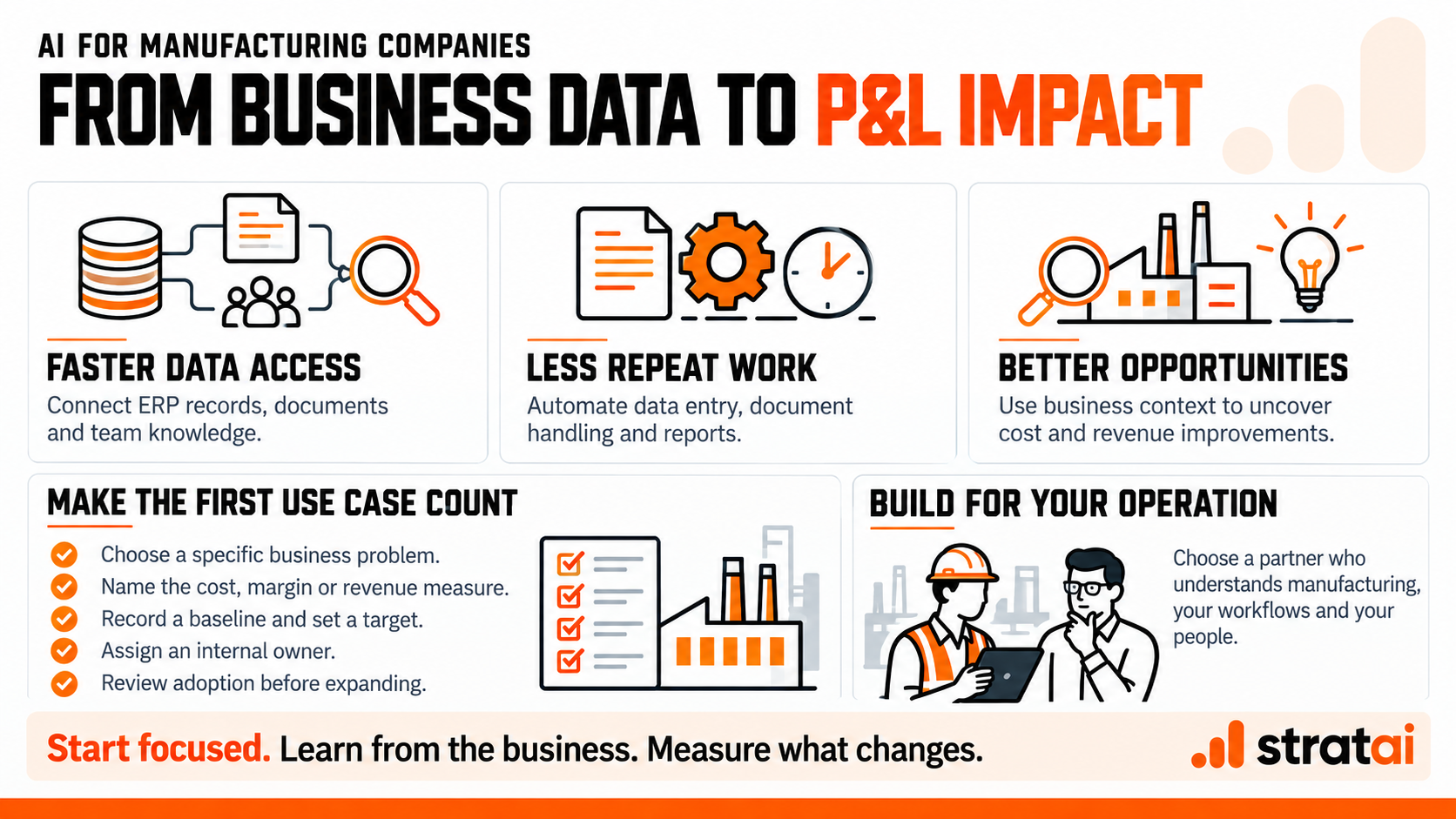
AI for manufacturing companies — as StratAI deploys it — operates on three value creation mechanisms. Every use case in every engagement traces back to one or more of these.
1. Improving Information Flow
Most manufacturing companies have the data they need. They do not have it available at the moment a decision must be made. It sits in an ERP that is 1-2 days behind reality. It sits in a document server that requires knowing exactly where to look. It sits in the heads of people who are not available when the question arises.
AI improves information flow by capturing data at the point of creation — a photo of a machinery screen, a voice input during a QC inspection, a document uploaded by a vendor — and making it instantly available, queryable, and connected to other data sources. The MD who can ask ‘are we on track against our forecast?’ and receive an answer from live SAP data rather than a two-day-old report is experiencing information flow improved by AI. This use case is live across multiple StratAI engagements, including for a listed cotton manufacturer managing sales, procurement, and production data across three previously siloed systems.
2. Eliminating Non-Value-Added Recurring Work
Every manufacturing operation has work that must be done but adds no value beyond its completion — data entry, document transfer, format conversion, report compilation. This work consumes skilled people at the cost of the judgment-intensive work only they can do.
AI eliminates this at the source. The shop floor use cases blog in this series documents eight live deployments of this principle — including 40 to 50 merchandisers across four countries reclaiming significant weekly hours from PO and shipping data entry that AI now handles entirely.
3. Surfacing High-ROI Opportunities
This is the most powerful mechanism — and the one that requires the most time and context to activate. The highest-value AI use cases in manufacturing are not visible from the outside. They emerge from understanding a business deeply: its commercial model, its operational reality, its specific cost structure and revenue levers.
A buying house with 2,000 T-shirt designs and a need to match European brand aesthetics more accurately — the AI design intelligence use case that emerged from that understanding was not in any original brief. It emerged from months of being close to the business. A furnishings company with over one lakh fabrics and an architect pipeline — the AI cataloguing system described in the revenue-side use cases blog was not visible until the business was understood at the product and sales process level. These are the use cases that produce the highest P&L impact.
Why context is the most important thing in AI for manufacturing
AI operates on context. The more a partner understands your business — your commercial model, your operational variations, your people’s actual workflows, your cost structure — the better the use cases they identify and the more precisely they can build systems that fit your reality. The design intelligence use case was invisible in month one. It became visible in month five, from sustained proximity to the business. Compounding context produces compounding value. This is why a retainer model — not a one-time project — is the only engagement structure that produces this outcome.
The Right Approach — From Intent to Impact
The companies that produce lasting competitive advantage from AI follow the same pattern — regardless of industry, size, or starting point. It is not a sophisticated pattern. It is a disciplined one.
Start with the intent to lead with AI — not to try it
The distinction between trying AI and leading with AI determines everything that follows. A try-AI intent produces engagements that lose priority when other pressures arrive. A lead-with-AI intent produces a team that pushes through early friction because the direction is committed. The intent is visible not in what a leader says in a meeting — it is visible in the decisions they make when the engagement faces its first obstacle. The full readiness diagnostic — including how to assess your own intent and the four other elements that determine whether an AI engagement will compound or stall — is in the AI readiness blog in this series.
Start small — one use case that hits the P&L
The first use case should be specific, measurable, and connected to a P&L line. Not ‘improve operational efficiency’ — specifically: eliminate the 1-2 day ERP data lag that turns quality data into a post-mortem tool rather than a live decision tool. Specifically: reduce commodity purchase cost by 0.3% through better purchase timing intelligence. The specificity creates accountability. Accountability creates results.
Select the right partner — domain depth matters more than AI expertise
The most common mistake in partner selection is evaluating AI capability rather than manufacturing domain depth. A partner who can build any AI system but does not understand your business model, your process variations, and your people’s actual workflows will build technically excellent systems that nobody uses. The partner whose domain understanding allows them to identify the right use case — not just build the one on the brief — is the partner who produces P&L impact.
Give them enough context — then let it compound
The diagnostic month exists to transfer context from the client to the partner. Not just the documented process — the actual process, with its variations, workarounds, and exceptions. Not just the stated pain points — the unstated ones that emerge from sitting with the people who do the work. The more context the partner accumulates, the better the use cases they identify. This is the compounding that produces the design intelligence use case in month five that was invisible in month one.
200%
average AI ROI in manufacturing across deployed use cases — the highest of any sector tracked.
Manufacturing produces the strongest AI ROI for reasons rooted in the sector’s operating model: every improvement maps to a known cost, baselines are quantifiable, and data streams are continuous. The constraint is not AI capability — it is strategic alignment between where AI is deployed and where it delivers actual impact.
Source: Capgemini Research Institute, Smart Factories Report 2025 / The Thinking Company, Manufacturing AI ROI Analysis 2026
What Works, What Doesn't, and What Shows in the P&L
Based on active deployments across mid-market manufacturers in India — textile, jewellery, furnishings, commodity processing, and component manufacturing — the following patterns hold consistently.
What Works
- Use cases with a clear, named P&L line — cost, margin, throughput, or revenue. Every successful engagement can answer which specific line moves, by how much, and by when. Vague efficiency gains do not sustain engagement or investment; without a named number to track, momentum fades the moment other priorities compete for attention.
- Information flow improvements — capturing data at source, eliminating lag, connecting siloed data. These produce the fastest visible impact.
- Eliminating non-value-added recurring work at scale — value is proportional to how many people do the task and how many hours per week it consumes.
- Engagements with a genuine internal champion who can provide access to the relevant teams. Vision without access produces nothing.
- Retainer engagements where context accumulates over time — the use cases that emerge in months four and five are consistently higher-value than those visible in month one.
What Doesn't Work
- Excessive imagination — wanting AI in everything simultaneously, before any single use case has proven itself. Focus creates depth. Depth creates adoption. Adoption creates P&L impact. Spreading effort across ten shallow initiatives produces less P&L impact than one use case built deeply enough that the team stops thinking of it as “the AI system” and starts thinking of it as simply how the work gets done.
- Pure tech teams with no manufacturing domain understanding — they build what they are asked to build, not what is actually needed.
- Premature scaling — moving to company-wide deployment before a use case is proven at team level. Every variation invisible in the pilot surfaces simultaneously at scale.
- Ignoring current operational reality — designing systems for how operations should work rather than how they actually work.
- Waiting for proof before starting — the Early Adopter window in Indian mid-market manufacturing is open now. The companies waiting for the majority to move will build parity, not advantage.
What Shows in the P&L
- ₹1.5 Crore+ bottom-line improvement from 0.3% better commodity purchase timing — listed cotton manufacturer, live deployment.
- 40-50 merchandisers reclaiming significant weekly hours from non-value-added data entry — German buying house, Tirupur, live deployment.
- 2-3 hour architect fabric search compressed to 10 minutes — Symphony Furnishings, live deployment.
- 6 confirmed B2B appointments in Indonesia in 2 weeks from an AI-powered outbound system deployed in 5 days — listed cotton manufacturer, live deployment.
- QC inspection time reduced from 3 minutes 45 seconds to 1 minute 45 seconds per piece across a live production run — German buying house, live deployment.
Every one of these results started with a half-day audit and one use case connected to a P&L line.
Start with a free half-day plant audit.
→ Book your audit — no commitment, no strings
We identify your highest-value AI use case before any technology decision is made. At the end of it, you can say no. Most don’t. We confirm your audit date within one business day.
Frequently Asked Questions
What is the difference between AI in manufacturing machinery and AI for manufacturing companies?
AI in manufacturing machinery refers to intelligence built into production equipment — sensors, robotics, CNC control systems, automated quality cameras. This is delivered by the machinery manufacturers as part of the equipment itself. AI for manufacturing companies operates on the information layer: the ERP, the documents, the data flows, the commercial intelligence. It does not require new machinery. It works with the data that already exists inside the business and makes it accessible, actionable, and compounding over time.
How long does it take for AI to show up in a manufacturing company's P&L?
The realistic minimum is six months. Month one is the diagnostic — understanding the business, identifying the right use cases, mapping current operational reality. Months two and three are build and behaviour alignment. Months four and five produce early signals. Month six onwards is where P&L impact becomes visible. Engagements that promise results in weeks are either measuring activity rather than impact, or deploying use cases too shallow to create real change. The full timeline is explained in the 6-Month P&L Horizon framework, applied across every StratAI engagement.
What manufacturing industries benefit most from AI?
All manufacturing industries benefit — because every manufacturing business has an information layer, and the information layer is where AI operates. In StratAI's active engagements: textile buying houses, spinning mills, value-added manufacturers, jewellery, furnishings, commodity processing, and component manufacturing. The specific use cases differ by industry. The mechanism — improving information flow, eliminating non-value-added work, surfacing hidden opportunities — is consistent across all of them.
How do I know which AI use case to start with?
Start with the use case that answers yes to three questions: Which specific P&L line will this move? By how much? By when? If you cannot answer all three with specificity, the use case is not ready. The highest-leverage starting use cases are almost always information flow problems — the 1-2 day data lag, the report that arrives too late to act on, the procurement decision made on incomplete data. The more complex, higher-ceiling use cases become visible after the diagnostic month, not before.
Is AI for manufacturing only relevant for large companies?
The mid-market is where AI creates the most disproportionate competitive advantage. Large companies implement AI slowly, with high overhead and complex procurement processes. A mid-market manufacturer that builds AI capabilities now will be 2-3 years ahead of its peers when the majority of the market moves. The investment required is proportional to the scale of the engagement — not to the company's size.
About StratAI
StratAI builds AI Advantage Systems for mid-market manufacturing companies across India. Official Registered Claude Partner and Anthropic Partner. 12+ retainer clients across textile, jewellery, furnishings, commodity processing, and component manufacturing.
stratai.io/contact · palani@stratai.io · +91 99402 25924
“If AI isn't in your P&L, it isn't real.” — StratAI
What is the difference between AI in manufacturing machinery and AI for manufacturing companies?+
How long does it take for AI to show up in a manufacturing company's P&L?+
What manufacturing industries benefit most from AI?+
How do I know which AI use case to start with?+
Is AI for manufacturing only relevant for large companies?+

Palaniappan SN is a Business Strategy Consultant who has spent his career at the intersection of business strategy and operational reality — working across management levels from the boardroom to the shop floor to understand where organisations actually win and lose. His conviction is simple: AI should never be an experiment. It should be an advantage. That belief is the foundation of StratAI's AI Advantage Systems methodology — built not from technology-first thinking, but from the ground up, with the discipline to walk away from projects where the conditions for success don't exist.