Before Your Manufacturing Company Invests in AI — Answer These 5 Questions. Most Can’t Answer Question 2.
98% of manufacturers are exploring AI. 20% are genuinely ready for it. The gap is not about technology or budget. It is about the five things that determine whether an AI engagement compounds — or quietly fails.
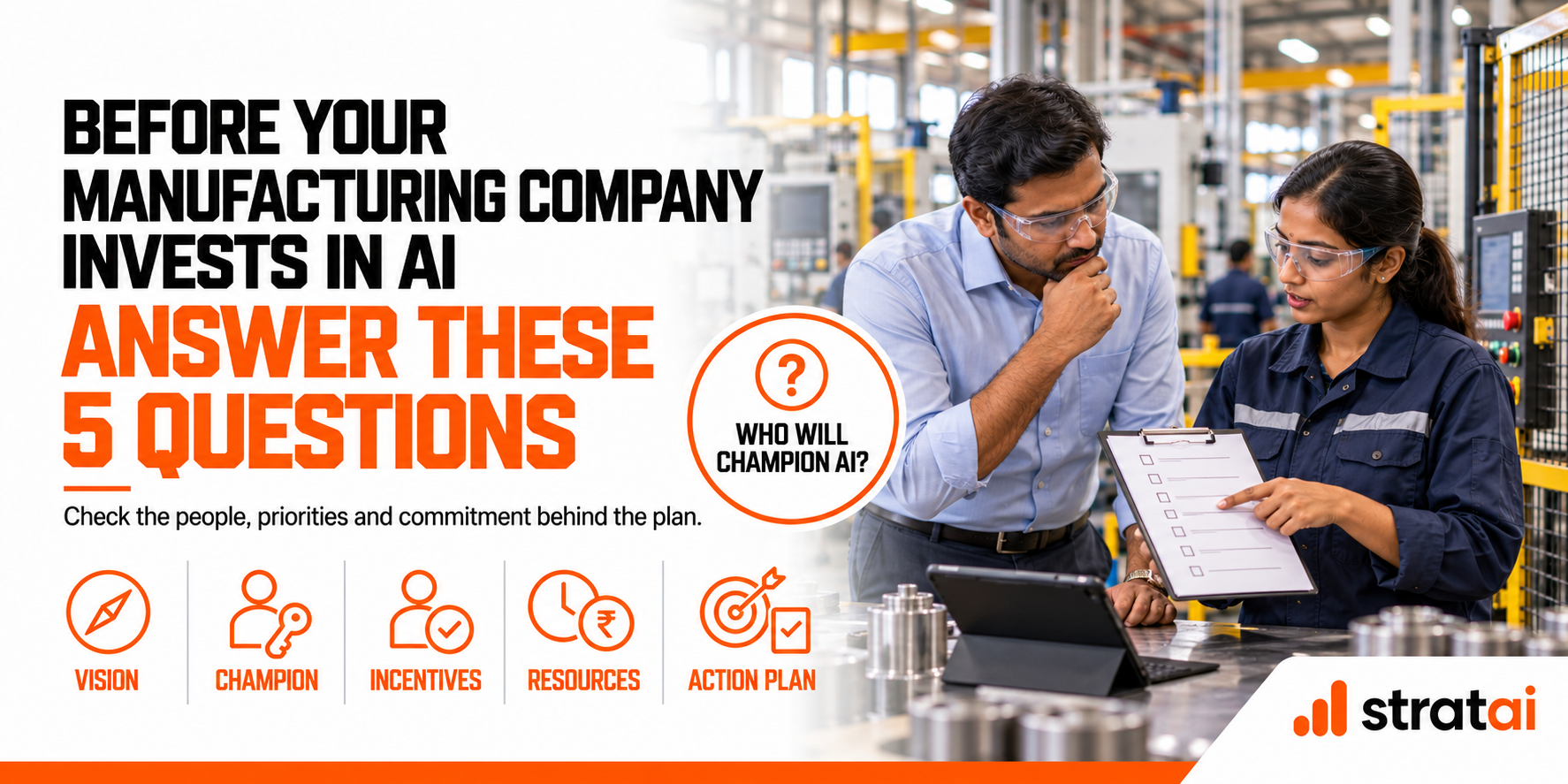
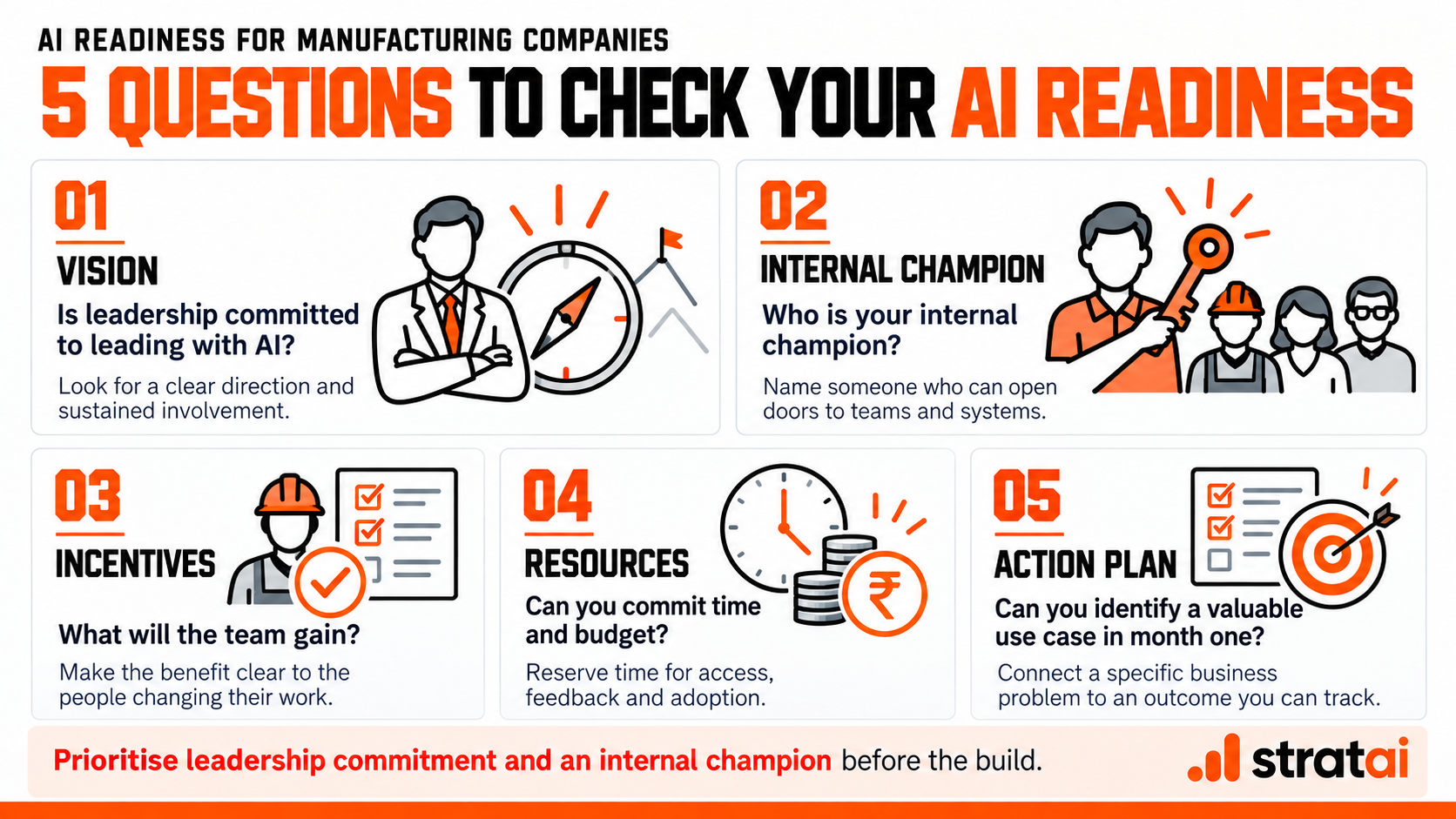
Five elements from the Lippitt-Knoster Model for Managing Complex Change determine whether a manufacturing company is ready for AI: leadership vision (try AI vs lead with AI), one internal champion who can provide access, genuine personal incentive for the people who must change, available management time and budget, and a specific high-value use case identifiable within month one. 98% of manufacturers are exploring AI; only 20% are genuinely ready — the gap is leadership and organisational, not technology or budget.
Before Your Manufacturing Company Invests in AI — Answer These 5 Questions. Most Can’t Answer Question 2.
98% of manufacturers are exploring AI. 20% are genuinely ready for it. The gap is not about technology or budget. It is about the five things that determine whether an AI engagement compounds — or quietly fails.
Direct answer: How do I know if my manufacturing company is ready for AI?
AI readiness for a manufacturing company is not a data infrastructure question or a technology checklist. It is a people and leadership question. The five things that determine genuine AI readiness are: leadership vision (try AI vs lead with AI), the presence of one internal champion, the existence of a real personal incentive for the people who must change, available management time and budget, and the ability to identify a high-value use case by the end of month one. A company with all five is ready to build lasting advantage. A company missing the first two is not ready yet — and no amount of technology investment changes that.
98%
of manufacturers are exploring AI. Only 20% are genuinely ready to deploy it.
The gap between ambition and readiness in manufacturing AI is the widest of any industry. Most manufacturers frame AI readiness as a technology decision. The evidence consistently shows it is a leadership and organisational decision first.
Source: Redwood Software, Manufacturing AI and Automation Outlook 2026
Why This Framework Exists
Every AI engagement StratAI enters begins with the same diagnostic. Not a data audit. Not a technology assessment. A conversation — and underneath that conversation, a structured read of five elements drawn from the Lippitt-Knoster Model for Managing Complex Change.
The Lippitt-Knoster model maps what happens when any one of five elements is missing from a complex change initiative. It is one of the most validated change management frameworks in organisational behaviour — and it applies precisely to AI implementation in manufacturing, because AI is not a software installation. It is an organisation evolution. The same discipline is behind the 7 things manufacturing companies must never do with AI — the pattern is identical: decision failures, not technology failures.
| Signal | ✓ Green — leads with AI | ⚠ Watch — trying AI |
|---|---|---|
| Vision | Leader wants to build competitive advantage with AI | Leader wants to try AI and see if it works |
| Skills | One internal champion who can bridge StratAI to the team | Everyone is interested but nobody is responsible |
| Incentives | Clear personal benefit for the people who must change | Management sees the benefit — ground team does not |
| Resources | Management time and budget genuinely available | Budget approved — time not allocated |
| Action Plan | High-value use case identifiable by month one | Broad aspiration — no specific use case defined |
Each missing element produces a specific, predictable failure mode: no vision creates confusion, no skills creates anxiety, no incentives create resistance, no resources create frustration, and no action plan creates false starts. Most companies have gaps in more than one. The diagnostic does not disqualify — it tells both sides where to focus before the build begins.
Manufacturers who conduct structured AI readiness assessments report 50% fewer failed pilots and 35% shorter time-to-production.
The assessment investment is a fraction of the implementation cost. The companies that skip it spend more and stall in pilot purgatory — the exact pattern the readiness assessment is designed to prevent.
Source: Capgemini Research Institute, Smart Factories Report 2025
The 5 Questions — In the Order That Matters
These questions are not asked as a formal assessment. They emerge from a conversation. But they are being evaluated in every first meeting — and the answers determine whether an engagement will compound or stall.
QUESTION 01 · Do you want to try AI — or lead with AI?
This is the most important question and the one most leaders answer incorrectly — not because they are dishonest, but because they have not been asked to distinguish between the two.
Trying AI means: ‘Let us see what AI can do for us. If it works, great. If not, we will move on.’ This intent sounds pragmatic. It is actually the most expensive approach — because try-AI engagements lose steam at the first obstacle. The moment another priority arrives, the engagement gets de-prioritised. The system gets built but not adopted. The organisation concludes that AI does not work for them.
Leading with AI means: ‘AI is how we intend to compete in the next five years. This engagement is the beginning of that.’ This intent changes every subsequent decision — how much management time is allocated, how the organisation responds to early friction, how the team treats the engagement when other priorities compete for attention.
We are early in the AI era. The leaders who make time now — who are willing to invest before the proof is common knowledge — are by definition in the Innovator and Early Adopter segments of the Rogers Diffusion of Innovations curve. Only 16% of any market. These are the companies that will build lasting competitive advantage. The remaining 84% will follow once the proof exists — but they will follow, not lead.
QUESTION 02 · Is there one internal champion who can give us access?
This is the question most manufacturing companies cannot answer. And it is the one that, if the answer is no, makes everything else harder.
The champion does not need to understand AI. They do not need technical skills. They need three things: enough organisational credibility to open doors to the relevant teams, enough curiosity to bridge StratAI’s work to the people who will use it, and enough management proximity to keep the engagement visible at the right level.
In different engagements, this champion has been the IT manager, a co-founder, a head of operations, or a senior team lead. The role is less important than the combination of access and intent. One person who can say ‘let me introduce you to the QC team’ or ‘I will make sure the merchandisers are available on Thursday’ is worth more than ten stakeholders who are broadly supportive but never facilitate anything.
The team’s current AI skill level is irrelevant to this question. Most teams will have minimal AI knowledge at the start of an engagement — that is expected and not a disqualifier. The critical skill StratAI brings is training AI on the team’s existing domain knowledge, not replacing that knowledge with AI. What is not importable is access. That must come from inside.
CIOs and CTOs are 5x more likely than COOs to say the workforce is ready to adopt AI.
The gap between what leadership believes about AI readiness and what is true on the ground is one of the primary causes of AI underperformance. This is precisely why one internal champion — someone who knows both sides — is the most critical readiness signal.
Source: Grant Thornton AI Impact Survey 2026 — 950 business leaders surveyed
QUESTION 03 · Is there a genuine personal incentive for the people who must change?
This question is not about money. Monetary incentives do not drive AI adoption. The incentive that matters is simpler and more immediate: does this make my job better?
Symphony Furnishings has a collection of over one lakh fabrics. Finding the right fabric for an architect’s brief — ‘European contemporary style, natural tones, subtle texture, suitable for commercial hospitality’ — previously required 2 to 3 hours of skilled search with uncertain results. With AI cataloguing, the sales team describes the brief in natural language and gets matched results in under 10 minutes with high accuracy.
The principle: incentive is created when AI helps a person do their job better, or helps them do a better version of their job. Both are valid. The first reduces friction — the same output in less time, with less stress. The second elevates quality — a better output that was previously impossible given time or scale constraints.
The good news: at this stage of the AI era, genuine incentive exists for almost every manufacturing team. We are at the beginning. There is no baseline. Just as websites became relevant for every business in the internet era — regardless of industry or size — AI-based productivity gains are now relevant for every team in every manufacturing company. The floor is zero, which means any meaningful improvement is visible immediately.
StratAI assesses incentive before the engagement begins — through secondary research on the company’s operations and through listening to what management describes as their most persistent pain points. The use case that will create the strongest personal incentive is usually visible from the outside before a single internal system is accessed.
QUESTION 04 · Can you give us the management time — not just the budget?
Budget is the easier resource to secure. Once the vision is aligned and the value proposition is clear, budget approval follows. The resource that actually determines whether an engagement succeeds is time.
Two specific signals: Is management open to a retainer engagement? And can key team members genuinely allocate 30 to 60 minutes per week to the engagement when needed?
The retainer question is diagnostic. A company that understands the retainer model understands that AI implementation is an evolving system, not a one-time project. They understand that the value compounds over time as the knowledge of their operations deepens. A company that wants a fixed-scope project with a handover date understands the wrong thing — and will treat the engagement accordingly.
The time question is more nuanced. StratAI deliberately minimises the management time required — identifying high-value use cases quickly without consuming the leadership team’s attention is a core operating principle. But minimal does not mean zero. The diagnostic month requires access. The build phase requires feedback. The adoption phase requires presence.
One medical devices engagement illustrates how resource allocation can evolve. The key department head was deeply sceptical of AI at the start. He was not hostile — but he did not provide time or access. StratAI’s first goal was not to convince him. It was to deliver visible value to his team first. Once the team’s experience of the system was positive, the department head began providing time voluntarily. Resources that were withheld at the start became available once the proof existed. The engagement deepened from that point.
QUESTION 05 · Can we identify a high-value use case by the end of Month 1?
The action plan question is the most concrete of the five. Not ‘do you have a project plan?’ A project plan is premature and usually wrong before the diagnostic is complete. The question is: based on what we know about your business from our conversation and secondary research, can we identify a specific, P&L-impacting use case that we are confident enough to build toward?
The answer does not need to be certain at first contact. It needs to be directionally strong. A rough sense of what pain can be resolved or what advantage can be created — specific enough that the engagement has a target, not so specific that it is locked in before the diagnostic confirms the reality.
A Power Press manufacturing company in Coimbatore — turnover above 100 Crores, currently an active prospect in conversation with StratAI rather than a confirmed retainer — presented a clear costing problem. Quotes are given based on theoretical costing from sample parts. Actual costs are tracked separately. Neither set of data is consistently updated. Every quote is assumption-based costing — and the consequence is constant anxiety: is this quote reflecting reality? Am I making a profit? Should I go lower or higher?
Once this use case was identified from the founder conversation, the action plan became clear. Not fully detailed — but directionally certain. That is enough. The month-one diagnostic refines the specifics. The confidence that a high-value, P&L-impacting use case exists is what the engagement needs before it begins.
The AI Readiness Hierarchy for Manufacturing Companies — Not All Five Questions Are Equal
Of the five elements, two are non-negotiable and outside StratAI’s control: Vision and the internal champion. These cannot be created from the outside. If the leadership vision is genuinely ‘try AI’ rather than ‘lead with AI,’ no amount of excellent implementation changes that — the engagement will lose priority when it needs sustained attention most. If there is no internal champion who can provide access to the relevant teams, the build will be contextually weak and the adoption will be shallow.
The other three elements are more malleable. Incentive can be demonstrated through the first use case. Resources often become available once value is visible — as with the medical devices engagement. The action plan sharpens through the diagnostic month.
75%
of manufacturers expect AI to rank among their top three contributors to operating margin by 2026. Only 21% report being fully prepared for its adoption.
The gap between ambition and readiness is not random. It maps precisely to the five elements identified in this framework. Companies that close these specific gaps — not just data infrastructure gaps — are the ones that cross from ambition to advantage.
Source: TCS and AWS Future-Ready Manufacturing Study 2025
This is why StratAI’s engagement begins with a free half-day plant audit before any contract is signed. The audit is not a sales exercise. It is a readiness diagnostic — the point where all five questions get answered from direct observation rather than conversation. A company that is genuinely ready looks different on the ground than it does in a meeting room. The audit surfaces that difference before either party commits. It is the same discipline behind the revenue-side AI use cases most manufacturers have never considered — identifying what is real and buildable before any technology decision is made.
These five questions are a readiness check, not the whole picture. the complete guide to AI for manufacturing companies covers what AI actually is in a manufacturing context, what it is not, and how it shows up in the P&L once you are ready to move.
Find out where you stand across all five questions.
→ Book your free half-day plant audit — no commitment, no strings
At the end of it, you can say no. Most don’t. We confirm your audit date within one business day.
Frequently Asked Questions
How do I know if my leadership vision is ‘lead with AI’ or ‘try AI’?
The distinction is not what you say in a meeting — it is what you do when the engagement faces its first obstacle. A try-AI vision produces a de-prioritised engagement the moment other pressures arrive. A lead-with-AI vision produces a team that pushes through friction because the direction is committed. Ask yourself: if this engagement produces no visible result in month one, do I give it more time or do I redirect the budget? The answer tells you more about your intent than any stated vision.
What if we do not have an obvious internal AI champion?
The first step is to identify who in your organisation has the combination of access and curiosity — not technical skills. In different engagements this has been an IT manager, a co-founder, a plant head, and a senior team lead. The role matters less than the combination of organisational credibility and genuine interest. If no such person exists at all, that is the most important finding — because it means the engagement will need to earn its champion by demonstrating value first, as happened with the medical devices company described in this blog.
Can AI be implemented in a manufacturing company that has never done anything digital?
Yes — and sometimes this is an advantage. Companies with no legacy digital systems have fewer integration constraints and fewer entrenched habits to overcome. The relevant question is not what digital infrastructure exists but whether the five readiness elements are present. A manufacturing company with paper-based processes and a leader who is genuinely committed to leading with AI is more ready than a heavily digitised company whose leadership sees AI as a departmental experiment.
How long does the Month 1 diagnostic take and what does it produce?
The month-one diagnostic is a paid engagement — it is the first month of the retainer. It involves StratAI sitting with the relevant teams, understanding processes and data in their actual operational state, and producing a specific recommendations document that maps the use cases, the implementation sequence, and the projected P&L impact. By the end of month one, both parties know exactly what will be built, in what order, and what it should deliver. This eliminates the ambiguity that causes most AI engagements to stall in month three.
Is a manufacturing company ever ‘not ready’ for AI?
The honest answer is yes — and identifying that before significant budget is spent is the purpose of the readiness assessment. A company whose leadership has try-AI intent and no internal champion will likely produce a technically functional system that gets abandoned. That outcome costs more than not starting. The more useful framing is: what needs to be true before this engagement can succeed? For most companies, the gap is specific and closeable — usually it is the champion or a sharper vision. The readiness assessment tells you what to fix, not just whether you pass.
About StratAI
StratAI builds AI Advantage Systems for mid-market manufacturing companies across India. Official Registered Claude Partner and Anthropic Partner. Every engagement begins with a free half-day plant audit — a readiness diagnostic that answers all five questions before any technology decision is made.
12+ retainer clients · 90%+ client retention · stratai.io/contact · palani@stratai.io · +91 99402 25924
“AI readiness is not a data question. It is a leadership question.” — StratAI
How do I know if my leadership vision is ‘lead with AI’ or ‘try AI’?+
What if we do not have an obvious internal AI champion?+
Can AI be implemented in a manufacturing company that has never done anything digital?+
How long does the Month 1 diagnostic take and what does it produce?+
Is a manufacturing company ever ‘not ready’ for AI?+

Palaniappan SN is a Business Strategy Consultant who has spent his career at the intersection of business strategy and operational reality — working across management levels from the boardroom to the shop floor to understand where organisations actually win and lose. His conviction is simple: AI should never be an experiment. It should be an advantage. That belief is the foundation of StratAI's AI Advantage Systems methodology — built not from technology-first thinking, but from the ground up, with the discipline to walk away from projects where the conditions for success don't exist.