AI Use Cases for Manufacturing Companies — Part 1: The Shop Floor Use Cases That Actually Change Your Cost Structure
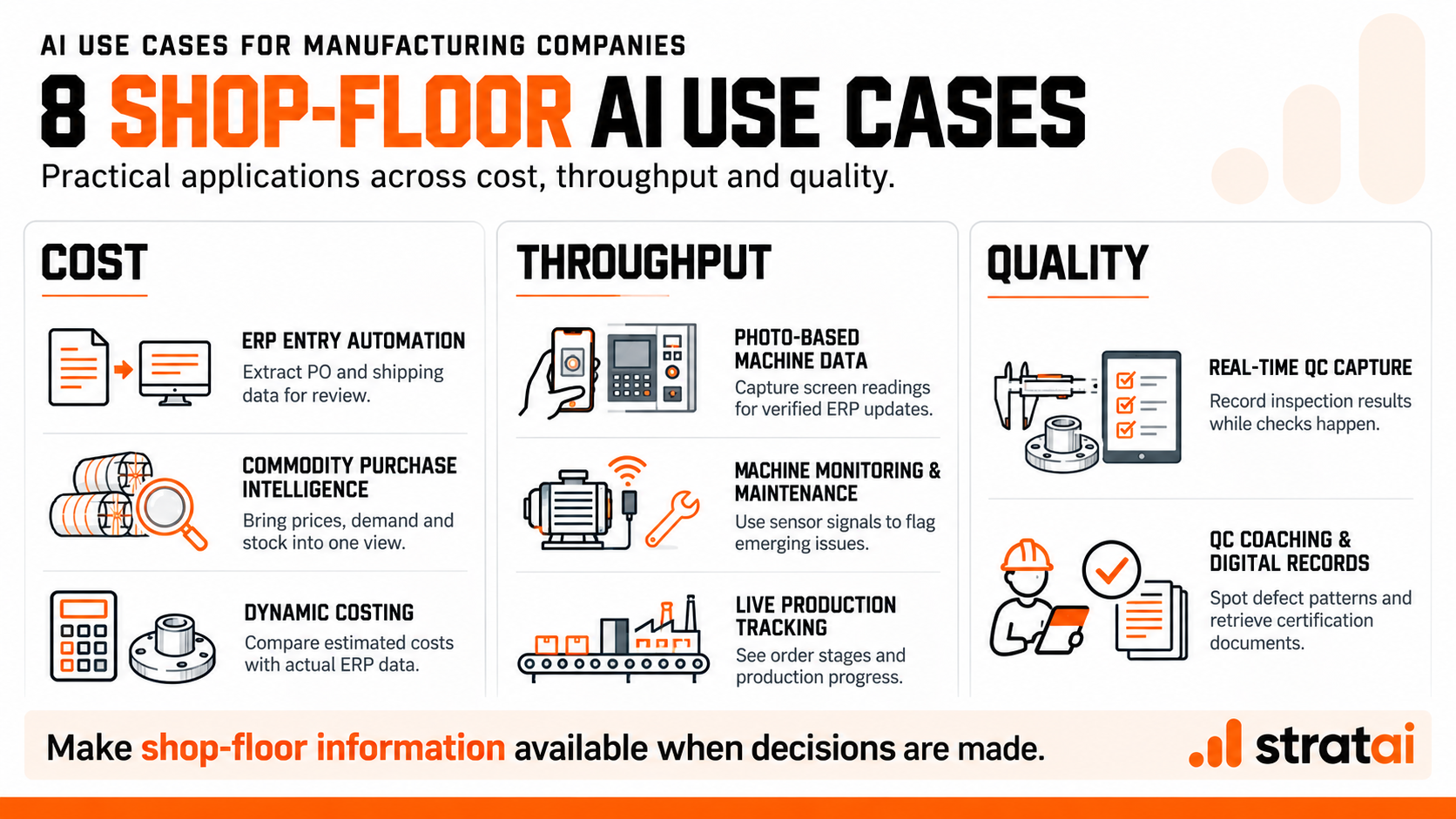
This is not a list of what AI could do in manufacturing. It is a list of what AI is doing — in active engagements, on real shop floors, measured against real P&L lines. Eight use cases across three categories: Cost, Throughput, and Quality.

Eight shop floor AI use cases across three P&L categories — Cost, Throughput, and Quality — are live in deployment or in active build in Indian mid-market manufacturing: bulk ERP data entry automation, photo-based machinery data capture, real-time QC data capture, AI-powered commodity purchase intelligence, dynamic costing systems, IoT machine monitoring and preventive maintenance, production black box elimination, and QC coaching plus certification digitisation. 56% of manufacturing organisations report direct cost savings from AI deployment — the highest rate of any industry.
AI Use Cases for Manufacturing Companies — Part 1: The Shop Floor Use Cases That Actually Change Your Cost Structure
This is not a list of what AI could do in manufacturing. It is a list of what AI is doing — in active engagements, on real shop floors, measured against real P&L lines. Eight use cases across three categories: Cost, Throughput, and Quality.
Direct answer: What are the most impactful AI use cases on the manufacturing shop floor?
The eight shop floor AI use cases producing real P&L impact in Indian mid-market manufacturing are: bulk ERP data entry automation (cost), photo-based machinery data capture (throughput), real-time QC data capture (quality), AI-powered commodity purchase intelligence (cost), dynamic costing systems (cost), IoT machine monitoring and preventive maintenance (throughput), production black box elimination (throughput), and QC coaching plus certification digitisation (quality). Every use case on this list is live in deployment or in active build — not theoretical.
56%
of manufacturing organisations report direct cost savings from AI deployment — the highest rate of any industry.
Manufacturing ties with software engineering as the sector reporting the highest AI cost savings — driven by operational automation, quality improvement, and procurement optimisation. The competitive advantage of AI in manufacturing is not theoretical. It is measurable, and it is already compounding for the companies that have started.
Source: McKinsey State of AI 2025 via AI Statistics Center
The 8 Use Cases — At a Glance
All eight use cases below are grouped by their primary P&L impact category. Every one is currently deployed or in active build in a StratAI engagement. This is the cost and throughput side of the picture — for the revenue-generating use cases, see the revenue-side AI use cases most manufacturers have never considered.
| # | Use Case | Industry / Segment | P&L Category | Status |
|---|---|---|---|---|
| 01 | Bulk ERP data entry automation — PO and shipping entry | Textile buying house · 40–50 merchandisers · 4 countries | Cost | ● Live |
| 02 | Photo-based machinery data capture into SAP | Cotton spinning mill | Throughput | ● Live |
| 03 | Real-time QC data capture for rejection reduction | Discrete manufacturing · applicable across sectors | Quality | R&D — deploying shortly |
| 04 | AI-powered commodity purchase intelligence | Listed cotton value-added manufacturer | Cost | ● Live |
| 05 | Dynamic costing — theoretical vs actual ERP reconciliation | Power press manufacturing · discrete mfg with complex catalogues | Cost | ◢ In build |
| 06 | IoT machine monitoring and preventive maintenance | Continuous production · spinning mills · process manufacturing | Throughput | R&D — deploying shortly |
| 07 | Production black box elimination — real-time order tracking | Batch production · job shops · fabrication units | Throughput | ● Live |
| 08 | QC coaching and certification digitisation | ISO / TUV certified manufacturers across sectors | Quality | R&D — deploying shortly |
● Live — Active retainer deployment · ◢ In build — Active engagement, system in development · R&D — Designed and validated, deploying with clients shortly
Category 1 — Cost: Reducing What You Spend
Cost-reduction use cases produce the most immediately quantifiable P&L impact. The three cost-side shop floor use cases below address procurement, operational efficiency, and quoting accuracy — three of the highest-leverage cost lines in any mid-market manufacturing operation.
USE CASE 01 · Bulk ERP Data Entry Automation · [COST]
A German buying house in Tirupur facilitates contract manufacturing for 60-plus European brands. Every Purchase Order contains multiple style numbers — each with detailed quantity breakdowns by colour and size. All of this must be entered into the ERP system. When factories dispatch goods, they send packing lists. From those packing lists, shipping entries must be made — again into the ERP.
Both processes are bulk, highly repetitive, non-value-added work. The merchandise team’s actual job — managing brand relationships, ensuring on-time delivery, resolving production issues — was being consumed by data transfer that required no judgment and added no insight.
40-50 Merchandisers · 4 Countries · Significant Weekly Hours Reclaimed
AI handles PO entry and shipping entry — document uploaded, AI extracts and populates, merchandiser verifies. The same use case for 4 merchandisers may not justify the investment. At 40-50 across 4 countries, it is one of the highest-value operational use cases in the engagement.
The scale principle for data entry automation: bulk ERP data entry automation creates value proportional to scale. The same system that transforms 50 merchandisers’ working week makes marginal difference for 4. Before prioritising this use case, answer: how many people do this task, how many hours per week, and what is the cost of that time versus the cost of the AI system? The mathematics must work at your specific scale.
USE CASE 04 · AI-Powered Commodity Purchase Intelligence · [COST]
A listed cotton value-added product manufacturer — one of the world’s two largest in its category — purchases several hundred crores of textile raw material annually. Commodity purchasing at this scale requires synthesising multiple data streams simultaneously: commodity price indices, World Cotton Report forecasts, forecasted demand from the sales team, current stock levels for each grade, and the actual order book from SAP.
Previously, this intelligence lived across multiple systems and documents — requiring significant manual effort to consolidate before each purchasing decision. The purchase-in-charge was making decisions on incomplete, partially outdated information.
AI now brings all data streams to one screen — live, query-accessible, always current. The purchase-in-charge estimates need more accurately and times purchases with visibility that was previously impossible.
0.3% Better Average Purchase Price = ₹1.5 Crore+ Directly to Bottom Line
On commodity purchases of several hundred crores annually, a 0.3% improvement in average purchase price translates directly to the bottom line — not revenue, margin. This use case was not in the original engagement scope. It was identified during the engagement by StratAI from being close enough to the business to see the opportunity.
USE CASE 05 · Dynamic Costing System · [COST]
In many manufacturing companies — particularly those with large, varied product catalogues — costing is based on theoretical assumptions established when a product was first designed. Actual production costs are tracked separately in the ERP. Neither set of data is consistently updated or compared against the other.
The result: every quote is assumption-based. The question hanging over every commercial decision — ‘is this price reflecting reality?’ — is answered by judgment rather than data. A Power Press manufacturer with over 100 Crore turnover described this as costing anxiety: the persistent uncertainty about whether quotes are profitable, competitive, and accurate.
AI bridges theoretical costing with actual ERP data and refines the comparison continuously across lakhs of parts. Quotes become accurate and traceable. The costing anxiety resolves into costing confidence — and commercial decisions that were previously judgment calls become data calls.
25-47% reduction in unplanned downtime and 75% cuts in scrap costs from AI at production scale.
Manufacturers who have moved AI from pilot to production scale consistently report compound improvements: cost savings that feed into throughput improvements that feed into quality gains. The use cases are not independent — they compound when implemented together.
Source: Mpiricsoftware / KPMG Manufacturing Analysis 2026
Category 2 — Throughput: Increasing What You Produce
Throughput use cases address the speed, visibility, and reliability of production. Three use cases below tackle the data lag that slows decisions, the machine downtime that stops production, and the order invisibility that breaks delivery promises.
USE CASE 02 · Photo-Based Machinery Data Capture · [THROUGHPUT]
In a cotton spinning mill, operators were responsible for manually noting data from 15 machines — reading each screen, writing each value, then entering all data into SAP. The process was sequential, time-consuming, and introduced a 1-2 day lag between data creation and data capture in the ERP.
That lag is not a minor inconvenience. When the ERP data is 1-2 days old, it cannot be used for live operational decisions. It becomes a post-mortem tool — useful only when something has already gone wrong, not useful for preventing it from going wrong.
The AI solution: the operator photographs the machine screen. AI extracts all data points and pushes them into SAP after a small verification step. The operator’s role shifts from data transcription to data verification. The ERP reflects the current state of every machine in real time.
The 1-2 day data lag pattern — and why it exists across manufacturing
The note → Excel → ERP sequence is not unique to spinning mills. It appears in almost every manufacturing operation where shop floor data is collected manually. In each case, the lag between data creation and ERP capture turns the ERP into a historical record rather than an operational tool. Real-time data capture — through photo, voice, or mobile app — eliminates this lag and transforms the ERP from a record system into a decision system.
USE CASE 06 · IoT Machine Monitoring and Preventive Maintenance · [THROUGHPUT]
For continuous production systems — spinning mills, extrusion lines, chemical reactors — unplanned machine stoppage is one of the most expensive operational events. A single hour of unexpected downtime carries the combined cost of lost production, emergency repair, quality disruption, and supply chain delay.
AI connected to IoT sensors monitors machine parameters and key metrics in real time — vibration signatures, temperature profiles, power draw patterns, acoustic emissions. When any key metric crosses a threshold that historically precedes failure, the system flags the operator and triggers a maintenance alert. Maintenance shifts from reactive (fix it when it breaks) to preventive (fix it before it breaks during a planned window).
This system is in R&D — we are deploying it with clients shortly.
30-50% Reduction in Unplanned Downtime · 25-40% Lower Maintenance Costs
Industry-documented outcomes from AI predictive maintenance deployments — McKinsey, IBM, and independent 2026 analysis. Prediction accuracy improves from 70-80% in early deployment to 85-95% within 12-18 months as models accumulate facility-specific failure history.
USE CASE 07 · Production Black Box Elimination · [THROUGHPUT]
In batch production systems, orders enter the production sequence and effectively become invisible. No one can track where a specific order is in the process — which machine it is on, which stage it is at, what the expected completion date is given current queue depth. This is the production black box.
The consequence is invariable: delivery delays, reactive customer calls, expediting costs, and strained relationships. The order was always there — just invisible to everyone who needed to see it.
AI-powered production tracking systems, designed specifically for the company’s workflow rather than adapted from a generic ERP template, create complete order visibility. The system knows where every order is, at every moment, with realistic completion estimates based on actual machine state — not planned schedules. With AI, these systems can be designed from scratch for a specific company in reasonable time and cost. The days of forcing a standard ERP to fit your production reality are over.
Manufacturers deploying AI across 3+ functions simultaneously achieve compounding ROI.
Deloitte’s manufacturing AI research consistently finds that quality improvements reduce rework costs that feed directly into maintenance planning, which reduces energy waste and improves scheduling accuracy. The shop floor use cases are not independent value streams — they compound when implemented together.
Source: Deloitte Manufacturing AI Research 2026 via AIBuzz
Category 3 — Quality: Reducing What You Reject
Quality use cases address the two most expensive quality failure modes in manufacturing: defects that reach the customer, and audits that fail because documentation is incomplete. Two use cases below tackle both.
USE CASE 03 · Real-Time QC Data Capture · [QUALITY]
The data lag problem described in Use Case 02 has a direct quality consequence. In an aluminium die casting manufacturer, QC data was being captured manually — noted on paper, transferred to Excel, entered into the ERP system with a 1-2 day delay. By the time the ERP reflected QC data, the production run was complete and the defective units were already in the warehouse.
The ERP data was being used for post-mortem analysis when a customer called out defects — not for real-time intervention to prevent them. The intelligence arrived after the damage was done.
With AI-powered real-time QC data capture — through mobile app during the inspection process itself, as deployed in the Tirupur buying house engagement — QC data enters the system as the inspection happens. Patterns in the data become visible immediately. Quality issues that would previously have been discovered by a customer complaint are now visible during production, in time to act.
This system is in R&D — we are deploying it with clients shortly.
USE CASE 08 · QC Coaching and Certification Digitisation · [QUALITY]
Two distinct quality use cases that address different dimensions of the quality problem.
QC Coaching
Based on actual QC data captured across multiple production runs, AI identifies the patterns that precede rejection — the specific parameter deviations, machine states, or process sequences that correlate with defects. This intelligence is used to coach the QC team on the specific areas to monitor and the interventions that reduce rejection rates.
This is not generic training. It is data-driven, role-specific coaching based on what is actually happening in the facility — which defect types are most common, which process stages generate them, and which interventions have historically reduced them. The QC team gets better at the specific job they are doing, informed by data about how they are currently doing it.
Certification Digitisation
ISO certifications, quality compliance documentation, and third-party audit records (TUV and equivalent) are currently stored as physical formats in racks — printed, filed, and retrieved manually during audits. The audit process is time-consuming and the documentation is always at risk of being incomplete or misfiled.
AI digitises certification documentation in real time — each certificate, inspection record, and compliance document captured and indexed as it is created. During an audit, the documentation is retrievable in seconds rather than hours. The audit process becomes a demonstration of organised compliance rather than a frantic search for physical records.
This system is in R&D — we are deploying it with clients shortly.
AI-driven quality systems deliver efficiency improvements of 20-40% and quality enhancements of up to 50%.
The combination of real-time data capture, AI-powered pattern detection, and coaching feedback loops produces compounding quality improvements — each production run informing the next, with the improvement rate accelerating as the system accumulates facility-specific data.
Source: MANTEC Manufacturing AI Analysis 2025
The One Principle Connecting All Eight AI Use Cases for Manufacturing Companies
Every use case above solves the same underlying problem: a lag between reality and the information available to make decisions about that reality.
The 1-2 day data entry lag. The commodity purchase decision made on incomplete data. The production order that nobody can see. The quality defect that shows up in a customer complaint instead of a production alert. The audit documentation that cannot be found.
In each case, the information existed. The production was happening. The machine was running. The order was in the queue. The certification was filed. AI does not create new information — it makes the information that already exists accessible at the moment it is needed, rather than 1-2 days later or after an hour of searching.
This is why the highest-leverage AI use cases in manufacturing are not the ones that require the most sophisticated AI. They are the ones where the gap between reality and decision-maker awareness is widest — and where closing that gap in real time changes the quality of every decision made from that moment forward. This is also the discipline behind the 7 things manufacturing companies must never do with AI — most of those mistakes come from chasing sophistication instead of closing the gap that actually matters.
These shop floor use cases are one half of where AI shows up. the complete guide to AI for manufacturing companies covers the full picture — including the revenue-side use cases that make up the other half — and how to decide where to start.
Tell us which of these use cases fits your operation.
→ Book your free half-day plant audit — no commitment, no strings
We identify the highest-value use case for your specific context before building anything. At the end of it, you can say no. Most don’t. We confirm your audit date within one business day.
Frequently Asked Questions
Which shop floor AI use case delivers the fastest ROI for a mid-market manufacturer?
It depends on scale and the specific cost structure, but commodity purchase intelligence consistently delivers the highest-ceiling ROI for manufacturers with large procurement volumes. A 0.3% improvement in purchase price on several hundred crores of annual commodity purchases creates a multi-crore bottom-line impact from a single use case. For manufacturers with smaller procurement volumes, bulk data entry automation or real-time QC capture often delivers the fastest visible impact — typically within the first 60-90 days of deployment.
Can AI-powered data entry automation work with our existing ERP system?
Yes — the AI layer sits above the existing ERP rather than replacing it. Documents are uploaded, AI extracts and structures the data, and the verified output is pushed into the ERP through its existing data entry interface. This approach works with SAP, Oracle, and most legacy ERP systems without requiring changes to the ERP architecture. The integration complexity depends on the ERP’s API accessibility, which the diagnostic month confirms before any build begins.
How is real-time QC data capture different from what we already have?
Most QC systems are designed for data storage, not for real-time decision support. The data is captured after the inspection, entered into the system with a lag, and reviewed periodically. Real-time QC capture — through a mobile app designed around the inspection process itself — captures data during the inspection, generates the full report instantly, and makes the data available for pattern analysis immediately. The difference is not the data collected. It is when that data becomes actionable.
What is the production black box problem and how common is it in Indian manufacturing?
The production black box describes batch production environments where orders enter the production sequence and become invisible to everyone who needs to track them — production planners, customer service teams, and management. It is extremely common in Indian mid-market manufacturing, particularly in job shops, fabrication units, and any operation running multiple concurrent orders through shared equipment. The visibility gap invariably leads to delivery delays, reactive customer communication, and expediting costs that could be avoided with real-time order tracking.
Does preventive maintenance AI require replacing existing machines with smart machines?
No — IoT sensors can be retrofitted to existing machinery at a fraction of the cost of equipment replacement. Sensor costs have dropped dramatically in recent years, making it economically viable to instrument critical machines in mid-market plants without capital equipment changes. The AI layer monitors the sensor data and generates alerts. The intervention still requires human maintenance teams — AI provides the early warning, not the repair.
About StratAI
StratAI builds AI Advantage Systems for mid-market manufacturing companies across India. Official Registered Claude Partner and Anthropic Partner. Every use case above is live in deployment or in active build — none are theoretical. Every engagement begins with a free half-day plant audit to identify which use cases are right for your specific operation.
12+ retainer clients · 90%+ client retention · stratai.io/contact · palani@stratai.io · +91 99402 25924
“The highest-leverage AI use cases in manufacturing are not the most sophisticated ones. They are the ones where the gap between reality and decision-maker awareness is widest.” — StratAI
Which shop floor AI use case delivers the fastest ROI for a mid-market manufacturer?+
Can AI-powered data entry automation work with our existing ERP system?+
How is real-time QC data capture different from what we already have?+
What is the production black box problem and how common is it in Indian manufacturing?+
Does preventive maintenance AI require replacing existing machines with smart machines?+

Palaniappan SN is a Business Strategy Consultant who has spent his career at the intersection of business strategy and operational reality — working across management levels from the boardroom to the shop floor to understand where organisations actually win and lose. His conviction is simple: AI should never be an experiment. It should be an advantage. That belief is the foundation of StratAI's AI Advantage Systems methodology — built not from technology-first thinking, but from the ground up, with the discipline to walk away from projects where the conditions for success don't exist.