The Production Black Box: Sales Made the Promise. The Plant Has to Keep It. And Nobody Can See Inside.
Every batch plant, make-to-order, and engineer-to-order facility faces the same problem. Once the order enters production, nobody can see it. Here is what that costs — and what a genuinely different system looks like.

The Production Black Box exists in every batch plant, MTO, and ETO facility. It is not a technology failure — it is a design failure. Every production planning system is built on the assumption that a calendar plan will reflect floor reality. Every Plant Head knows that assumption is wrong. The Reality-Driven Planning Model, with AI as the data capture layer, replaces calendar assumptions with floor reality — measurable in your P&L within 4 to 6 months.
In batch manufacturing, make-to-order, and engineer-to-order plants across India, the same problem exists in every factory. Once an order enters production, it disappears. This is what that actually costs — and what a genuinely different system looks like.
The sales team confirmed the delivery date.
Nobody asked the Plant Head.
The order entered production and disappeared. Sales is waiting. The customer is waiting. Procurement needs to know if the raw material call-up is still on schedule. The MD wants a status update by end of day. And the Plant Head is doing what Plant Heads across India do every single day — walking the floor, checking in person, calling supervisors on WhatsApp, carrying the entire picture in their head because there is no system that shows it to them accurately, in real time.
This is the Production Black Box.
It exists in batch manufacturing plants, make-to-order facilities, and engineer-to-order shops. It exists whether your ERP is SAP or Zoho or a system built ten years ago. It exists in a ₹50 Crore factory and a ₹900 Crore one. And it costs more than most manufacturers have ever actually calculated.
What the Production Black Box Actually Is
The Production Black Box is not a technology failure. It is a design failure.
Every production planning system in use today was built on the same assumption: that a plan created on a calendar will reflect reality on the floor. That if you assign a task to Tuesday, the task will happen on Tuesday. That if a batch is scheduled to complete on Friday, it will complete on Friday.
Every Plant Head reading this knows that assumption is wrong.
Machine breakdowns do not check the calendar. Raw material delays do not check the calendar. Quality rejections mid-batch do not check the calendar. A worker calling in sick, a priority order arriving from the MD at 10am, a supplier delivering the wrong specification — none of these events talk to the plan. The plan just continues, undisturbed, increasingly fictional, until someone — almost always the Plant Head — reconciles it manually with what is actually happening on the floor.
A calendar-based plan is a photograph of a river. By the time you look at it, the river has moved.
The Production Black Box is the gap created by this mismatch. It is the space between what the plan says is happening and what is actually happening — a space that widens with every hour, every shift, every unrecorded event.
This problem is most acute in three production environments:
- Batch manufacturing — 10 to 15 orders running simultaneously, each at a different stage. Nobody has a single live view of where each batch is. The Plant Head carries it all.
- Make-to-order — every order is unique, every timeline is custom, every routing is different. There is no standard to compare against. The only benchmark is the Plant Head's experience.
- Engineer-to-order — the longest lead times, the highest complexity, the maximum exposure. A problem at week three of a twelve-week order is invisible until week eleven when the delivery date is already broken.
What the Black Box Looks Like at Scale
A German buying house operating out of Tirupur coordinates more than 25 contract textile manufacturers, over 50 global brands, and 50 merchandisers across three countries. At any point in time, each brand has 10 to 15 styles in active production simultaneously. One merchandiser manages multiple brands.
They have an ERP system. It is used for one purpose only: documentation. When a European buyer raises a quality complaint, the ERP provides the evidence trail. That is the entirety of its function. It gives zero real-time visibility to QC executives on factory floors, to merchandisers coordinating from three countries, to plant heads managing actual production, or to management making capacity decisions.
The structural reason is straightforward. Because the operation involves more than 25 independent contract manufacturers, each factory runs its own production planning system. The tasks showing in the shared ERP are completely disconnected from what is actually happening on any floor. The ERP and the floor are two separate universes. Trust in the shared system has eroded completely. Nobody believes the numbers. Everyone works around it.
The workarounds are the same ones used in factories a fraction of this size. WhatsApp messages between merchandisers and factory supervisors. Phone calls to check on delayed batches. Manual tracking sheets that are already one shift behind by the time someone reads them.
The consequence in this operation is particularly visible because the customer is European. When a shipment is delayed — which happens regularly, because the Black Box makes delays invisible until it is too late to prevent them — the goods have to be air-freighted. The cost of one air shipment can eliminate the margin on the entire order. And the client relationship deteriorates with every late delivery, in an industry where on-time performance is already the exception, not the rule.
The Black Box is not just a planning problem. It is a trust problem. Every delayed shipment is a missed commitment. Every missed commitment is a conversation the Plant Head has to have that the system should have prevented.
The Four Workarounds Every Plant Head Uses — And What They Actually Cost
Because the planning system does not reflect reality, Plant Heads have built parallel systems to manage the gap. All four are in use simultaneously in most factories.
Real-time updates happen on WhatsApp groups between supervisors, QC leads, and the Plant Head. It works until it does not — messages are missed, shift handovers get lost, and the thread becomes the system of record for decisions that should be tracked.
The Plant Head physically visits each station or calls each supervisor at the start of every shift. It is the most reliable source of real data in the entire factory. It is also two hours of a senior person's day, every day.
Someone — usually a production coordinator or a supervisor's assistant — maintains a master Excel file. It is updated once a day, sometimes twice. By the time the next update happens, three things have changed. It is never wrong enough to be discarded and never accurate enough to be trusted.
The most dangerous workaround of all. The Plant Head — through years of experience — holds a complete mental model of the production status. They know which orders are at risk, which machines are underperforming, which supervisors are optimistic about their numbers. The system runs on one person's cognitive load.
The Cascade: What the Black Box Costs the Whole Business
| FUNCTION | IMPACT OF THE BLACK BOX |
|---|---|
| Sales | Promises delivery dates without knowing actual production status. When the date is missed, the conversation with the customer falls to sales — who had no information to begin with. |
| Procurement | Calls up raw material based on the plan, not on actual consumption. Results in overstocking when production slips and shortages when it accelerates. Both conditions cost money. |
| Quality | Quality deviations identified after the batch completes rather than during it. By the time the data is entered, the damage is already done. A problem caught at unit 50 is different from a problem caught at unit 500. |
| Finance / Cash Flow | Air freight costs, rework costs, penalty clauses, and delayed invoicing from late deliveries compress margins. Working capital tied up in excess inventory. Procurement inefficiency affecting credit lines. |
| Shift Handover | Incoming shift does not know actual status of in-progress orders. First hour is spent on discovery rather than production. Mistakes made in the first hour of a shift trace back to poor handover information — not to the incoming team. |
| Management | Capacity decisions, customer commitments, and capex decisions are made on data that is hours or days old. The Plant Head becomes the only real-time data source — which creates a single point of failure for every operational decision. |
What a Genuinely Different System Looks Like
The solution to the Production Black Box is not a better ERP. ERP systems are built on the same calendar assumption. A more expensive ERP with more fields to fill in is a more expensive version of the same problem.
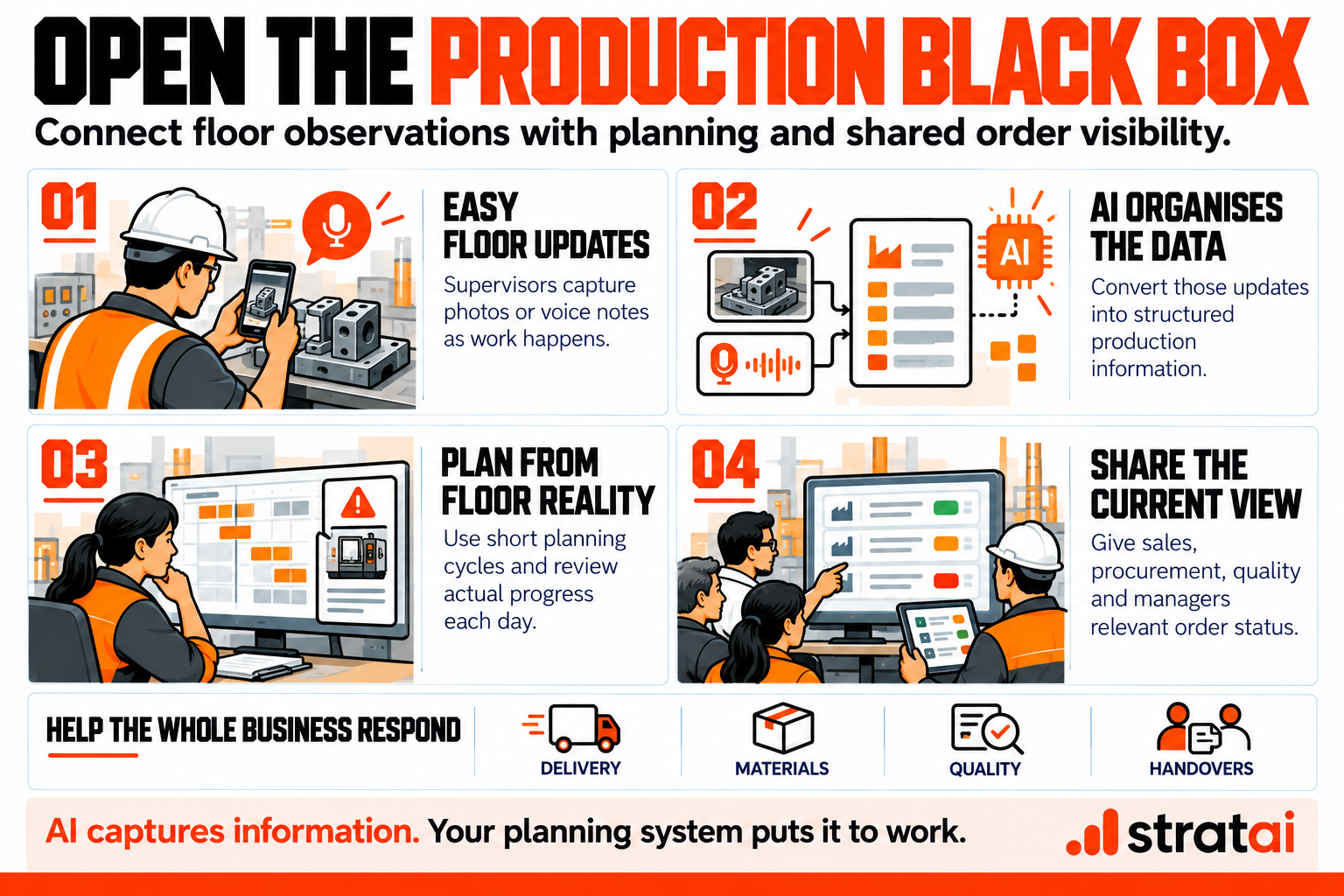
The solution requires two things simultaneously: a different planning philosophy and AI as the capture layer that makes real-time data entry possible without adding burden to the people on the floor.
A system planned at 3-day or weekly horizons and recalibrated daily against what actually happened on the floor — with AI as the capture layer that removes data entry burden from the people who have least time for it.
The key distinction: AI is not the brain of this system. AI is the eyes and ears. A QC supervisor does not sit at a computer and type a report. They take a photo. They speak an update. The AI captures it, structures it, and delivers it to the right person in the right format. The system thinks. AI listens and records without friction.
This distinction matters because it is why pure AI vendors cannot solve this problem alone, and why ERP vendors cannot solve it alone either. The Production Black Box requires systems thinking — designing for every variation the floor produces — combined with AI capability that removes the data entry burden from the people who have least time for it.
For manufacturing companies already running SAP or a legacy ERP, this challenge has a specific dimension. How AI agentic systems work alongside existing ERP infrastructure is a separate question we have addressed in detail — the short answer is that the Reality-Driven Planning Model does not replace your ERP. It works alongside it, feeding it real data instead of waiting for manual entry.
Choosing the right partner for a problem that requires both systems thinking and AI capability is not the same as choosing an AI vendor. The Domain-First Principle — and the three questions every manufacturer should ask before selecting any AI implementation partner — applies here as much as anywhere.
What Closing the Black Box Actually Unlocks
When production becomes visible in real time — to the right people, in the right format, at the right moment — the cascade reverses.
- Sales sets realistic delivery commitments based on actual production status, not calendar assumptions. Client trust improves not because delivery gets faster, but because the commitment made on Monday reflects what is actually possible.
- Customer escalations drop. When sales has visibility into production status, they can proactively communicate delays before the customer calls. The conversation changes from reactive damage control to professional expectation management.
- Procurement plans raw material call-ups against real consumption rates, not projected ones. Over-ordering and line stoppages both reduce.
- Quality problems are caught mid-batch, not at the end. The QC alert that fires in the same shift — not 12 hours later — is the difference between a contained problem and a scrapped batch.
- Shift handovers become structured. The incoming shift starts with the actual status of every active order, not a verbal summary that varies by who is doing the handover.
- Management makes decisions on current data. The Plant Head stops being the only person who knows what is happening and starts being the person who leads what should happen next.
- In contract manufacturing operations, every vendor's actual production status is visible to the coordinating team. Air shipments become a last resort, not a regular budget line.
The ERP has the data. The floor has WhatsApp. And the Plant Head has twenty years of experience holding it all together in their head. That is not a system. That is a person.
StratAI's starting point is always a diagnostic. We spend time on your floor, understand your order types, your data sources, and your people, before proposing anything. The Reality-Driven Planning Model is not a product. It is a system designed around what we find inside your specific operation.
For manufacturing CXOs weighing this at the board level, what AI implementation actually looks like once the board has approved it — the constraints, the first month, and what changes after that — is worth reading alongside this.
IS YOUR PRODUCTION PLAN BUILT ON CALENDAR ASSUMPTIONS?
If your production plan is still built on calendar assumptions — let's talk about what a reality-driven system would look like in your specific operation.
A 30-minute call. No proposal until we understand your context. StratAI works with manufacturing leaders to diagnose where the highest-leverage AI opportunity sits in their specific business — and build the system that makes it show up in the P&L.
→ Let's Map Your First AI Advantage System
Not ready for a conversation yet?
Answer 23 questions about your business and get a personalised AI readiness score, your biggest P&L gap, and 3 specific next steps — in under 5 minutes.
→ Take the AI Readiness Assessment and Get Detailed Feedback
Why does our ERP not solve the Production Black Box?+
Is the Production Black Box just a technology problem or does the process need to change?+
Our workers will not adopt a new system. How is the Reality-Driven Planning Model different?+
How do you account for variations like machine breakdowns and material delays?+
What is the realistic timeline for a real-time production visibility system to show P&L impact?+
Does the Reality-Driven Planning Model work alongside an existing ERP or does it replace it?+

Palaniappan SN is a Business Strategy Consultant who has spent his career at the intersection of business strategy and operational reality — working across management levels from the boardroom to the shop floor to understand where organisations actually win and lose. His conviction is simple: AI should never be an experiment. It should be an advantage. That belief is the foundation of StratAI's AI Advantage Systems methodology — built not from technology-first thinking, but from the ground up, with the discipline to walk away from projects where the conditions for success don't exist.