Board Wants Results. CFO Wants Proof. Team Resists. Data Is Messy. This Is What AI Implementation Actually Looks Like.
Every manufacturing CXO who has approved an AI investment faces the same four walls simultaneously. Here is the honest account of what those walls look like from the inside — and how to break through each one.
AI approval is not the hard part. The hard part begins the day after the board says yes. The four constraints — board pressure, CFO proof needs, team resistance, and siloed data — are present in every manufacturing company. The 1-Month Diagnostic is the StratAI methodology for understanding reality before building anything. Built on a ₹900 Crore textile engagement with 9 use cases identified, 7 approved, and ₹1 Crore procurement saving identified in month one.
Every manufacturing CXO who has approved an AI investment faces the same four walls simultaneously. Here is the honest account of what those walls look like from the inside — and how to break through each one.
The meeting lasted one hour.
A listed cotton spinning manufacturer — ₹900 Crore annual revenue, five plants across South India, one of the most respected names in their segment — had decided something significant. The board had looked at where the textile industry was heading and made a call: they would be the company that led the sector into AI. First-mover advantage. Not in two years. Now.
The MD walked in with that clarity. We walked in with one question: what does the reality inside your business actually look like?
What followed was the most honest account of AI implementation we have experienced. Because this company — serious, well-run, board-committed, genuinely ready — still faced every constraint a manufacturing CXO faces. All four. Simultaneously. From day one.
Board pressure for results. CFO needing proof. Middle management skeptical. Data siloed across SAP, a document server, and ten years of unstructured email. And beneath all of it, the question every CXO carries but rarely says out loud: what does this actually look like when it starts?
This blog is the honest answer to that question.
The Four Walls Every Manufacturing CXO Hits After Approval
AI approval is not the hard part. The hard part begins the day after the board says yes.
In our previous blog on what AI investment failure actually looks like, we described why most AI projects never show up in the P&L. The reasons are structural. But understanding why things fail is different from understanding what to do when you are the CXO who has just approved the investment and is now standing at the beginning of the journey.
The four constraints below are not theoretical. They are drawn from every engagement StratAI has run across manufacturing sectors. Every company has all four. The combination and severity vary. The fact of their existence does not.
The 4 Constraints — And How Each One Actually Gets Handled
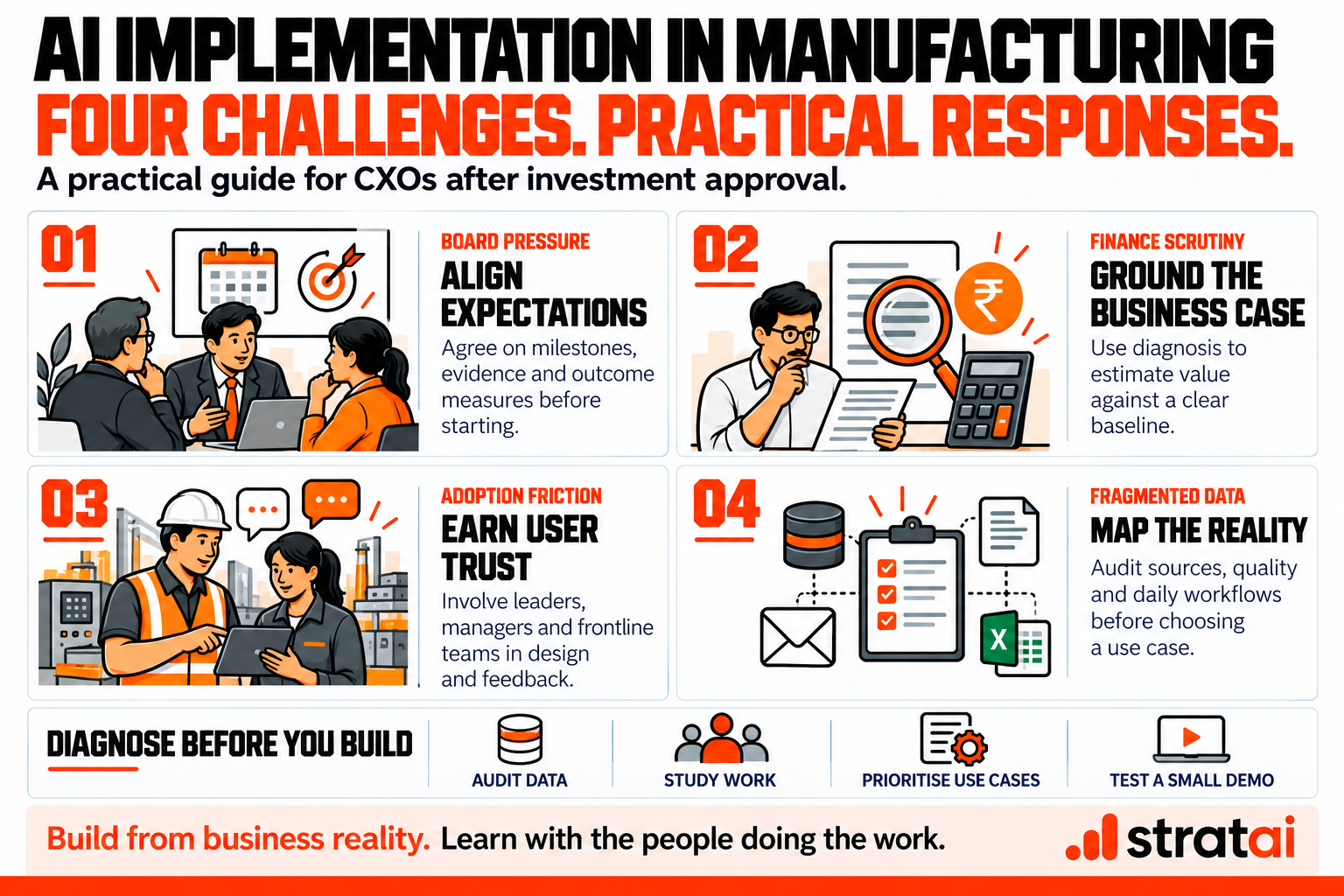
Constraint 01 — Board Wants Results
The board approved AI with an expectation of visible progress. The CEO is simultaneously carrying the mandate, managing the skeptics, and privately uncertain whether this will work. The CFO released the first tranche but is watching the clock. The timeline in the boardroom and the timeline of real AI systems are structurally misaligned — and the CXO is standing in the middle of that gap.
Expectation alignment before month one begins.
We do not start building until we have presented the board with a specific, honest 6-Month P&L Horizon — what months one to three look like, what month four signals mean, and what the compound effect looks like in month six and beyond. We build a micro demo of a simple use case in the first month — not to prove AI works in general, but to give the board something real to react to, so they understand what they are investing in before they have to wait for month four.
Constraint 02 — CFO Wants Proof
The CFO is not unreasonable. They are doing their job. The problem is that real AI ROI cannot be calculated before diagnosis — but the CFO is being asked to commit capital before the diagnosis has happened. They compare AI investment to capex: machinery, plant expansion. Different mental model, different payback timeline, different risk profile.
A 0.3% saving in procurement costs on ₹900 Crore annual revenue. Identified in month one. Specific to this business. Not a generic benchmark. That single number — derived from our analysis — unlocked CFO approval for procurement AI.
Constraint 03 — Team Resists
Resistance is not a single event. It is a pattern at every level simultaneously. Middle management feels exposed. Shop floor workers revert to old ways the moment nobody is watching. The AI champion who drove the initiative gets pulled into other priorities. And the entire team is already overloaded — AI adds work before it reduces it, and nobody has visible bandwidth for that.
The Marketing Director entered month one skeptical. She had seen consulting projects that produced slide decks and nothing else. By month two, she was routing every AI-related question from her team through our project POC. Not because we asked for that authority. Because when we presented the first data findings — specifically, what the email audit revealed about how BD conversations were being lost at the handover stage — she recognised the problem immediately. She had lived it. The evidence was from her own data. That is what converts a skeptic: not persuasion. Evidence from inside their own business.
We work at all three levels from day one. Board, middle management, shop floor. Horizontal relationships, not a top-down rollout. We set expectations slightly low and beat them. We iterate with user feedback so rapidly that the people using the system feel heard — and that feeling is what converts skeptics into supporters.
Constraint 04 — Data Is Messy
Every manufacturing company has data. What they almost never have is integrated, trusted, real-time data. The reality is some combination of: data siloed across systems that do not talk to each other, the ERP capturing post-mortem data that tells you what happened but not what to do next, different teams maintaining different spreadsheet versions of the same metric, and data quality so poor that early AI outputs trigger distrust rather than adoption.
In the textile engagement, month one identified a hidden pain that nobody had named. Production orders entered the system and became invisible. Sales was promising delivery dates based on the plan. The plant was managing reality. No shared view existed between them. By the time a delay was visible in the data, it was too late to prevent the client escalation. The Production Visibility Gap — the absence of real-time production status visible to sales, management, and the plant simultaneously — was costing client relationships. Nobody had called it that until the diagnostic named it. Once it was named, it became addressable.
This is the same structural problem covered in depth in The Production Black Box — what happens when sales makes a promise the plant has no way to see, let alone keep.
Month one is entirely a diagnostic, not a build. We do not start building AI systems until we understand the data reality completely. In the textile engagement, this meant auditing over one hundred thousand emails across ten years using AI. It meant twelve hours of business development and customer support process study. It meant identifying a hidden pain that nobody had named.
The 1-Month Diagnostic — What Month One Actually Looks Like
Every StratAI engagement begins with the same structured first month. Not a sales process. Not a scoping exercise. A genuine diagnostic — designed to understand the reality of the business before recommending a single line of implementation.
| WEEK | WHAT ACTUALLY HAPPENS | OUTPUT |
|---|---|---|
| WEEK 1 | Data audit across all systems — SAP, email, document server, shared drives, spreadsheets. How integrated is the data? How accurate? What is trusted and what is not? | Data reality map. Identify which data source is clean enough to build the first use case on. |
| WEEK 2 | Functional analysis. Factory visits. BD, sales, operations, production, QC, procurement. What does work actually look like — not the process document version, the real version? | Pain map. Where is time lost? Where are decisions made on bad data? Where is the first hidden opportunity? |
| WEEK 3 | Use case identification and prioritisation. Which AI applications will move the P&L? In what order? What is the implementation complexity versus the impact? | Ranked use case list with P&L impact estimates. First use case selected for micro demo. |
| WEEK 4 | Micro demo of the first use case. Management presentation of all findings. Approval of the full use case roadmap. Retainer scope defined. | Management alignment. Use case roadmap approved. Month two scope defined and agreed. |
In the textile engagement, month one produced: an AI-powered audit of over one hundred thousand emails identifying nine high-value use cases estimated to move revenue by 10 to 12 percent. A clear data architecture recommendation connecting SAP, document server, and email. The identification of the Production Visibility Gap that was costing client relationships. And a procurement AI case that translated to ₹1 Crore annual savings on procurement cost alone.
Management approved seven of nine use cases. The engagement has now entered month three. Chatbot and procurement AI are running in parallel. Visible output is expected in months four and five.
Real results take a minimum of 4 to 6 months. We are in month three. Progress is good. That is the honest truth — and it builds more trust than any promise ever could.
Why the First Month Changes Everything
The Domain-First Principle is not an abstract philosophy. The 1-Month Diagnostic is what it looks like in practice. Every AI system we build is built on the foundation of what we actually found inside the business — not what we assumed, not what a previous client's system looked like, not what a generic AI vendor would deploy.
The data architecture is designed around the data that exists, not the data that should exist. The use cases are prioritised by actual P&L impact, not by technical elegance. The UI is designed to be so simple that adoption is not a choice — it is the path of least resistance. And the change management is not a separate workstream. It is embedded in how we design, how we iterate, and how we communicate at every level of the organisation.
The retainer model makes all of this possible. On a fixed-cost project, month one is a scoping exercise designed to define deliverables. On a retainer, month one is a diagnostic designed to understand reality. The difference in output — at month four, at month six, and at month twelve — is the difference between a P&L that moves and one that does not.
For manufacturing companies running SAP or a legacy ERP, the diagnostic often uncovers a specific and widespread failure: shop floor non-adoption that makes the entire ERP investment invisible in the P&L. AI agentic systems built on voice and OCR are the first credible solution manufacturing has had for this problem.
What the Next Six Months Actually Look Like
| MONTH | WHAT HAPPENS | WHAT THE BOARD SEES |
|---|---|---|
| MONTH 1 | Diagnostic. Data audit, floor visits, use case identification, micro demo. | A working demo. A ranked use case list with P&L estimates. A clear month two plan. |
| MONTHS 2–3 | Build and iteration. First AI systems deployed. User feedback integrated. Rapid iteration cycles. | Working systems in users' hands. Early feedback positive. System improving with each iteration. |
| MONTH 4 | Early P&L signals. First measurable outcomes begin to appear. Adoption stabilises. | First data points: time saved, decisions improved, early cost signals. Confidence in the system grows. |
| MONTHS 5–6 | P&L movement measurable. Second use case in build. Compound effect begins. | Measurable P&L impact. Board question shifts from "is this working?" to "what do we build next?" |
What to Do If You Are Reading This at the Decision Stage
If the board has approved AI and you are now holding the question of how to begin — the answer is not to find a vendor who promises the fastest results. The answer is to find a partner who is willing to spend a month understanding your business before recommending anything.
Ask them to describe your procurement process. Ask them what they found in their last manufacturing engagement that the client had not seen themselves. Ask them what they would not automate in your business. If the answers are specific, the domain knowledge is real. If the answers are generic, the implementation will be too.
The four constraints — board pressure, CFO proof, team resistance, messy data — are not obstacles that disappear with the right technology. They are management challenges that require a partner embedded in your business, moving at your pace, earning trust at every level, and building systems designed for your reality.
Every manufacturing company that has seen AI move their P&L started with one honest month. Not a promise. A diagnostic. That is where everything is decided.
The companies that win with AI in manufacturing are not the ones that started first. They are the ones that started right.
IS YOUR AI INVESTMENT ON TRACK TO SHOW UP IN YOUR P&L?
The four constraints are real. They exist in every manufacturing company at every stage. The difference is whether your AI partner has the domain expertise, the methodology, and the commercial structure to handle them.
StratAI's first step is always a diagnostic. Not a proposal. Not a demo. A genuine, structured month of understanding your business before recommending anything. A 30-minute call. No pitch deck. Just clarity on whether the conditions for real AI success exist in your business.
→ Let's Start With a Conversation
Not ready for a conversation yet?
Answer 23 questions about your business and get a personalised AI readiness score, your biggest P&L gap, and 3 specific next steps — in under 5 minutes.
→ Take the AI Readiness Assessment and Get Detailed Feedback
How long does it realistically take to see AI results in a manufacturing company?+
How do you handle board pressure for quick AI results?+
What does the first month of a StratAI engagement actually involve?+
How do you handle team resistance to AI in manufacturing?+
What do you do when the data is siloed and messy?+
Why does StratAI use a retainer model instead of project-based pricing?+

Palaniappan SN is a Business Strategy Consultant who has spent his career at the intersection of business strategy and operational reality — working across management levels from the boardroom to the shop floor to understand where organisations actually win and lose. His conviction is simple: AI should never be an experiment. It should be an advantage. That belief is the foundation of StratAI's AI Advantage Systems methodology — built not from technology-first thinking, but from the ground up, with the discipline to walk away from projects where the conditions for success don't exist.