Part 2 of 4 in the CAPTURE CONVERT COMPOUND series | All you need to understand about data
Part of the CAPTURE CONVERT COMPOUND series
This blog is the CAPTURE deep dive in StratAI's four-part series on manufacturing data strategy. CAPTURE is the first of three data problems every manufacturer must diagnose before building any AI system. If the data is not reaching the system at source, in time, from a consolidated source - no AI layer built on top of it will produce reliable intelligence. This blog covers all five CAPTURE attributes: Volume, Source Consolidation, Access, Lag, and Trigger Nature.
Most manufacturing CEOs believe their data is captured. The ERP has records. The QC system has inspection logs. The production module has order entries.
What they do not see is the journey that data took to get there.
From the event on the floor to the entry in the ERP, manufacturing data passes through an average of three to four human intermediaries, accumulates a lag of twelve to twenty-four hours, loses the contextual detail that makes it useful for root cause analysis, and arrives in a system that was designed to record transactions - not to capture the operational reality of what actually happened.
The ERP is not the capture system. It is the destination of a manual relay chain. And the relay chain is where most of the data value is destroyed - before any AI ever sees it.
Poor data integrity in legacy systems - not lack of ambition or budget - is the single biggest barrier to scaling AI in Indian manufacturing plants.
Before evaluating AI tools or vendors, the right question is whether your data is being captured at the quality and speed AI requires. An AI system fed manually entered, lagged, contextually stripped data will produce outputs that are technically correct for the data it received - and operationally wrong for the reality that data was supposed to represent.
Source: Team Computers / MarketsandMarkets, India AI in Manufacturing, 2026
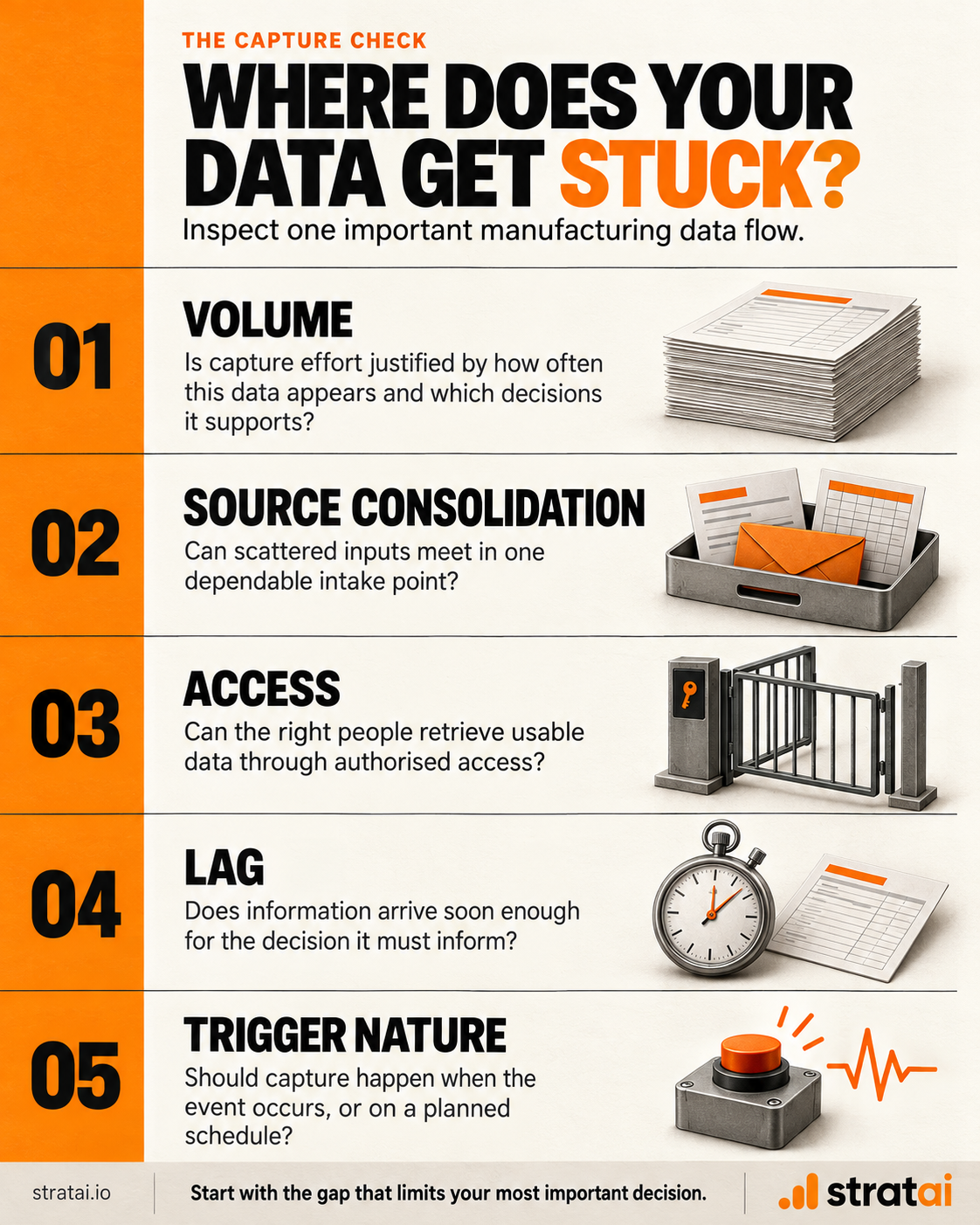
The Five CAPTURE Attributes - and What Each One Costs You
Work through all five against your most important current data flow. The attribute where you score lowest is where the CAPTURE investment should start.
States: High (Bulk) / Low (One-off)
Diagnostic question: Is this data generated repetitively at scale - or is it a one-time event?
Low state: Low volume, one-off data. A capture system for data that appears once a quarter does not justify the investment.
High state: High volume, repetitive data. Every production shift, every machine cycle, every inspection event - hundreds of times a day.
From the field: In most mid-market manufacturing plants, the highest-volume data is shift production data, QC inspection records, and machine runtime data. These are generated on every shift, for every machine, every day. The volume is high. The capture is manual. This is the highest-ROI capture investment available.
Value unlock: High volume + repetitive = automation ROI justifies the build cost. Every hour saved per shift across twenty machines across three shifts compounds fast. Prioritise capture automation on high-volume, repetitive data flows first.
Watch for: Volume is not the only consideration. High-volume data that is irrelevant to any decision is noise. Always pair Volume with Decision Impact to confirm the data being captured will change a decision.
States: Consolidated (single source) / Scattered (multiple sources)
Diagnostic question: Does this data arrive from one place - or from many?
Low state: Scattered sources: data arrives from email, WhatsApp, paper forms, Excel files, and ERP entries - about the same event, from different people, at different times.
High state: Consolidated source: the data arrives from one system, one format, one point of capture. A single mobile form. A single sensor.
From the field: In a textile buying house, one purchase order involves a Tech Pack (PDF), a quantity breakdown (email), a fabric specification (WhatsApp), a delivery schedule (Excel), and a sample approval (physical document). Five sources for one document. Before any AI can process the PO, a human must consolidate these - 30-45 minutes per order across 50 merchandisers.
Value unlock: Scattered sources need an aggregation layer before any AI can act on them. Build the consolidation layer first - a single intake point that pulls from all sources - then build the AI on top of it.
Watch for: Some scatter is structural - it reflects how the business has grown across tools and systems. Do not try to eliminate all sources simultaneously. Identify the single highest-value scattered flow and build a consolidation layer for that one first.
States: High Access / Low Access
Diagnostic question: Does the data exist - but remain hard to reach because of system barriers, permission structures, or format constraints?
Low state: Low access: the data exists in a system but requires manual export, special permissions, or technical extraction. A production engineer who wants three months of machine data must raise an IT request, wait for an export, receive a CSV, and clean it before analysis.
High state: High access: the data is queryable in real time by the people who need it, in the format they need it, without an intermediary step.
From the field: In many mid-market plants, ERP data is technically available but practically inaccessible. A plant head who wants the current inventory position for a specific raw material must open the ERP, navigate to the right module, and run a report - or call the store manager. Most call the store manager.
Value unlock: Low access + data exists = a quick win. The data is already there. The investment is access infrastructure: APIs, query layers, role-based dashboards. This is often the fastest ROI in the CAPTURE category because no new data needs to be generated.
Watch for: Access problems are often misdiagnosed as CONVERT problems. If people are not using data, first ask: can they actually get to it? Fix access before assuming the problem is willingness or trust.
States: High Lag / Low Lag
Diagnostic question: How much time passes between the moment data is generated and the moment it is available in the system?
Low state: High lag: twelve to twenty-four hours or longer. The shift notebook is compiled at shift end. The Excel is updated the next morning. The ERP entry is made by afternoon. By the time the data is available, the conditions that produced it have changed.
High state: Low lag: seconds to minutes. The operator logs the observation on a mobile device. The system receives it immediately. The AI model sees it in real time and can flag patterns before they produce further consequences.
From the field: The most consequential lag we observe is the QC defect lag. A defect occurs. It is noted in a shift register. It is compiled at shift end. It is entered into the ERP the next morning. It appears in a quality report at the next weekly review. By then, the machine has run three more shifts with the same underlying issue - producing the same defect hundreds more times.
Value unlock: Reducing lag is often higher ROI than building better analytics. A 24-hour lag reduced to a 5-minute lag on a high-impact defect data flow can prevent more quality cost than any sophisticated AI model built on lagged data.
Watch for: Not all lag is equal. A 24-hour lag on monthly financial data is acceptable. A 24-hour lag on production defect data is expensive. Always assess lag in the context of the decision it informs - and the cost of making that decision on stale information.
States: Event-triggered / Schedule-triggered
Diagnostic question: Does the need for this data arise when something happens - or on a calendar cycle?
Low state: Schedule-triggered when it should be event-triggered: inventory reviewed quarterly when a stockout occurs mid-cycle. Quality reported weekly when a defect trend emerges on Tuesday. The review schedule misses the event window.
High state: Event-triggered: the system captures and surfaces data at the moment the relevant event occurs - not on the next scheduled review. A machine parameter drifts outside spec. The system flags it immediately.
From the field: In demand planning, a common CAPTURE failure is treating demand signals as schedule-driven when they are event-driven. A major customer places an unusually large order. A competitor goes out of stock. These are events - but most manufacturers process demand data on a fixed weekly or monthly cycle. The event has already passed by the time the scheduled review occurs.
From the field (manufacturing floor): A machine that runs above 85°C for more than three consecutive cycles is an event - but most plants review machine temperature data in a weekly maintenance summary.
Value unlock: Event-triggered data on a schedule = missed windows. The fix is redesigning capture around the trigger - not the calendar. Identify which data flows are currently schedule-driven but should be event-driven. Build alerting and real-time capture for those flows first.
Watch for: Trigger redesign is not always an AI project. Sometimes it is a simple alerting rule - if machine temperature exceeds threshold X, send a notification. Start with the simplest possible trigger implementation.
The CAPTURE Diagnostic
Before any AI project begins, run these five questions against the data flow you plan to use. A No to any one means the CAPTURE gap exists.
| # | Diagnostic question | If No... |
|---|---|---|
| V | Is this data generated at sufficient volume and frequency to justify a capture system? | Low volume - evaluate ROI before investing in capture infrastructure. |
| SC | Does this data arrive from a single consolidated source? | Scattered - build an aggregation layer before any AI layer. |
| A | Can people access this data in real time without a manual export or intermediary? | Low access - fix the access layer before diagnosing willingness or trust. |
| L | Is this data available within minutes of the event that generated it? | High lag - reduce lag before building analytics. |
| T | Is this data captured at the moment the relevant event occurs - not on a schedule? | Schedule-triggered - redesign capture around the event trigger. |
The five-question diagnostic in this blog can be run in 30 minutes against any data flow. One conversation maps the full CAPTURE gap across your operation.
If your AI system is being fed data that passed through three human intermediaries and a 24-hour lag - the problem is not the AI.
Map your CAPTURE gaps: stratai.io/contact
We identify which of the five CAPTURE attributes is costing you the most - and what the first investment looks like to close it.
Frequently Asked Questions
What is the CAPTURE problem in manufacturing data?
The CAPTURE problem is the gap between when data is generated and when it reaches a system in usable form. In most mid-market manufacturing plants, data passes through a manual relay chain - notebook to Excel to ERP - accumulating a lag of twelve to twenty-four hours and losing the contextual detail that makes it useful for AI. The five CAPTURE attributes (Volume, Source Consolidation, Access, Lag, Trigger Nature) diagnose exactly where in this journey the data is being degraded.
Why does data lag matter so much for manufacturing AI?
An AI system can only flag patterns in the data it receives. If that data arrives with a 24-hour lag, the AI flags patterns from yesterday - after the machine has run another full shift producing the same defect. The lag does not just delay the response - it fundamentally changes what the AI can do. Real-time capture turns AI into a preventive system. Lagged capture turns it into a post-mortem analysis tool.
How is CAPTURE different from data quality?
Data quality problems - inaccurate values, inconsistent formats, missing fields - are often symptoms of CAPTURE failures, not independent issues. Data manually transcribed from a notebook into Excel into an ERP by three different people will have quality problems. Data captured at source by the person who generated it, at the moment it was generated, will have significantly fewer quality problems. Fixing CAPTURE often fixes data quality as a by-product.
Part 2 of 4 in the CAPTURE CONVERT COMPOUND series.
Pillar: All you need to understand about data
Next - CONVERT: Your data is available. Your decisions are not changing.
Next - COMPOUND: You are using your data. But only at face value.
About StratAI
StratAI helps manufacturing firms in India build AI Advantage Systems. 10+ live deployments across textile, jewellery, furnishings, commodity processing, and component manufacturing. Official Registered Claude Partner and Anthropic Partner.
stratai.io/contact | palani@stratai.io | +91 99402 25924
"The ERP is not the capture system. It is the destination of a manual relay chain. And the relay chain is where most of the data value is destroyed - before any AI ever sees it."
- Palaniappan SN, Co-Founder, StratAI