Part 4 of 4 in the CAPTURE CONVERT COMPOUND series | All you need to understand about data
Part of the CAPTURE CONVERT COMPOUND series
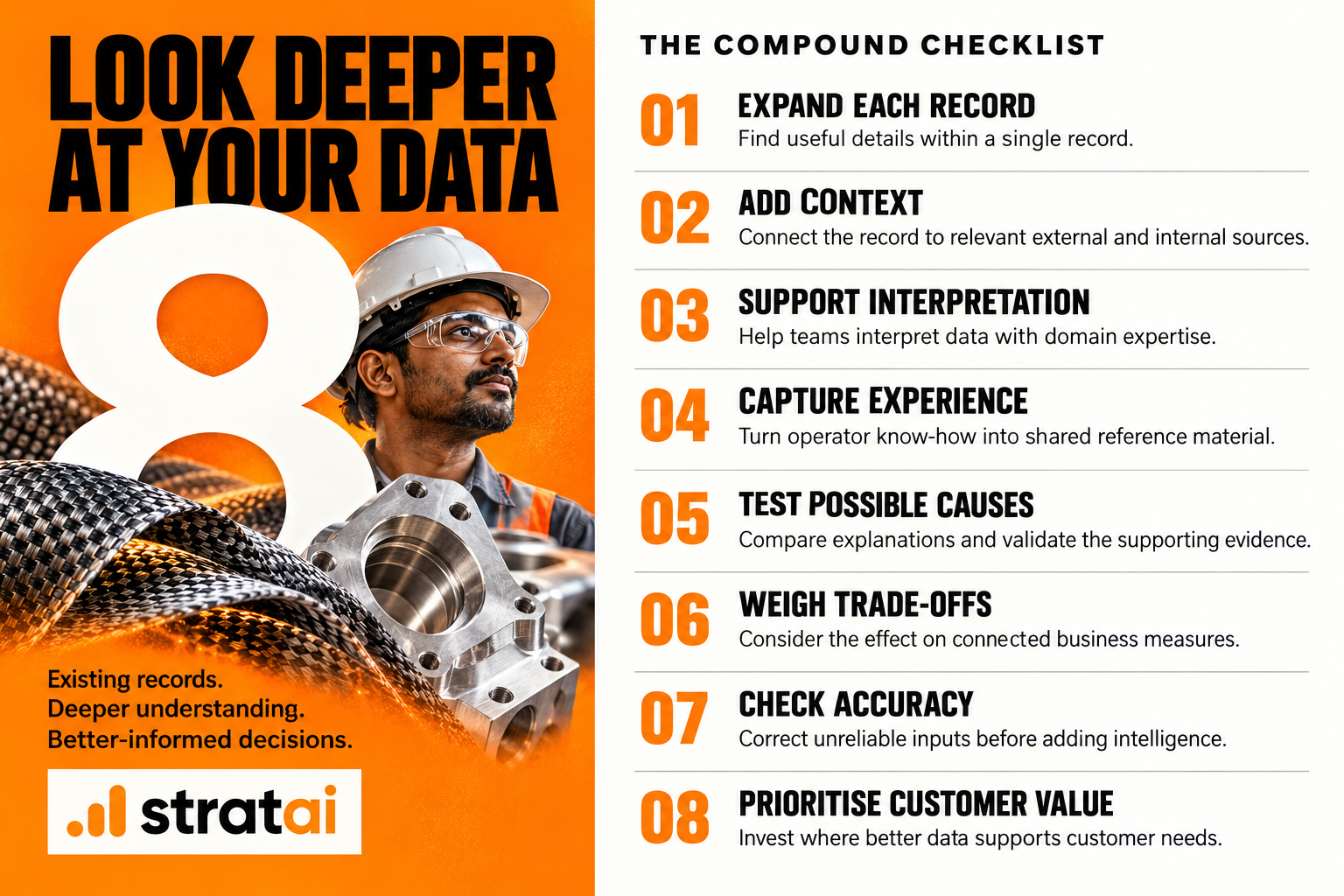
This blog is the COMPOUND deep dive - the third and most strategically powerful of the three data problems. COMPOUND extracts everything the data actually contains, far beyond what most manufacturers are currently using. This blog covers all eight COMPOUND attributes: Expandability, Research Depth, Intelligence Required, Tacit to Explicit Potential, Causal Mapping, Trade-off Mapping, Accuracy, and Relevance to Customer.
You have solved CAPTURE. The data reaches the system at source, in real time. You have solved CONVERT. The data is reaching decisions. People are using it. You believe the data job is done.
It is not. You are at 20%.
The data you have captured and converted contains far more value than what you are currently extracting from it. One defect record is being read as a count. It could yield a causal analysis, a pattern detection signal, a predictive maintenance trigger, and a knowledge base entry - simultaneously. One fabric image is being filed as a visual record. It could yield fifteen structured product attributes. The tacit knowledge of your most experienced operator is being used during their shift. It could become institutional intelligence available to every operator, every shift, permanently.
COMPOUND is the discipline of extracting everything data actually contains - not just what it obviously shows. It is where AI produces its most distinctive competitive advantage in manufacturing. And it is where most manufacturers have not yet started.
AI can reduce unplanned downtime by 30-50% and increase production throughput by 20-30% when applied to existing machine and operational data - without new sensors in most cases.
These gains are COMPOUND gains. The machine data already exists. The value is not in collecting more data - it is in building the intelligence layer that extracts the predictive signal, the causal pattern, and the compound knowledge the existing data already contains.
Source: McKinsey Global Institute, The Future of Manufacturing, 2025
What You Have vs What You Are Extracting - The COMPOUND Gap
| What you have | What you are extracting | What COMPOUND makes possible |
|---|---|---|
| One defect record per cycle | Defect count. Machine. Shift. Date. | Causal analysis linking defect to machine parameters, material batch, die temperature trend, operator pattern, and FMEA failure mode - surfaced at the moment of the defect. |
| One fabric inspection image | A visual record. Pass or fail. | 15 structured product attributes: yarn count, weave type, colour density, defect type, defect location, and more - extracted by an AI model trained on fabric characteristics. |
| One supplier invoice | Amount. Date. Line items. | Lead time trend, pricing drift, partial delivery frequency - building supplier intelligence from data you already hold. |
| One experienced operator's shift | Their judgement during that shift. | Institutional knowledge captured through structured prompts - available to every operator, every shift, permanently. The tacit knowledge gap closed. |
| One machine's runtime log | Hours run. Downtime events. | Predictive maintenance signal: the specific combination of temperature deviation, vibration pattern, and cycle time drift that precedes failure. |
The Eight COMPOUND Attributes
States: High / Low
Diagnostic question: Can one data point be decomposed into multiple valuable attributes - or are you extracting only its surface value?
Low state: Low expandability: the data is read as a single unit. A defect count is a number. An image is a visual. Each data point produces one piece of information.
High state: High expandability: one data point contains many structured attributes. One fabric image contains yarn count, weave structure, colour density, defect type, defect location, and more.
From the field: In home furnishings manufacturing, one fabric inspection image is currently used to record a pass/fail result. An AI model trained on fabric characteristics can extract fifteen structured product attributes from the same image - yarn count, weave type, colour consistency, defect classification, defect location coordinates. This is data multiplication: one data point becoming fifteen without generating any new data.
Value unlock: High expandability is the COMPOUND attribute with the fastest visible ROI. Identify the highest-volume data flow where each record currently produces one piece of information. Build the AI layer that extracts multiple attributes from each record. The value multiplies with every record processed.
Watch for: Expandability requires a model trained on the specific domain. A generic AI model will not extract meaningful fabric attributes from a textile image. Domain specificity is the investment that makes expandability work.
States: High / Low
Diagnostic question: Can this data be enriched by pulling more context around it from connected sources?
Low state: Low research depth: each data record is treated as self-contained. A supplier invoice is a transaction. A customer order is a line item.
High state: High research depth: each record is enriched with context from connected sources. A supplier invoice pulls delivery history, price trend, quality performance, and market rate context - building a rich supplier intelligence profile from what started as a transaction.
From the field: In manufacturing procurement, one supplier record enriched with market intelligence, alternative supplier options, commodity price trends, and geopolitical risk signals becomes a strategic procurement tool rather than an address book entry.
Value unlock: Research depth is the enrichment unlock. Every data record exists in a context that contains more intelligence than the record itself. The enrichment layer pulls that context - from internal connected systems and historical patterns - and attaches it to the record at the moment it is needed.
Watch for: Enrichment layers must be designed with a clear purpose. Identify the specific decision that would improve if more context were available - and build the enrichment layer for that decision first.
States: High / Low
Diagnostic question: How much interpretation is needed to turn this data into a decision - and is that interpretation currently happening?
Low state: High intelligence required, low utilization: the data exists, but converting it into a decision requires expertise that is scarce, expensive, or unavailable at the decision moment.
High state: Low intelligence required: the AI does the intelligence work and surfaces the conclusion, not the raw data. The interpretation is built into the system.
From the field: In aluminium die casting, identifying the root cause of a porosity defect requires someone who understands the relationship between injection velocity, die temperature, material batch characteristics, and cycle time - simultaneously. This expertise exists in the most experienced QC supervisor. It does not exist in the data entry team or the night shift operator. When the intelligence required exceeds the intelligence available at the decision point, the data does not convert into action.
Value unlock: High intelligence required + low utilization = the highest-priority candidate for an AI-assisted interpretation layer. The AI does not replace the expert. It makes the expert's interpretive capability available at every decision point, every shift, without requiring the expert to be physically present.
Watch for: The interpretation layer must be validated by the domain expert before deployment. An AI model that interprets QC data incorrectly will produce confident wrong conclusions at scale.
States: High / Low
Diagnostic question: Is critical knowledge about this data flow trapped in the head of one or two experienced people - and has it never been systematically captured?
Low state: Low tacit-to-explicit potential: the knowledge required to act on this data is already documented - in SOPs, FMEA documents, training materials.
High state: High tacit-to-explicit potential: the knowledge exists only in the heads of experienced operators, QC supervisors, or functional heads. When those people leave, the knowledge leaves with them.
From the field: A senior QC supervisor in a die casting plant can tell - from the sound of the injection cycle and a subtle change in the machine's rhythm - that the next five shots will produce porosity. Before the machine data shows it. This pattern recognition is built from thousands of hours on the floor. It exists in one person's sensory memory. When that person retires, it is gone. AI-assisted structured capture - guided prompts, voice input, mobile logging during production - externalises this knowledge over time. Once captured, it becomes training data for a model that makes the supervisor's thirty years of pattern recognition available to every operator, every shift.
Value unlock: Tacit to explicit conversion is the most time-limited COMPOUND investment. The window closes when the person leaves. Start with the single most critical knowledge holder in each function and build a structured capture protocol before the window closes.
Watch for: Tacit knowledge capture requires the cooperation of the knowledge holder. Design the capture protocol around their workflow - not around the system's requirements.
States: Multiple candidate causes identified / Single assumed cause
Diagnostic question: When a key metric moves, do you have a structured model for identifying which of the candidate causes drove the movement?
Low state: Low causal mapping: when a metric moves, the response is either to guess based on intuition or to assume the most recent change was responsible. Both approaches are unreliable.
High state: High causal mapping: a structured cause-attribution model identifies the candidate drivers, weights them by likelihood, and surfaces the most probable cause with supporting evidence.
From the field: In a textile plant, when defect rates increase, the candidate causes include: raw material batch quality, machine calibration drift, operator change, humidity variation, needle condition, and washing process temperature. Without causal mapping, the investigation begins with the most recently changed variable. With causal mapping, all six candidates are evaluated simultaneously against the data - and the investigation begins where the evidence points.
Value unlock: Causal mapping is the COMPOUND attribute that most directly converts data volume into decision quality. A manufacturing plant that has been capturing production, quality, and machine data for three years holds the pattern evidence to build a robust causal model for its highest-impact metrics.
Watch for: Causal models must be built for specific metrics in specific contexts. Domain expertise is required to identify the candidate causes and validate which variables are genuinely causally linked versus correlated by coincidence.
States: Trade-offs identified and managed / Single-metric optimisation
Diagnostic question: Does optimising this metric have a known effect on other metrics - and is that trade-off being actively managed?
Low state: Low trade-off awareness: one metric is optimised without tracking its effect on connected metrics. Cost is reduced without tracking service level impact.
High state: High trade-off awareness: the relationship between metrics is mapped and monitored. When one metric is optimised, the system simultaneously tracks the effect on connected metrics - and surfaces the trade-off before it becomes a downstream problem.
From the field: In manufacturing procurement, reducing purchase cost is a measurable and celebrated achievement. But purchase cost reduction achieved by switching to a lower-quality raw material creates a downstream quality cost - higher reject rates, more rework - that often exceeds the procurement saving. Without trade-off mapping, the procurement success and the quality failure are tracked in different systems by different teams and never connected.
Value unlock: Build a balanced decision layer, not single-metric optimisation. For every high-impact metric, map the two or three metrics most likely to be affected when it is optimised. Build monitoring that tracks all of them simultaneously.
Watch for: Trade-off mapping is not about avoiding optimisation. It is about optimising with full awareness of the system effects. Some trade-offs are acceptable. The investment is having the information to make that choice deliberately.
States: High / Low
Diagnostic question: Can the values in this data flow be trusted as recorded - or do they carry known inaccuracies that limit what can be built on top of them?
Low state: Low accuracy: the data exists but cannot be trusted. Machine parameters manually entered and often rounded. QC results recorded after the fact by someone who was not present.
High state: High accuracy: the data reflects reality as it occurred, captured at source, by the person or system that generated it, at the moment it was generated.
From the field: Accuracy is placed in COMPOUND because the most consequential accuracy failures occur when data is combined or used as training data for AI models. A manually entered production record with a 5% rounding error is acceptable for a weekly summary. The same record used as training data for a predictive maintenance model produces a model that is systematically wrong by the same margin - compounding the error across every prediction.
From the field (manufacturing floor): A 5% rounding error in one record is a minor inaccuracy. The same rounding error across 50,000 training records produces a model that is systematically wrong by 5% on every prediction - and systematically confident about it.
Value unlock: Fix accuracy at source before building COMPOUND layers. Automating inaccurate data produces confident wrong intelligence at the scale and speed of AI. The accuracy investment is a redesign of the capture process that eliminates the intermediary who introduces the inaccuracy.
Watch for: Accuracy and precision are different. High accuracy means the value is close to the true value. High precision means values are consistent with each other. A system can be precise but inaccurate (consistently wrong in the same direction). Both matter for COMPOUND.
States: High / Low
Diagnostic question: Does this data ultimately connect to something the end customer values - or does it exist only for internal operational purposes?
Low state: Low relevance to customer: the data tracks internal efficiency metrics with no direct connection to the customer experience.
High state: High relevance to customer: the data connects directly to what the customer values - delivery reliability, product quality consistency, lead time predictability.
From the field: In a precision components plant serving the automotive sector, dimensional accuracy and delivery adherence are the two metrics that directly determine customer retention. Both are measurable. Both are improvable with AI-assisted quality control and production planning. Both have a direct P&L connection through scrap reduction and on-time delivery bonuses.
Value unlock: Focus COMPOUND investment on data that connects to customer value first. Internal efficiency improvements that do not translate to better delivery, quality, or cost for the customer have a ceiling on their commercial impact.
Watch for: Customer relevance is not the only prioritisation criterion. Some low-customer-relevance data - machine health, energy consumption, waste rates - has high COMPOUND value through cost reduction. Do not exclude it, but prioritise high-relevance data first.
The COMPOUND Diagnostic
| # | Diagnostic question | If No... |
|---|---|---|
| EX | Can one data point be decomposed into multiple valuable attributes? | Low expandability - build the intelligence layer that extracts what the data already contains. |
| RD | Can this data be enriched by pulling more context from connected sources? | Low research depth - identify what adjacent data would make this record more valuable. |
| IQ | Is the interpretation required to act on this data currently happening - at the decision point? | High intelligence required, low utilization - candidate for an AI-assisted interpretation layer. |
| TE | Is critical knowledge about this flow trapped in the head of one or two experienced people? | High tacit potential - begin structured knowledge capture before the window closes. |
| CM | When a key metric moves, do you have a structured model for identifying which cause drove it? | Low causal mapping - build a cause-attribution model. Replace guessing with structured diagnosis. |
| TM | Does optimising this metric have a known effect on other metrics - and is that trade-off managed? | Low trade-off awareness - map the metric relationships before optimising. |
| AC | Can the values in this flow be trusted as recorded? | Low accuracy - fix at source before building COMPOUND layers. Automating bad data = confident wrong intelligence. |
| RC | Does this data connect to what the end customer values? | Low customer relevance - deprioritise enrichment. Invest COMPOUND effort on customer-facing data first. |
The COMPOUND diagnostic identifies which of the eight attributes holds the most untapped value in your specific data - and what the intelligence layer looks like to unlock it in the next 90 days.
The data you already have contains more value than you are currently extracting from it. The question is which of the eight COMPOUND attributes to unlock first.
Map your COMPOUND opportunities: stratai.io/contact
We identify which COMPOUND attributes hold the most value in your specific operation - and what the intelligence layer looks like to unlock the first one.
Frequently Asked Questions
What is the COMPOUND problem?
The COMPOUND problem is the gap between what data contains and what is currently being extracted from it. Most manufacturing organisations read data at face value - one defect equals one count, one image equals one visual record. COMPOUND asks what else the data contains. The eight COMPOUND attributes identify specific ways manufacturing data is being underutilised - and what intelligence layer is required to extract each additional dimension of value.
What is data multiplication?
Data multiplication is the Expandability principle - when one data record contains far more structured information than is currently being extracted. One fabric inspection image contains fifteen structured product attributes if an AI model trained on fabric characteristics reads it. One defect record contains a causal analysis if connected to machine parameters, material batch, FMEA, and production cycle history. Data multiplication does not require generating new data. It requires building the intelligence layer that extracts what the existing data already contains.
Which COMPOUND attribute should a manufacturer prioritise first?
Start with Tacit to Explicit Potential - if the knowledge holder is likely to leave within the next two to three years. This is the most time-limited opportunity. Once tacit knowledge capture is underway, move to Expandability - identify the highest-volume data flow where each record yields one attribute and could yield many. This produces the fastest measurable return. Then build Causal Mapping for the metrics that most directly drive P&L outcomes.
This completes the CAPTURE CONVERT COMPOUND series.
Pillar: All you need to understand about data
Sub Blog 1 - CAPTURE: Why your data is not reaching your AI
Sub Blog 2 - CONVERT: Your data is available. Your decisions are not changing.
About StratAI
StratAI helps manufacturing firms in India build AI Advantage Systems. 10+ live deployments across textile, jewellery, furnishings, commodity processing, and component manufacturing. Official Registered Claude Partner and Anthropic Partner.
stratai.io/contact | palani@stratai.io | +91 99402 25924
"The data you have captured and converted is not the ceiling of what your data can do. It is the floor. COMPOUND is the discipline of extracting everything data actually contains - and building the intelligence layer that makes your existing data worth ten times what you are currently getting from it."
- Palaniappan SN, Co-Founder, StratAI