Part 3 of 4 in the CAPTURE CONVERT COMPOUND series | All you need to understand about data
Part of the CAPTURE CONVERT COMPOUND series
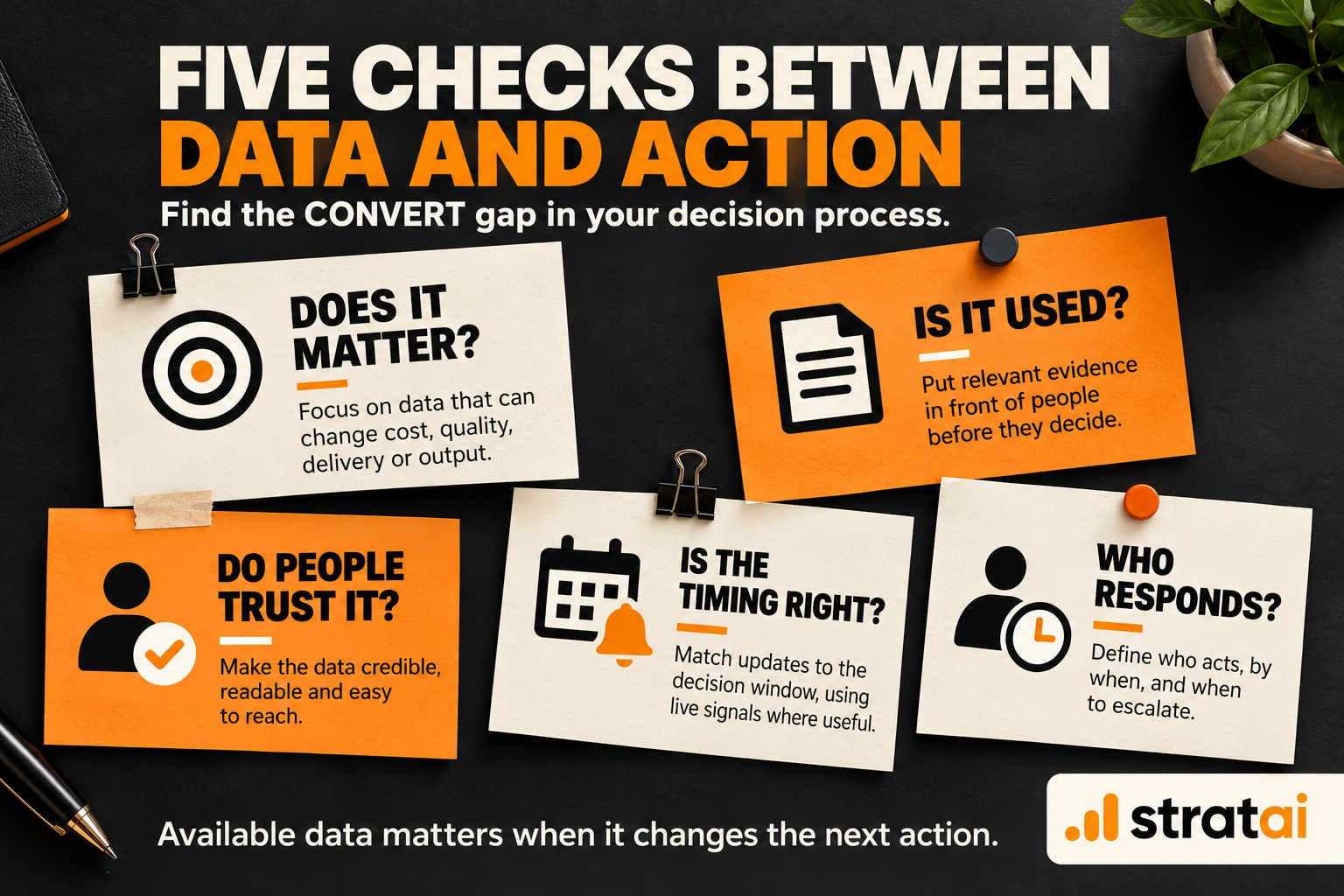
This blog is the CONVERT deep dive. CAPTURE gets data into the system. CONVERT gets it into decisions. This blog covers all five CONVERT attributes: Decision Impact, Utilization, Willingness to Use, Static vs Dynamic Use, and Response Time to Data.
The data is available. The report is live. The dashboard refreshes every morning. The management meeting happens every week.
And the decision is still being made from WhatsApp. From gut feel. From whoever spoke to the plant head last.
This is the CONVERT gap. The most expensive data problem in manufacturing - and the least visible - because it hides behind the appearance of a functioning data system. Reports exist. Meetings happen. Dashboards show numbers. Everything looks like it is working. Except the decisions.
CONVERT is not a data problem. It is a decision architecture problem. The fix is not more data - it is understanding why the data that already exists is not reaching the decision that needs it.
Only 43% of collected manufacturing data is used effectively - meaning 57% of data that is captured and available never reaches a decision.
More than half of manufacturing data investment produces records, not decisions. The problem is not that the data does not exist. The problem is that the decision architecture was not built around the data. The data was built around the decision architecture that already existed - which is why the decisions have not changed.
Source: Sigma Computing / kreativecoretech, ERP and Data Utilization in Manufacturing, 2026
The Five CONVERT Attributes - and What Each One Costs You
States: High Value / Low Value
Diagnostic question: Does this data drive a consequential decision - or does it fill a report that nobody acts on?
Low state: Low decision impact: this data is tracked, reported, and reviewed - but no decision changes based on it. It exists because it always has.
High state: High decision impact: this data drives a decision that materially changes output, cost, quality, or revenue. Whether to run a second shift. Whether to reorder raw material. Whether a machine needs maintenance before the next cycle.
From the field: In most mid-market manufacturing plants, the highest-decision-impact data is production schedule adherence, raw material availability, machine downtime, and first-pass yield. These are the numbers that - if known accurately and in real time - change what the plant does next. Most plants track them. Few track them at the speed and granularity required for the decision to change in time to matter.
Value unlock: Prioritise CONVERT investment on high-decision-impact data flows first. Map your top five decisions and identify which data flows feed them - then CONVERT those flows first.
Watch for: Decision impact is not the same as data volume. High-volume data with low decision impact is noise. Low-volume data with high decision impact is the most underinvested data flow in most manufacturing plants.
States: High / Low
Diagnostic question: Is this data actually being referenced before decisions are made - or produced after decisions have already happened?
Low state: Low utilization: the data exists in the system. The report is generated. The decision is made by calling the relevant person or relying on the most experienced person in the room. The data was never opened before the decision was made.
High state: High utilization: the data is the first reference point for the relevant decision. Before the scheduling meeting, the production adherence report is opened. Before the procurement call, the inventory position is checked.
From the field: We have observed management meetings where three functional heads present three different versions of the same production week - each drawing from a different system, each correct from their own source, none of them the same. The data exists in all three systems. None of it has been utilised into a unified decision. The meeting ends with a debate about which version is correct rather than a decision about what to do next.
Value unlock: Low utilization is almost never solved by more data. It is solved by connecting the data to the decision moment - surfacing the right number at the right time in the right format. If the scheduling decision happens at 9am on Monday, the relevant production data must be in front of the decision-maker at 8:55am - not in a report that requires opening a system and exporting to Excel.
Watch for: Before investing in new data infrastructure, audit utilization on existing data. Find the three most important decisions in any function and ask: what data is actually referenced before this decision is made?
States: High / Low
Diagnostic question: Even when data is available and accurate - do the people who need it choose to use it?
Low state: Low willingness: the system produces the data. The people who should reference it do not. They use their own experience, their own notebooks, or their own informal networks instead.
High state: High willingness: the people who make decisions actively seek out the data before making calls. They reference it in conversations. They challenge each other when decisions are made without it.
From the field: Low willingness is one of the most misdiagnosed problems in manufacturing data strategy. The instinct is to solve it by producing more data. The real cause is almost always one of three things: the data is not trusted, the format is wrong, or the accessibility is too high (opening the system takes more time than calling someone).
Value unlock: Low willingness is a trust, format, or accessibility problem - not a data problem. Diagnose which of the three is driving low willingness before prescribing a solution. Never add more data to a low-willingness environment.
Watch for: Solving the wrong root cause is expensive and ineffective. A trust problem requires demonstrating the data's track record. A format problem requires redesigning how data is presented. An accessibility problem requires reducing friction between the person and the number.
States: Static (periodic cycle) / Dynamic (rolling real-time)
Diagnostic question: Is this data currently used in a periodic review cycle when it could be informing rolling decisions continuously?
Low state: Static use: inventory reviewed monthly. Quality reported weekly. Production performance summarised at the quarterly review. The data exists continuously - but the decision cycle is periodic. Events between reviews are invisible until the next scheduled meeting.
High state: Dynamic use: the same data drives rolling decisions in real time. Inventory triggers a reorder at the moment it crosses a threshold. A quality trend triggers an alert the moment it breaches the control limit.
From the field: In most mid-market plants, inventory is reviewed on a schedule. A stockout that develops on the 18th of the month is discovered at the monthly review on the 30th. By then, the production line has been interrupted, expediting costs incurred, and a customer delivery missed. The same data, used dynamically, triggers a reorder alert on the 15th - before the stockout occurs.
From the field (manufacturing floor): A defect trend that begins on Tuesday is reported at the Friday quality meeting. By then, three shifts have run with the same underlying condition. Dynamic use means the trend triggers an alert on Tuesday - not a report on Friday.
Value unlock: Converting static to dynamic use is one of the highest-ROI CONVERT investments. It requires three things: a defined threshold or trigger condition, an alerting mechanism, and a clear owner who acts on the alert. The data is already there. The decision cycle is the constraint.
Watch for: Not all data should be dynamic. Some decisions benefit from periodic review - it forces deliberate reflection rather than reactive response. Only convert data flows where the event window is tighter than the current review cycle.
States: Low latency in human action / High latency
Diagnostic question: Once the data signals something important - how quickly does a human act on it?
Low state: High response latency: the alert fires. The flag appears. The anomaly is visible. And the human response arrives two days later, after the signal has compounded into a larger problem. The data was working. The workflow was not.
High state: Low response latency: the alert fires and the relevant person acts within the decision window the signal requires. A machine parameter drifts outside spec. The operator receives the alert. The correction happens before the defect.
From the field: Response time to data is one of the most commonly misdiagnosed problems in manufacturing data strategy. When a warm lead goes cold because nobody followed up - the instinct is to fix the CRM. But the CRM was working. It flagged the lead as warm. The problem was the workflow: no alert, no assigned owner, no escalation protocol.
Value unlock: Slow response time is a workflow problem, not a data problem. The fix is an alert and escalation protocol: who receives the signal, what is the expected response time, and what happens if the response does not occur within that window.
Watch for: Response time requirements vary by decision type. A machine safety alert requires minutes. A demand forecast deviation may allow hours. Define the response time window for each high-impact signal before building the alert.
The CONVERT Diagnostic
| # | Diagnostic question | If No... |
|---|---|---|
| DI | Does this data drive a decision that meaningfully changes outcomes? | Low decision impact - invest CONVERT effort on high-impact data first. |
| U | Is this data referenced before decisions are made - not produced after? | Low utilization - surface the data at the decision moment, not in a periodic report. |
| WU | Even when available and accurate, do people choose to use it? | Low willingness - fix trust, format, or accessibility. This is not a data problem. |
| SD | Could this periodic data drive rolling real-time decisions instead? | Static use - identify the decision that would improve if made on a rolling basis. |
| RT | Once the data signals something, how quickly does a human act? | Slow response - build an alert and escalation protocol. The data is working. The workflow is not. |
The CONVERT diagnostic takes one conversation. By the end, you know exactly which of the five attributes is costing you the most - and what the decision architecture fix looks like for your specific operation.
Your data may already be available. The question is whether it is changing your decisions - or just filling your reports.
Map your CONVERT gaps: stratai.io/contact
We identify which of the five CONVERT attributes is costing you the most - and what the first investment looks like to close the gap.
Frequently Asked Questions
What is the CONVERT problem?
The CONVERT problem is the gap between data being available and data changing decisions. Most manufacturing plants have data in systems - ERPs, quality systems, production modules - but it does not reliably reach the decision-maker at the right moment, in the right format, with enough trust to change behaviour. The five CONVERT attributes diagnose exactly where in the decision chain the data is failing to land.
Why do people not use available data to make decisions?
Three root causes - each requiring a different fix. First: trust. People believe their own experience is more accurate than the system. Fix: demonstrate the data's track record over time. Second: format. The data exists but not in a form that fits how the decision is actually made. Fix: redesign how the data is presented at the decision point. Third: accessibility. Getting to the data takes more effort than calling someone. Fix: reduce the friction between the person and the number.
How is CONVERT different from CAPTURE?
CAPTURE is about getting data into the system. CONVERT is about getting data into decisions. CAPTURE problems are visible - the notebook is on the floor, the lag is measurable. CONVERT problems are invisible - the data is in the system, reports are being generated, meetings are happening. The distinction: does the data change what the decision-maker does? If the decision would have been the same without the data - the CONVERT problem exists, regardless of how good the capture is.
Part 3 of 4 in the CAPTURE CONVERT COMPOUND series.
Pillar: All you need to understand about data
Previous - CAPTURE: Why your data is not reaching your AI
Next - COMPOUND: You are using your data. But only at face value.
About StratAI
StratAI helps manufacturing firms in India build AI Advantage Systems. 10+ live deployments across textile, jewellery, furnishings, commodity processing, and component manufacturing. Official Registered Claude Partner and Anthropic Partner.
stratai.io/contact | palani@stratai.io | +91 99402 25924
"Available is not the same as used. Used is not the same as acted on. Acted on is not the same as acted on in time. CONVERT is the discipline of closing every gap in that chain - until the data that exists in your system is producing decisions that would not have happened without it."
- Palaniappan SN, Co-Founder, StratAI